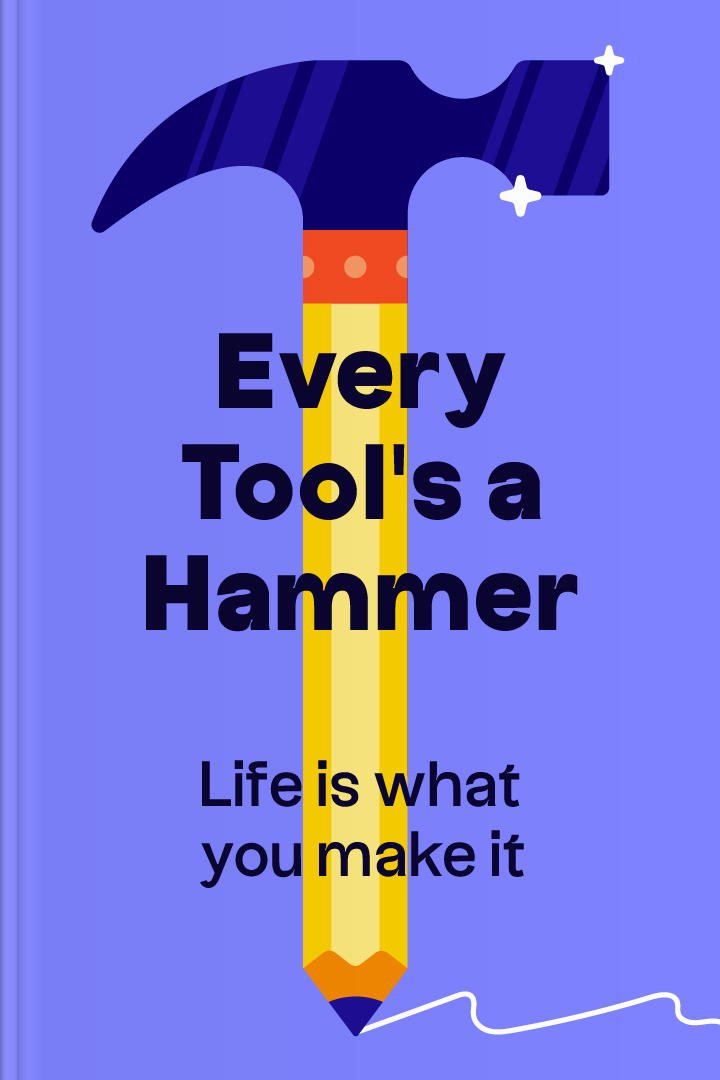
Every Tool's A Hammer audiobook cover - Through stories from movie props, MythBusters, and decades of hands-on building, Adam Savage gently reminds listeners that creating is a human instinct—and that with curiosity, simple planning tools, and a forgiving attitude toward mistakes, anyone can grow into their maker self.
Theme Song

Every Tool's A Hammer

Through stories from movie props, MythBusters, and decades of hands-on building, Adam Savage gently reminds listeners that creating is a human instinct—and that with curiosity, simple planning tools, and a forgiving attitude toward mistakes, anyone can grow into their maker self.

Adam Savage

4.0 / 5(3 ratings)
Start ListeningDownloadQR code that opens AudiobookHub on the App StoreTry free on iPhoneScan to start in 5 seconds

If You're Curious About These Questions...

You should listen to this audiobook

Listen to Every Tool's A Hammer — Free Audiobook

Loading player...

Key Takeaways from Every Tool's A Hammer

Learning Tools

Reinforce what you learned from Every Tool's A Hammer

Mind Map

Every Tools A Hammer
The Maker Mindset & Origins+
Following Your Passions+
Invisible Tools for Finishing+
Overcoming Internal Saboteurs+
Sharing and Community+
Organizing the Workspace+
Sustaining the Maker's Path+

Quiz — Test Your Understanding

Question 1 of 10
What sparked Adam Savage's initial realization that he wanted to be a maker?
  • A. A school woodworking project.
  • B. The physical reality and details of the Star Wars universe.
  • C. A museum exhibit on historical inventions.
  • D. His early success as a television host.
Question 2 of 10
How does Adam Savage view the act of 'making'?
  • A. It is a rare talent reserved for highly skilled professionals.
  • B. It requires formal education and certification to be done properly.
  • C. It is a fundamentally human activity that we all engage in.
  • D. It is an activity defined strictly by working with physical tools and raw materials.
Question 3 of 10
When people struggle with knowing how to start a creative journey, what does Adam suggest they focus on?
  • A. Studying what is currently popular or profitable.
  • B. Forcing a grand, original idea into existence.
  • C. Looking for the 'secret thrills' or obsessions that already move them.
  • D. Replicating a project exactly as someone else has done it.
Question 4 of 10
According to Adam, what is the primary benefit of making lists during a complex project?
  • A. They prove to clients that you are actively working.
  • B. They drain the magic from the work so you can focus logically.
  • C. They hold information so the mind can focus on solving problems and building.
  • D. They act as a strict schedule that prevents any changes to the design.
Question 5 of 10
How does Adam view the use of deadlines in the creative process?
  • A. They are harmful constraints that produce unnecessary anxiety.
  • B. They focus effort, remove fog, and gently expose excuses.
  • C. They should only be used for paid client work, not personal projects.
  • D. They limit the creative scope and should be avoided when possible.
Question 6 of 10
What is Adam’s recommended approach to dealing with mistakes during the making process?
  • A. See them as clear indicators that the project should be abandoned.
  • B. Hide them from clients and collaborators to maintain a professional image.
  • C. Stop labeling them as failures and treat them as experiments that generate valuable data.
  • D. Prevent them entirely by planning for an additional month before touching materials.
Question 7 of 10
What practical method does Adam suggest to build 'mistake tolerance'?
  • A. Working only on digital projects where there is an 'undo' button.
  • B. Buying twice as many raw materials as you think you’ll need.
  • C. Never showing your first draft to a client.
  • D. Delegating the most difficult parts of a project to someone else.
Question 8 of 10
Why does Adam advocate for openly sharing your creative process and finished work?
  • A. It guarantees an immediate increase in financial compensation.
  • B. It protects your ideas from being stolen by competitors.
  • C. It proves to critics that your work is entirely original.
  • D. It contributes to a community's evolution and helps propel others forward.
Question 9 of 10
What are the two basic rules Adam uses to organize his workspace?
  • A. Maximum aesthetic appeal and soundproof walls.
  • B. Minimal clutter and easy retrievability of tools.
  • C. Keeping everything in drawers and categorizing by color.
  • D. Storing tools in separate rooms to encourage movement and breaks.
Question 10 of 10
Why is Adam Savage generally not a fan of using drawers in a workspace?
  • A. They take up too much vertical space.
  • B. They are often too expensive to install in a standard shop.
  • C. They cause things to disappear and be forgotten.
  • D. They cannot hold the heavy tools required for prop making.

Every Tool's A Hammer — Full Chapter Overview

Every Tool's A Hammer Summary & Overview

This warm, practical summary follows Adam Savage’s journey from a childhood spark of wonder—watching Star Wars and asking who makes the props—to a life devoted to building, experimenting, and learning in public. Along the way, it shows how creativity is less about talent and more about attention: noticing what thrills you, following curiosity, and giving yourself permission to begin.

Across the chapters, Adam offers supportive guidance on the real-world habits that help makers finish what they start: using lists, checkboxes, and deadlines; building patience and “mistake tolerance”; asking for help and collaborating; sharing knowledge; and shaping a workspace that reflects how you think. The message is steady and encouraging: there is a maker in all of us, and the path gets clearer one small step at a time.

Who Should Listen to Every Tool's A Hammer?

  • Creatives, hobbyists, and aspiring makers who want more confidence to start projects—even when they’re not sure what to make yet
  • Artists, builders, and DIY learners who struggle with perfectionism, impatience, or self-doubt and want a kinder way to keep going
  • Busy people who want practical systems—lists, checkboxes, deadlines, and workspace habits—to help finish side projects without burning out

About the Author: Adam Savage

Adam Savage is a maker and special effects fabricator known for creating props and costumes and for co-hosting the television show MythBusters. Across decades of building, teaching, and sharing his process, he has become a widely recognized voice in modern maker culture, encouraging curiosity, experimentation, and creative craft.

🎧
Listen in the AppOffline playback & background play
Get App
Every Tool's A HammerTheme Song
NOW PLAYING
Every Tool's A Hammer

Every Tool's A Hammer

Theme Song
0:000:00