Theme Song
If You're Curious About These Questions...
You should listen to this audiobook
- Have you ever wondered why evolutionary science has historically ignored the female body, and what critical secrets we've missed as a result?
- Did you know that the story of human survival might have less to do with male hunters and more to do with the biological evolution of wet nurses and menstruation?
- Are you curious about how 200 million years of female biology actually shaped the human species in ways your history books never mentioned?
Listen to Eve — Cinematic Audio Edition
Loading player...
Key Takeaways from Eve
- Discover how female biology drove human evolution, overturning outdated, male-centric origin stories to reveal women's true impact on the survival of our species.
- Learn how breast milk functions as a two-way communication system, using a baby's saliva to instruct the mother's body on exactly which antibodies and nutrients to produce.
- Understand why pregnancy is actually a biological battle for resources, where menstruation originally evolved as a maternal defense mechanism against aggressive, nutrient-hungry embryos.
- Find out how early female networks invented midwifery and gynecology to survive the evolutionary disadvantage of narrowing human pelvises and growing infant head sizes.
- Recognize that reproductive control and women's health technologies—rather than male-crafted weapons—were the pivotal innovations that enabled human civilization to expand globally.
Learning Tools
Reinforce what you learned from Eve
Mind Map
Eve
Scientific Paradigm Shift+
Evolution of Milk+
Pregnancy as a Battlefield+
Invention of Gynecology+
The Female Brain+
Menopause and Longevity+
Love and Patriarchy+
Quiz — Test Your Understanding
Question 1 of 7
According to the text, what was the original evolutionary purpose of the mucus that eventually became mother's milk?
Question 2 of 7
What is the biological function of the 'upsuck' phenomenon during breastfeeding?
Question 3 of 7
How does the book characterize the evolutionary function of human menstruation?
Question 4 of 7
What behavioral innovation allowed early humans like Homo habilis to overcome the evolutionary disadvantage of larger baby heads and narrower pelvises?
Question 5 of 7
What does the text suggest is the primary cause of differences in aptitude and behavior between men and women, such as math performance?
Question 6 of 7
Beyond the 'grandmother hypothesis,' what evolutionary advantage does the text propose for why humans evolved to live long past their reproductive years?
Question 7 of 7
What was the 'devil's bargain' that early human females allegedly made to secure resources for increasingly challenging childbirths?
Eve — Full Chapter Overview
- 1Recommendation
- 2Communication through breast milk
- 3The womb as a battleground
- 4From gynecology to global domination
- 5The not-so-different female brain
- 6Living longer because of menopause
- 7Love, or the devil’s bargain
- 8Final summary
Eve Summary & Overview
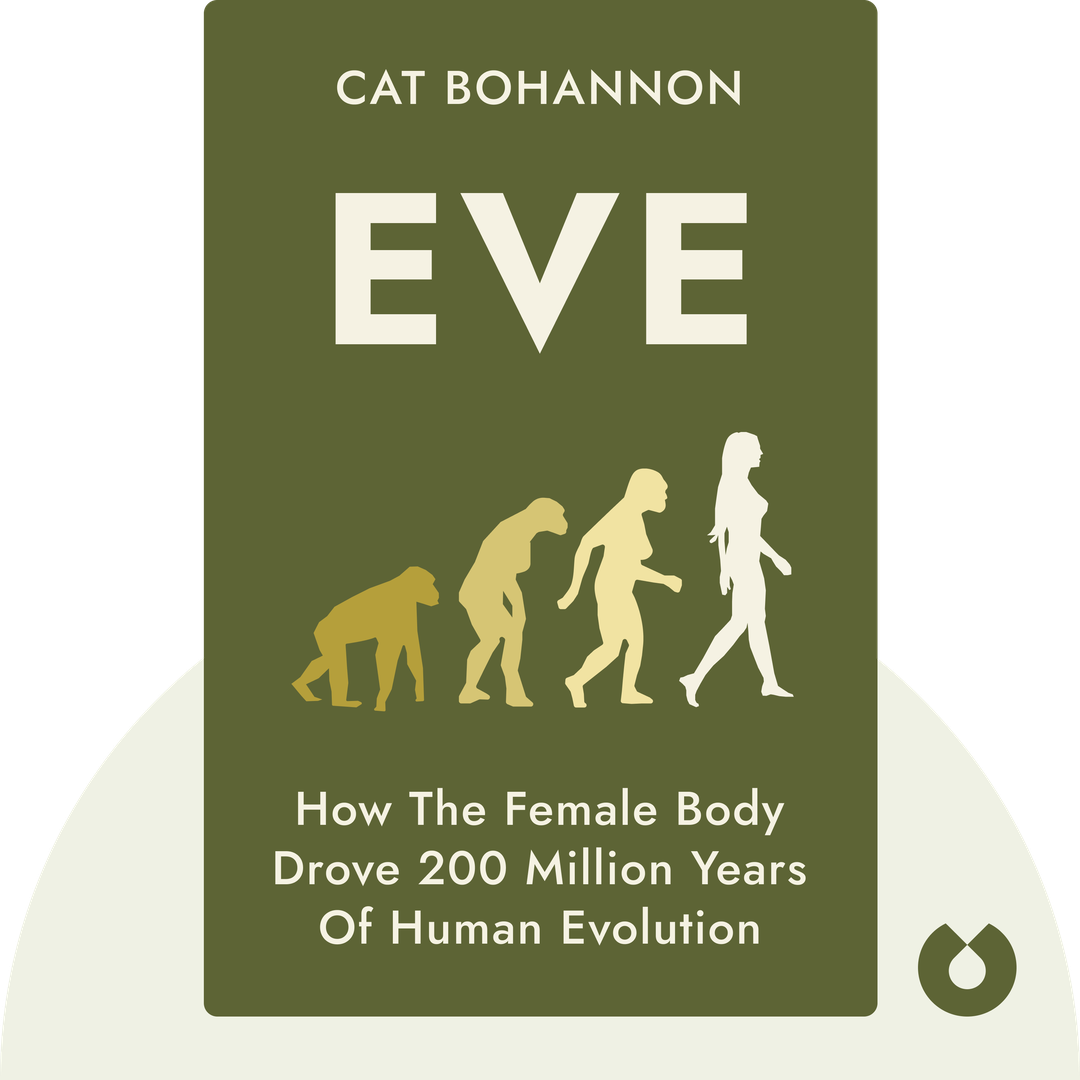
Eve (2023) is a witty corrective to human evolution, spanning 200 million years of biology. Asking why science overlooked key questions about female bodies, it upends male-centric assumptions about how our species evolved. Ranging from wet nurses to C-sections, these musings will change what you think you know about evolution.
Who Should Listen to Eve?
- Readers interested in evolutionary biology and the history of the female body
- Feminists seeking greater scientific understanding of human evolution
- Students and academics studying gender, reproduction, and human development
Books Similar to Eve
Readers who enjoyed this also liked these titles.