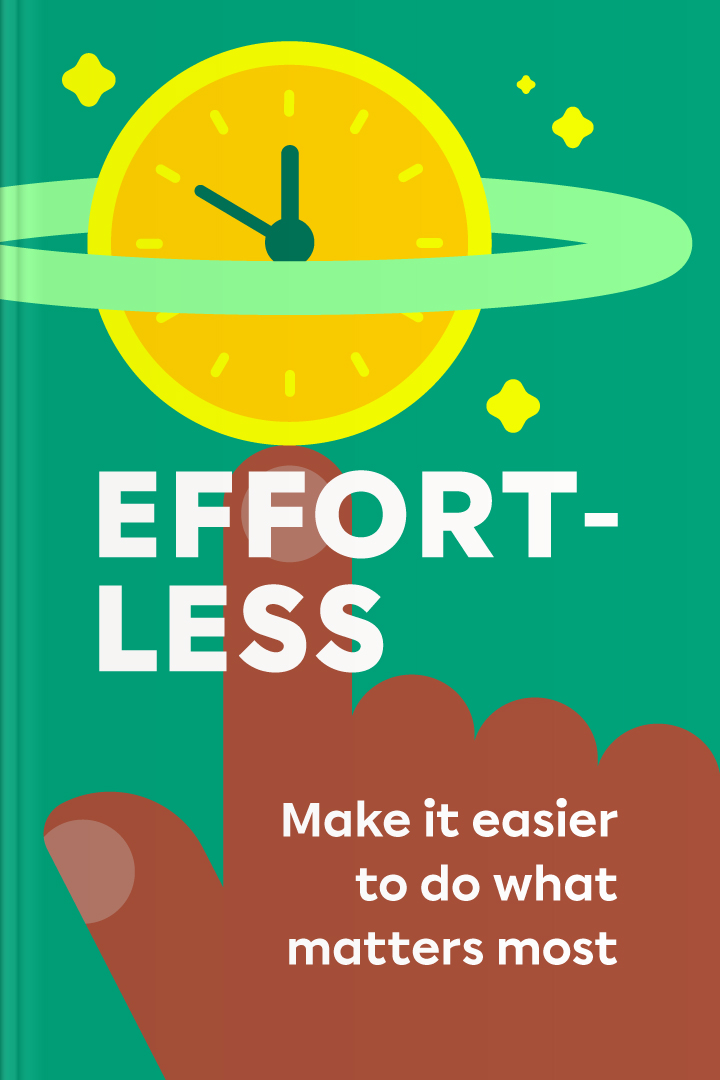
If You're Curious About These Questions...
You should listen to this audiobook
- Have you ever wondered why we’ve been conditioned to believe that for a result to be meaningful, it must require agonizing effort and exhaustion?
- What if you could bypass burnout and achieve your most ambitious goals by simply identifying and removing the hidden friction in your daily routine?
- What’s the secret to defining a clear 'done' point that prevents perfectionism from turning simple tasks into never-ending projects?
Listen to Effortless — Cinematic Audio Edition
Key Takeaways from Effortless
- Discover the power of asking, 'Where could this be easier than I’m making it?' to identify and remove the invisible friction that complicates your daily goals.
- Understand why constant exhaustion is not a requirement for success, and learn to work with your natural rhythms of effort and recovery to prevent burnout.
- Learn how to enter an 'Effortless State' by viewing simplicity as a strength rather than laziness, allowing you to choose smarter paths instead of just pushing harder.
- Master the technique of blending utility with enjoyment by shortening the gap between work and reward, turning tedious tasks into comforting rituals.
- Realize that intentionally doing nothing is a highly productive strategy, providing the mental rest needed to protect your focus and clear your emotional weather.
Learning Tools
Reinforce what you learned from Effortless
Mind Map
Quiz — Test Your Understanding
Effortless — Full Chapter Overview
- 1Recommendation
- 2Making things effortless begins with entering the Effortless State and ends with Effortless Results.
- 3Finding easier or more enjoyable methods helps us enter the Effortless State.
- 4Use Effortless Action to achieve more without overexerting yourself.
- 5Progress becomes effortless when you’re not afraid to start with rubbish.
- 6Knowledge and automation are levers for creating Effortless Results.
- 7You can secure Effortless Results by working with trustworthy people and preventing problems before they arise.
- 8Final summary
Effortless Summary & Overview
This summary explores the idea that progress doesn’t have to feel like constant strain. Many people live as if success requires endless effort, but that mindset often creates exhaustion, anxiety, and diminishing returns. Instead, the “effortless” approach is about reducing friction, focusing on what matters, and finding cleaner, simpler ways to follow through.
Across seven chapters, the narration invites listeners to notice where they’re overcomplicating tasks, overworking their energy, and carrying too much mental clutter. With practical shifts—like defining what “done” means, using short bursts of focus, building checklists, and creating trust through clear agreements—this approach supports consistent results with less stress.
Who Should Listen to Effortless?
- People who feel busy all the time yet still behind, and want a kinder, more sustainable way to be productive.
- Professionals or students who struggle with perfectionism, distractions, or burnout and want simpler systems that actually stick.
- Leaders, managers, and teammates who want better results through trust, clarity, and preventative problem-solving.
Books Similar to Effortless
Readers who enjoyed this also liked these titles.