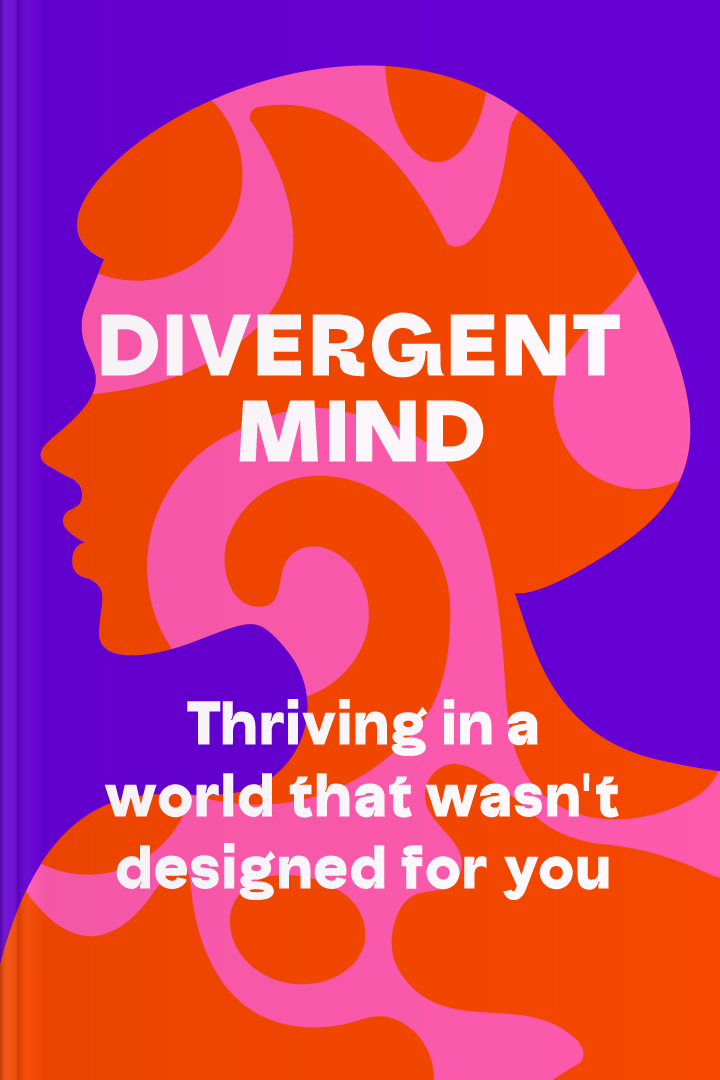
Divergent Mind audiobook cover - A warm, practical tour through neurodivergence—especially in women—exploring why so many people hide their traits, how history shaped misunderstanding, and how sensitivity, support, and healthier environments can help each mind belong without shame.

Divergent Mind

A warm, practical tour through neurodivergence—especially in women—exploring why so many people hide their traits, how history shaped misunderstanding, and how sensitivity, support, and healthier environments can help each mind belong without shame.

Jenara Nerenberg

4.2 / 5(5 ratings)

If You're Curious About These Questions...

You should listen to this audiobook

Listen to Divergent Mind — Free Audiobook

Loading player...

Key Takeaways from Divergent Mind

Learning Tools

Reinforce what you learned from Divergent Mind

Mind Map

Divergent Mind
The Gender Gap in Neurodiversity+
Types of Neurodivergence+
The Social Experience+
Coping & Thriving+
Designing a Divergent World+

Quiz — Test Your Understanding

Question 1 of 6
Why has medical research historically lacked adequate information about neurodiversity in women and nonbinary individuals?
  • A. Women typically do not experience neurodivergent traits until later in adulthood, making early study impossible.
  • B. Researchers feared female hormones and reproductive cycles made them too complicated for controlled studies.
  • C. Early definitions of neurodiversity strictly excluded female behavioral patterns by law.
  • D. Neurodivergent conditions like ADHD and autism are genetically linked only to the male population.
Question 2 of 6
What is 'masking' in the context of neurodivergent individuals, and what is its frequent long-term consequence?
  • A. The conscious rejection of neurotypical behaviors, resulting in workplace discrimination and job loss.
  • B. The medical treatment of sensory processing disorders, which often leads to a dulling of emotional responses.
  • C. The mental and behavioral effort to mimic social norms, which can lead to social isolation, imposter syndrome, and depression.
  • D. The tendency to project sensory overload onto others, resulting in broken family relationships and conflict.
Question 3 of 6
According to the text, how should the deep sensory processing of Highly Sensitive Persons (HSPs) be viewed when it is not pathologized?
  • A. As an evolutionary advantage that can help solve complex problems and invent innovative solutions.
  • B. As a temporary phase of emotional dysregulation that requires immediate behavioral therapy.
  • C. As a symptom of childhood trauma that manifests as an inability to handle chaotic environments.
  • D. As a primary indicator of synesthesia, where individuals confuse different sensory inputs.
Question 4 of 6
How does the concept of 'mirror neurons' relate to the struggles of neurodivergent women?
  • A. They completely lack mirror neurons, preventing them from understanding basic human social structures.
  • B. Their mirror neurons are hyperactive, causing them to unconsciously steal the identities of those around them.
  • C. They use mirror neurons to successfully cure their sensory processing challenges by mimicking neurotypical people.
  • D. They experience distorted social mirroring but tend to blame themselves for failing to live up to societal expectations.
Question 5 of 6
What common stereotype about individuals with ADHD or autism does the text identify as a fundamental misunderstanding?
  • A. They are overly emotional and unable to control their feelings in professional settings.
  • B. They lack empathy or deep emotions, when in reality they are often highly sensitive to the emotions of others.
  • C. They require constant physical touch to remain calm in chaotic environments.
  • D. They are completely unaffected by environmental factors like noise, smells, or lighting.
Question 6 of 6
How does the text challenge the traditional design of office and institutional environments regarding neurodivergent individuals?
  • A. It argues that standard offices are too visually chaotic and need to be redesigned with stark, minimal features.
  • B. It claims that these environments are already perfectly optimized for neurodivergent people, but neurotypical people struggle in them.
  • C. It suggests that rather than being overstimulating, the sensory monotony of beige walls and fluorescent lighting is actually understimulating and dulls the senses.
  • D. It proposes that open-plan offices are the only way to trigger the parasympathetic nervous system for relaxation.

Divergent Mind — Full Chapter Overview

Divergent Mind Summary & Overview

This audio summary explores neurodivergence through a compassionate lens, with special attention to how often women and girls have been overlooked in research and misunderstood in everyday life. It gently explains why “masking” can look like coping on the outside while quietly creating anxiety, exhaustion, and depression on the inside.

Moving from history into lived experience, it introduces four sensitivity-linked forms of neurodivergence—high sensitivity, ADHD, autism, and sensory processing differences—and reflects on how structured environments, supportive relationships, and thoughtful spaces can reduce strain and help strengths emerge. The central invitation is simple: learn, listen, and help create a world where different brains are treated as human variation, not a problem to hide.

Who Should Listen to Divergent Mind?

  • Women and girls who suspect they may be neurodivergent and want language for what they’ve been carrying silently
  • Partners, parents, friends, educators, and managers who want to support neurodivergent people with more understanding and less judgment
  • Anyone interested in how sensitivity and environment shape mental health, identity, and belonging

About the Author: Jenara Nerenberg

This narration is adapted from the user-provided summary content. It references ideas popularized in the broader neurodiversity conversation, including work associated with advocates and authors such as Jenara Nerenberg, and researchers like Elaine Aron, while keeping the focus on supportive understanding rather than diagnosis.

🎧
Listen in the AppOffline playback & background play
Get App