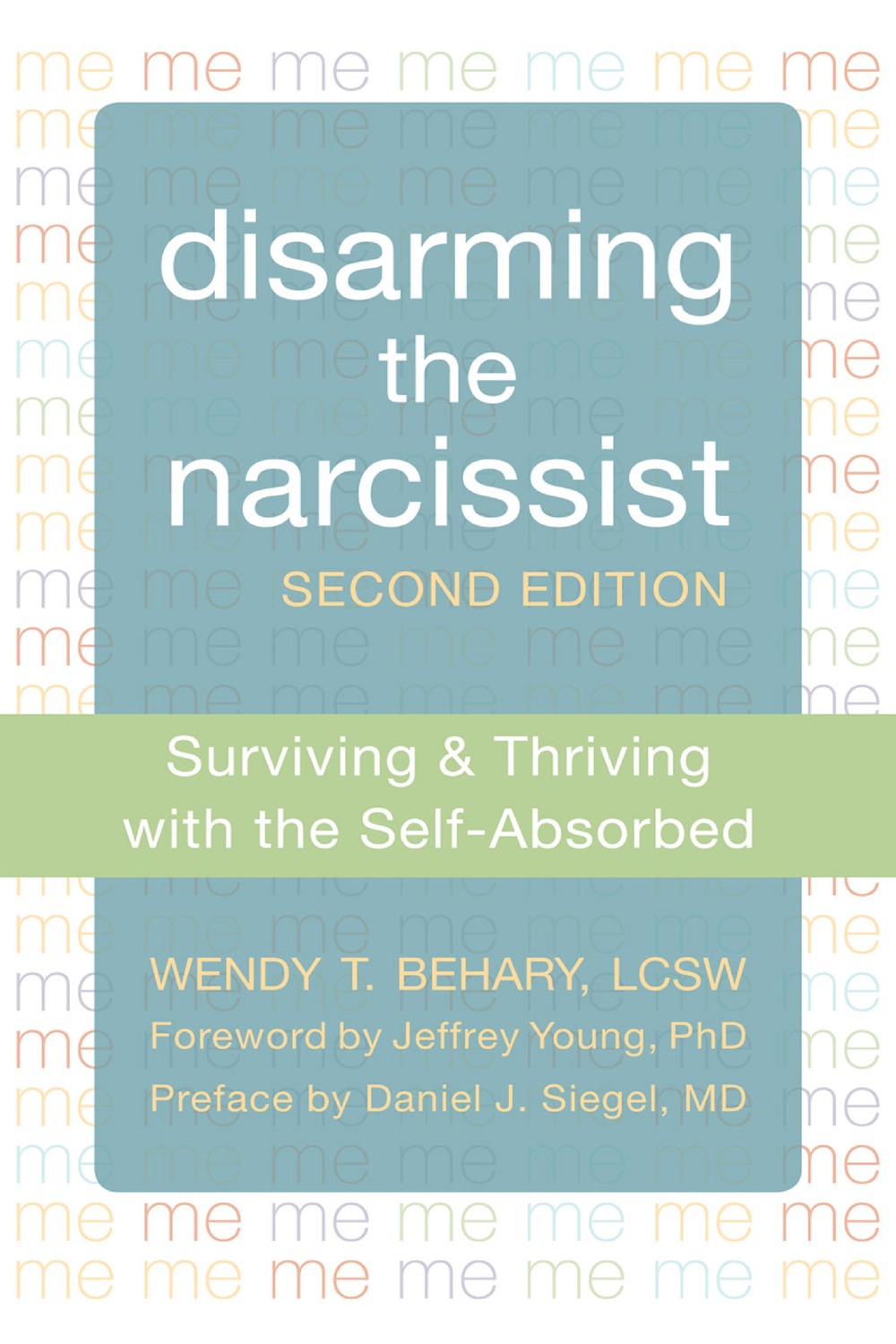
Disarming the Narcissist: Surviving and Thriving with the Self-Absorbed audiobook cover - When charm turns into control, criticism, or emotional neglect, arguing harder rarely helps. Wendy Behary offers a more effective path: understand the narcissist's defenses, recognize personal triggers, set enforceable limits, and communicate with empathy without surrendering dignity or safety.
Theme Song

Disarming the Narcissist: Surviving and Thriving with the Self-Absorbed

When charm turns into control, criticism, or emotional neglect, arguing harder rarely helps. Wendy Behary offers a more effective path: understand the narcissist's defenses, recognize personal triggers, set enforceable limits, and communicate with empathy without surrendering dignity or safety.

Wendy T. Behary, LCSW

★ 3.7 / 5(3,598 ratings on Goodreads)
Start Listening

If You're Curious About These Questions...

You should listen to this audiobook

Listen to Disarming the Narcissist: Surviving and Thriving with the Self-Absorbed — Cinematic Audio Edition

Loading player...

Key Takeaways from Disarming the Narcissist: Surviving and Thriving with the Self-Absorbed

Learning Tools

Reinforce what you learned from Disarming the Narcissist: Surviving and Thriving with the Self-Absorbed

Mind Map

Disarming The Narcissist
Understanding Narcissistic Armor+
Blueprint Beneath the Behavior+
Recognizing and Regulating Triggers+
Four Narcissistic Masks+
Safety, Consequences, and Repair+
Empathy with a Backbone+
Recovering the Authentic Self+

Quiz — Test Your Understanding

Question 1 of 12
What primarily distinguishes healthy narcissism from maladaptive narcissism?
  • A. Healthy narcissism avoids ambition, while maladaptive narcissism pursues achievement
  • B. Healthy narcissism preserves empathy and reciprocity, while maladaptive narcissism replaces them with entitlement and approval seeking
  • C. Healthy narcissism is always covert, while maladaptive narcissism is always overt
  • D. Healthy narcissism develops in adulthood, while maladaptive narcissism begins in childhood
Question 2 of 12
According to schema therapy, what are schemas?
  • A. Temporary moods caused by stressful situations
  • B. Conscious strategies used to manipulate other people
  • C. Enduring patterns of belief, emotion, bodily sensation, and memory rooted in unmet childhood needs
  • D. Biological traits that cannot be changed through awareness or therapy
Question 3 of 12
Why did the possibility that Louis's wife might leave create an opening for therapy?
  • A. It proved that Louis had already overcome his defenses
  • B. It allowed Louis to avoid discussing his childhood
  • C. It convinced his wife to accept his behavior without conditions
  • D. It created a meaningful consequence strong enough to compete with the comfort of his defenses
Question 4 of 12
How does Behary distinguish fault from present responsibility for someone affected by narcissistic behavior?
  • A. People did not choose their early schemas, but they are responsible for recognizing and changing current coping patterns
  • B. People are responsible for both their childhood schemas and the narcissist's behavior
  • C. Because childhood coping strategies were once useful, they should not be changed
  • D. Only the narcissistic person has any responsibility for the current relationship pattern
Question 5 of 12
What is the correct order of Behary's four-stage alternative to fight, flight, or freeze?
  • A. Assessment, observation, differentiation, identification
  • B. Identification, differentiation, observation, assessment
  • C. Observation, assessment, identification, differentiation
  • D. Observation, identification, confrontation, resolution
Question 6 of 12
Which response does Behary recommend when dealing with the narcissistic 'bully' mask?
  • A. Offer extra praise to reduce the person's insecurity
  • B. Use calm, direct accountability and refuse insults or intimidation
  • C. Match the person's aggression to demonstrate strength
  • D. Withdraw without explanation whenever disagreement occurs
Question 7 of 12
When perilous narcissism threatens safety, what should take priority over empathic confrontation?
  • A. Offering more reassurance and admiration
  • B. Exploring the narcissistic person's childhood in greater depth
  • C. Waiting for a sincere apology before taking action
  • D. Safety planning, confidential support, professional assistance, and legal or financial guidance
Question 8 of 12
What is required for workable repair after a moderate narcissist betrays trust?
  • A. Genuine accountability, transparency, empathy, patience, and sustained behavioral change
  • B. A prompt apology followed by an agreement never to mention the event again
  • C. Immediate forgiveness from the injured person
  • D. A detailed explanation of how childhood experiences caused the betrayal
Question 9 of 12
What two messages are combined in empathic confrontation?
  • A. The behavior was justified, and the injured person should adapt to it
  • B. The narcissistic person is entirely at fault, and understanding is unnecessary
  • C. The reaction is understandable in light of the person's history, but the resulting behavior remains unacceptable and must change
  • D. Both people are equally responsible, regardless of what occurred
Question 10 of 12
Which of Behary's seven gifts involves restating what was heard, checking its meaning, and looking for feelings beneath anger or grandiosity?
  • A. Foresight
  • B. Reflective listening
  • C. Discernment
  • D. Collaboration
Question 11 of 12
What does the acronym FORCE represent in Behary's communication framework?
  • A. Fairness, objectivity, restraint, courage, and empathy
  • B. Focus, openness, responsibility, clarity, and endurance
  • C. Flexibility, observation, respect, competence, and emotional control
  • D. Flexibility, openness, receptivity, competence, and enlightenment
Question 12 of 12
What does the book ultimately mean by 'disarming narcissism'?
  • A. Removing the old triggers that once disarmed the self rather than defeating the other person
  • B. Discovering a communication technique that guarantees the narcissist will change
  • C. Accepting responsibility for healing the narcissistic person's childhood wounds
  • D. Learning to suppress emotional reactions so conflict never occurs

Disarming the Narcissist: Surviving and Thriving with the Self-Absorbed — Full Chapter Overview

Disarming the Narcissist: Surviving and Thriving with the Self-Absorbed Summary & Overview

Disarming the Narcissist is a practical guide for people living or working with someone whose entitlement, self-absorption, defensiveness, or hunger for admiration repeatedly damages relationships. Drawing on schema therapy, cognitive therapy, and interpersonal neurobiology, Wendy Behary explains how narcissistic behavior can develop from indulgence, dependency, emotional deprivation, conditional love, and deeply concealed shame.

The book also turns attention toward the reader. It shows how schemas involving abandonment, self-sacrifice, subjugation, defectiveness, or emotional deprivation can make a person unusually vulnerable to intimidation and manipulation. Behary then presents tools for mindful self-awareness, assertive communication, limit setting, and empathic confrontation. Her approach does not excuse harmful behavior or promise that every narcissist will change. Instead, it helps readers distinguish difficult but potentially workable relationships from perilous situations involving abuse, threats, addiction, or remorseless exploitation. The ultimate objective is not to defeat the narcissist, but to recover an authentic voice, protect essential rights, and make clear-eyed decisions about staying, changing the relationship, or leaving safely.

Who Should Listen to Disarming the Narcissist: Surviving and Thriving with the Self-Absorbed?

  • Partners, relatives, friends, or employees who feel diminished, controlled, or chronically unheard by a self-absorbed person.
  • Readers seeking practical tools for boundaries, assertiveness, emotional regulation, and difficult conversations.
  • Clinicians and helping professionals interested in schema-informed approaches to narcissism and high-conflict relationships.

About the Author: Wendy T. Behary, LCSW

Wendy T. Behary, LCSW, is the founder and clinical director of the Cognitive Therapy Center of New Jersey. She has served on the faculty of the Cognitive Therapy Center and Schema Therapy Institute of New York and is a distinguished founding fellow of the Academy of Cognitive Therapy. Her clinical work specializes in narcissism and high-conflict couples.

🎧
Listen in the AppOffline playback & background play
Get App
Disarming the Narcissist: Surviving and Thriving with the Self-AbsorbedTheme Song
NOW PLAYING
Disarming the Narcissist: Surviving and Thriving with the Self-Absorbed

Disarming the Narcissist: Surviving and Thriving with the Self-Absorbed

Theme Song
0:000:00