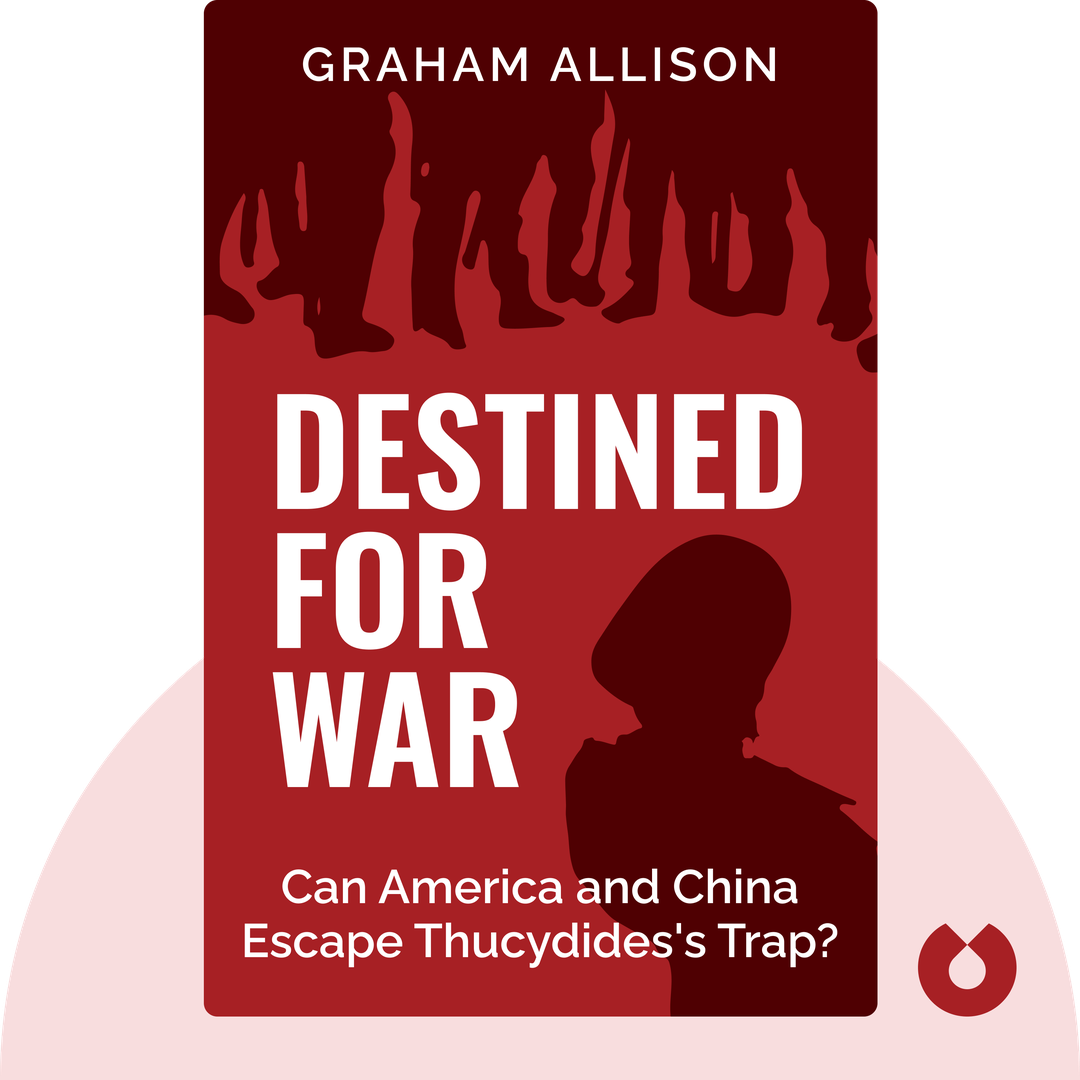
If You're Curious About These Questions...
You should listen to this audiobook
- Did you know that out of the last 16 times a rising power challenged an established one, 12 ended in a devastating war?
- Have you ever wondered why an ancient Greek historian’s observations from 2,400 years ago are the key to understanding today’s high-stakes tension between the US and China?
- Are you curious about the hidden patterns behind global power struggles and the narrow path world leaders must take to avoid a catastrophic conflict?
Listen to Destined for War — Free Audiobook
Loading player...
Key Takeaways from Destined for War
- Understand the 'Thucydides Trap,' an ancient geopolitical concept explaining how war often becomes inevitable when a rapidly rising power threatens an established dominant force.
- Discover how China's stratospheric economic growth and rapid industrialization over the past few decades have directly positioned it to challenge US global supremacy.
- Recognize how shifting global power creates severe structural stress, turning ordinary diplomatic tensions into highly volatile flashpoints that can trigger epic conflicts.
- Learn to identify 'rising power syndrome,' a dangerous phase where a developing nation's rapid growth fuels new ambitions, a sense of entitlement, and potential military aggression.
- Explore vital historical parallels, from ancient Greece to twentieth-century Japan, to uncover actionable lessons on how the US and China might avoid a catastrophic future war.
Learning Tools
Reinforce what you learned from Destined for War
Mind Map
Destined for War
The Thucydides Trap+
China's Stratospheric Rise+
Historical Case Studies+
Potential US-China Flashpoints+
Paths to Peace+
Quiz — Test Your Understanding
Question 1 of 7
According to the ancient Greek historian Thucydides, what is the primary underlying cause of conflict between a rising power and an established power?
Question 2 of 7
How did former Singaporean Prime Minister Lee Kuan Yew characterize China's trajectory as a global power?
Question 3 of 7
Which historical event does the text use to illustrate 'rising power syndrome,' where a state's ambition and sense of entitlement grow alongside its capabilities?
Question 4 of 7
According to the Harvard think tank analysis mentioned in the text, how frequently have historical instances of the 'Thucydides Trap' resulted in war?
Question 5 of 7
The text compares geopolitical analysts to park rangers during fire season. Which of the following is NOT mentioned as a potential 'spark' that could ignite a US-China war?
Question 6 of 7
How did Britain successfully avoid war with the United States when the US emerged as a rising power in the early twentieth century?
Question 7 of 7
Which of the following is proposed as a potential strategic option for the US to peacefully manage its relationship with China?
Destined for War — Full Chapter Overview
- 1Recommendation
- 2China’s meteoric growth makes it a credible rival to the US
- 3Thucydides’s ideas illuminate global conflicts throughout history
- 4Many different scenarios could lead to war
- 5War between the US and China isn’t inevitable
- 6Final summary
Destined for War Summary & Overview
Destined for War (2017) applies ancient military thinking to a very contemporary conflict: the power struggle between the established power of the US, and the rising power of China. It uncovers how this dynamic has led to conflict in past centuries, and spells out what the US and China must do in the future to avoid all-out war.
Who Should Listen to Destined for War?
- News junkies who want a deeper understanding of the US’s relationship with China
- Those interested in how ancient political theory can be applied to contemporary conflicts
- Those new to world politics who are curious about the current power struggle between China and the US
Books Similar to Destined for War
Readers who enjoyed this also liked these titles.