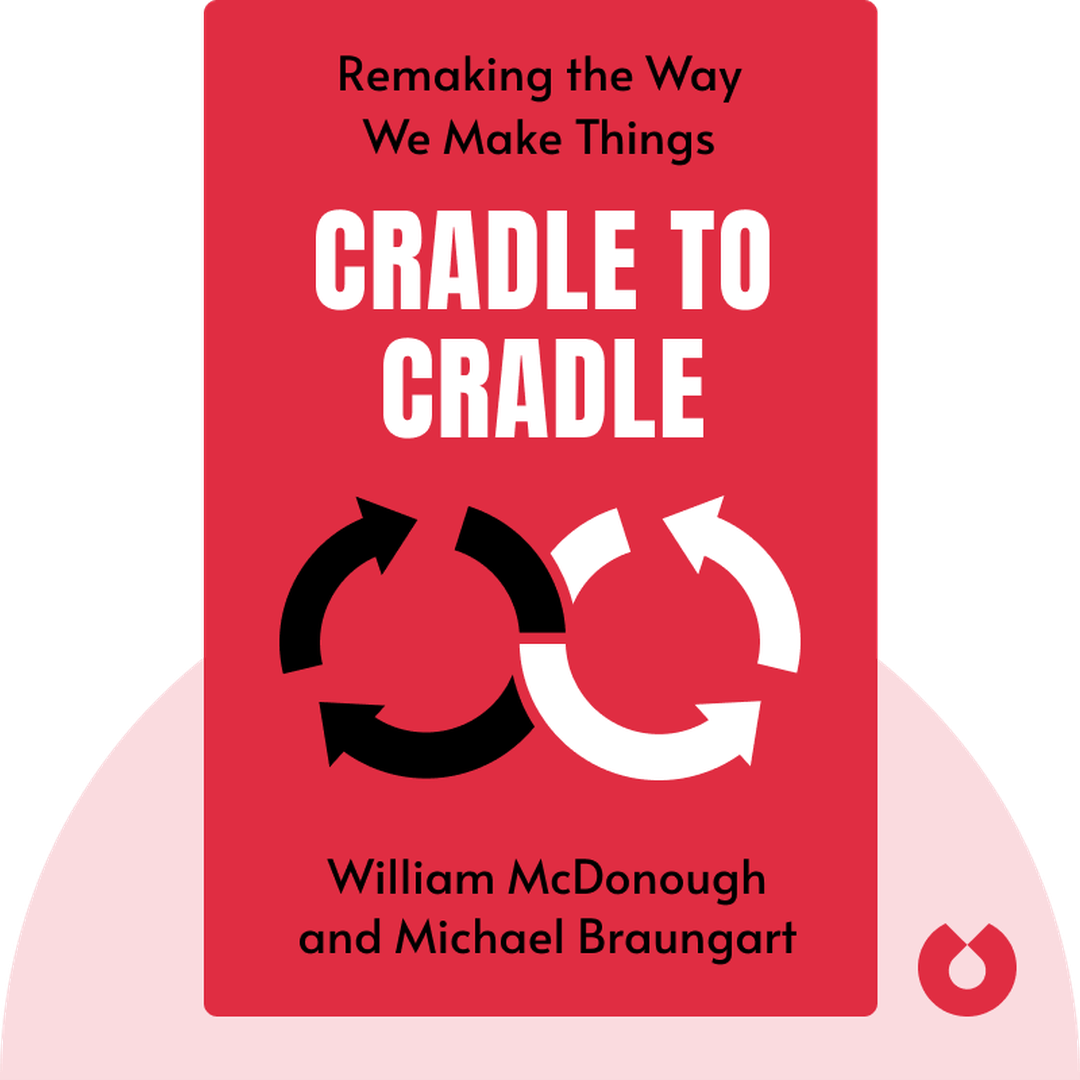
If You're Curious About These Questions...
You should listen to this audiobook
- Did you know that most 'eco-friendly' recycling is actually just 'downcycling' that eventually leads to the same pile of waste?
- Have you ever wondered why being 'less bad' for the environment isn't the same thing as actually doing good?
- What if you could design products that don’t just minimize harm, but actually function as 'nutrients' for the planet?
Listen to Cradle to Cradle — Free Audiobook
Loading player...
Key Takeaways from Cradle to Cradle
- Understand why modern manufacturing's linear 'cradle-to-grave' model inherently damages the environment by designing products destined for the trash.
- Discover why the traditional 'reduce, reuse, recycle' mantra falls short, and how standard recycling is actually 'downcycling' that permanently degrades material quality.
- Learn how well-intentioned eco-efficiency efforts, like highly insulated buildings, often create new hazards such as trapped indoor air pollution.
- Find out why current environmental regulations only offer industries a 'license to harm' rather than incentivizing the fundamental redesign of toxic products.
- Embrace the 'cradle-to-cradle' approach of eco-effectiveness, which replaces the wasteful product-to-waste pipeline with a completely sustainable product-to-product cycle.
Learning Tools
Reinforce what you learned from Cradle to Cradle
Mind Map
Cradle to Cradle
The Cradle-to-Grave Problem+
The Failure of Eco-Efficiency+
The Cradle-to-Cradle Solution+
Redesigning Materials+
Leveraging Local Diversity+
Sustainable Business Practices+
Quiz — Test Your Understanding
Question 1 of 8
What is the fundamental problem with the current industrial production model according to the text?
Question 2 of 8
How do major soap manufacturers illustrate the flawed 'one-size-fits-all' approach of modern industry?
Question 3 of 8
Why do the authors argue that traditional recycling is actually 'downcycling'?
Question 4 of 8
What is the primary critique of eco-efficiency and current environmental regulations?
Question 5 of 8
How does the concept of 'eco-effectiveness' differ from 'eco-efficiency' in the context of building design?
Question 6 of 8
According to the cradle-to-cradle model, what is a 'technical nutrient'?
Question 7 of 8
Why do the authors suggest that product packaging should differ from region to region?
Question 8 of 8
When transforming a company into an eco-efficient/eco-effective one, what three aspects make up the 'fractal triangle' that businesses must balance?
Cradle to Cradle — Full Chapter Overview
- 1Recommendation
- 2Industry is fundamentally harmful to the environment.
- 3Reducing, reusing, and recycling aren’t enough to create real ecological change.
- 4Eco-efficiency and today’s environmental regulations aren’t viable long-term solutions.
- 5Eco-effectiveness is a stronger approach than eco-efficiency.
- 6If we redesign how we make things, we can stop producing waste.
- 7We should respect and make use of the world’s diversity.
- 8Make your company more eco-efficient.
- 9Final summary
Cradle to Cradle Summary & Overview
Cradle to Cradle (2009) exposes the fundamental flaws of manufacturing and the damage it inflicts upon our environment, even as we attempt to be eco-friendly. These blinks also introduce you to ways in which you can make a positive impact on the planet, and guide you through the process of rethinking your business in order to become eco-efficient.
Who Should Listen to Cradle to Cradle?
- Businesses looking to become more environmentally friendly
- People interested in the impact of industry today
- Anyone curious about alternative approaches to doing business
Books Similar to Cradle to Cradle
Readers who enjoyed this also liked these titles.