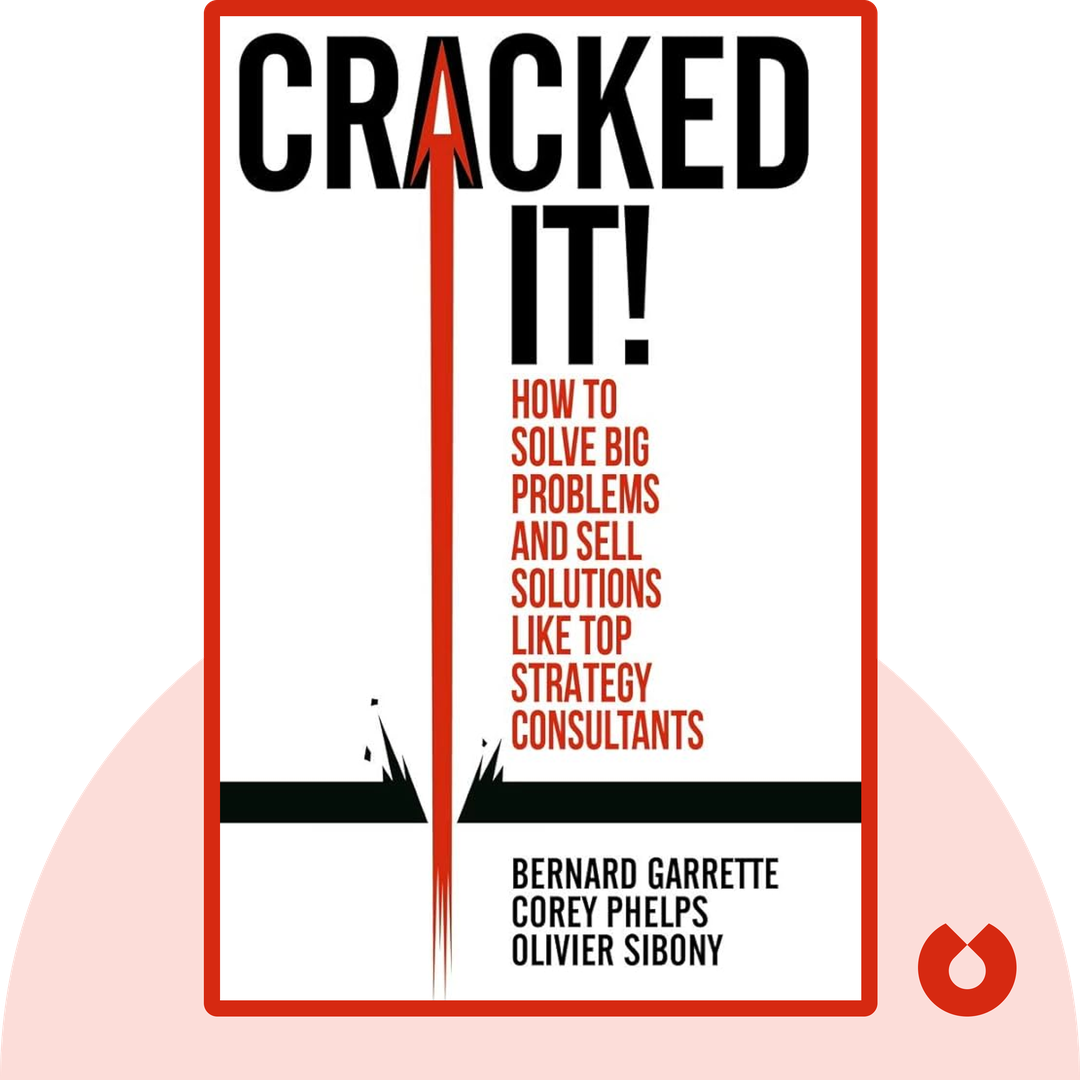
If You're Curious About These Questions...
You should listen to this audiobook
- Have you ever wondered why even the smartest leaders often fail to solve complex problems, and how a structured framework could change your results?
- What if you could master the exact same 'hypothesis-driven' techniques used by elite consultants to tackle any business challenge with precision?
- What’s the secret to using the Pyramid Principle to ensure your solutions are not only brilliant but also impossible for your organization to ignore?
Listen to Cracked it! — Cinematic Audio Edition
Loading player...
Key Takeaways from Cracked it!
- Master the 4S method—State, Structure, Solve, and Sell—to completely transform how you tackle complex business challenges and persuasively pitch your solutions.
- Discover how to balance fast, intuitive thinking with slow, methodical analysis to overcome cognitive biases without falling into analysis paralysis.
- Understand why domain expertise can actually blind you to alternative answers, and learn how to cultivate a beginner's mindset to uncover broader perspectives.
- Apply the TOSCA framework—Trade-offs, Objectives, Scope, Constraints, and Authority—to comprehensively define a problem so you never waste time solving the wrong issue.
- Find out how to look beyond surface-level symptoms to identify connected, underlying problems, ensuring you build robust, long-term strategies rather than temporary quick fixes.
Learning Tools
Reinforce what you learned from Cracked it!
Mind Map
Cracked it!
Core Mindsets+
Step 1: State+
Step 2: Structure+
Step 3: Solve+
Step 4: Sell+
Quiz — Test Your Understanding
Question 1 of 6
According to the text, what is a recommended strategy to overcome the 'trap of expertise' when solving complex problems?
Question 2 of 6
What does the acronym TOSCA stand for in the context of the 'State' stage of problem-solving?
Question 3 of 6
When structuring a problem, what is identified as a major risk of using a hypothesis-driven approach?
Question 4 of 6
In the hypothesis-driven approach, what is the purpose of the MECE principle?
Question 5 of 6
How does the Pyramid Principle structure communication during the 'Sell' stage?
Question 6 of 6
Why does the author recommend presenting your core message early and asking for initial thoughts during a presentation?
Cracked it! — Full Chapter Overview
- 1Recommendation
- 2Finding your way through the maze of problem-solving
- 3Exploring the first step in 4S problem-solving
- 4Mastering the Structure stage of 4S
- 5Moving from solving to selling in 4S
- 6Final summary
Cracked it! Summary & Overview
Cracked it! (2018) offers you a toolbox for solving complex problems with speed and precision. Uncover how to apply methods from hypothesis-driven thinking to the Pyramid Principle, ensuring you tackle challenges effectively. Elevate your decision-making skills and become the go-to problem solver in your organization.
Who Should Listen to Cracked it!?
- MBA students learning problem-solving techniques
- Business executives seeking actionable strategies
- Consultants looking to sharpen skills
Books Similar to Cracked it!
Readers who enjoyed this also liked these titles.