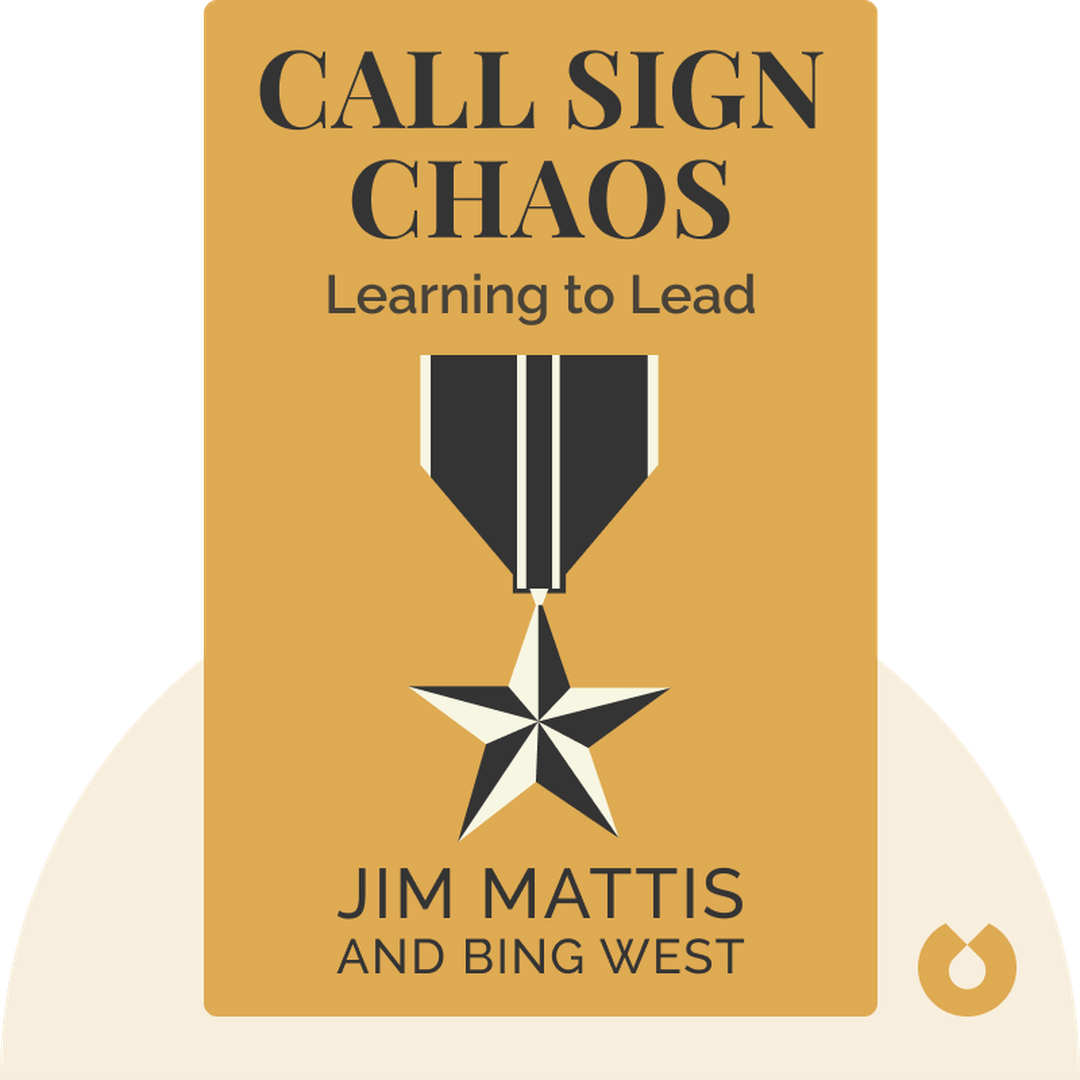
If You're Curious About These Questions...
You should listen to this audiobook
- Did you know that General Mattis’s famous call sign “Chaos” wasn’t actually about creating disorder, but contained a hidden acronym that defined his entire leadership philosophy?
- Have you ever wondered how a legendary commander transitions from leading a small squad on the ground to making high-stakes strategic decisions that impact global foreign policy?
- What’s the secret to maintaining a clear head and decisive leadership when you’re operating in the middle of some of the most complex and volatile conflict zones in modern history?
Listen to Call Sign Chaos — Free Audiobook
Loading player...
Key Takeaways from Call Sign Chaos
- Understand why relying solely on personal experience limits your leadership potential, and discover how extensive reading and dedicated mentorship can accelerate your growth.
- Discover the 'recruit for attitude, train for skill' approach to hiring, and learn why a candidate's mindset and desire to learn are more valuable than their existing expertise.
- Master the transition to executive leadership by placing absolute trust in your subordinates, a psychological strategy that naturally motivates your team to go the extra mile.
- Find out how to cultivate an open environment that prioritizes good ideas over corporate or military rank, ensuring you never miss a brilliant solution from a lower-level team member.
- Learn how to communicate your intent with crystal clarity while remaining flexible enough to change your convictions when they no longer serve your organization's mission.
Learning Tools
Reinforce what you learned from Call Sign Chaos
Mind Map
Call Sign Chaos
Foundations of Leadership+
The First Gulf War (1991)+
Afghanistan War (2001)+
Iraq War: Invasion & Blunders+
Insurgency & Fallujah (2004)+
Stabilization & ISIS+
Quiz — Test Your Understanding
Question 1 of 9
Why did Jim Mattis ultimately find a sense of purpose in the Marines after being a mediocre college student?
Question 2 of 9
According to Mattis, what are the three essential factors for effective military leadership, especially in an all-volunteer force?
Question 3 of 9
Why did Mattis view the 1991 First Gulf War as a 'model military campaign'?
Question 4 of 9
Why was Mattis initially prevented from bringing his Marines into Afghanistan immediately after the 9/11 attacks?
Question 5 of 9
What was the primary reason US Central Command denied Mattis permission to pursue Osama bin Laden in Tora Bora?
Question 6 of 9
What post-invasion decision in Iraq did Mattis consider a 'huge mistake' that fueled the insurgency?
Question 7 of 9
How did Mattis initially attempt to handle the rising insurgency in Anbar province before politicians demanded a forceful response?
Question 8 of 9
What was the 'Anbar Awakening' that Mattis helped facilitate in 2006?
Question 9 of 9
According to the text, what was the direct consequence of the total withdrawal of US troops from Iraq in 2011?
Call Sign Chaos — Full Chapter Overview
- 1Recommendation
- 2Jim Mattis was a carefree young man who found purpose in the Marines.
- 3Mattis learned leadership during the turbulent Vietnam War years.
- 4Mattis led the US attack on Iraqi forces in the First Gulf War.
- 5Outdated strategic thinking forced Mattis to wait before joining the fight against Al Qaeda.
- 6Mattis helped bring down the Taliban in Afghanistan but was denied permission to pursue bin Laden.
- 7Mattis led his Marines into Iraq in 2003, despite his own doubts about the war.
- 8Poor planning alienated both Iraqi soldiers and civilians.
- 9Postwar Iraq strategies of force and de-escalation were both abandoned too soon.
- 10The early withdrawal of American forces from Iraq helped pave the way for ISIS.
- 11Final summary
Call Sign Chaos Summary & Overview
Call Sign Chaos (2019) examines US foreign policy through the eyes of one of America’s most formidable strategic thinkers – General Jim Mattis. These blinks span Mattis’ entire storied career, from his youthful decision to join the Marines to his leadership of US forces in Afghanistan and Iraq. They provide a deep and personal take on the American military.
Who Should Listen to Call Sign Chaos?
- History buffs
- Politically-inclined individuals
- Leaders
Books Similar to Call Sign Chaos
Readers who enjoyed this also liked these titles.