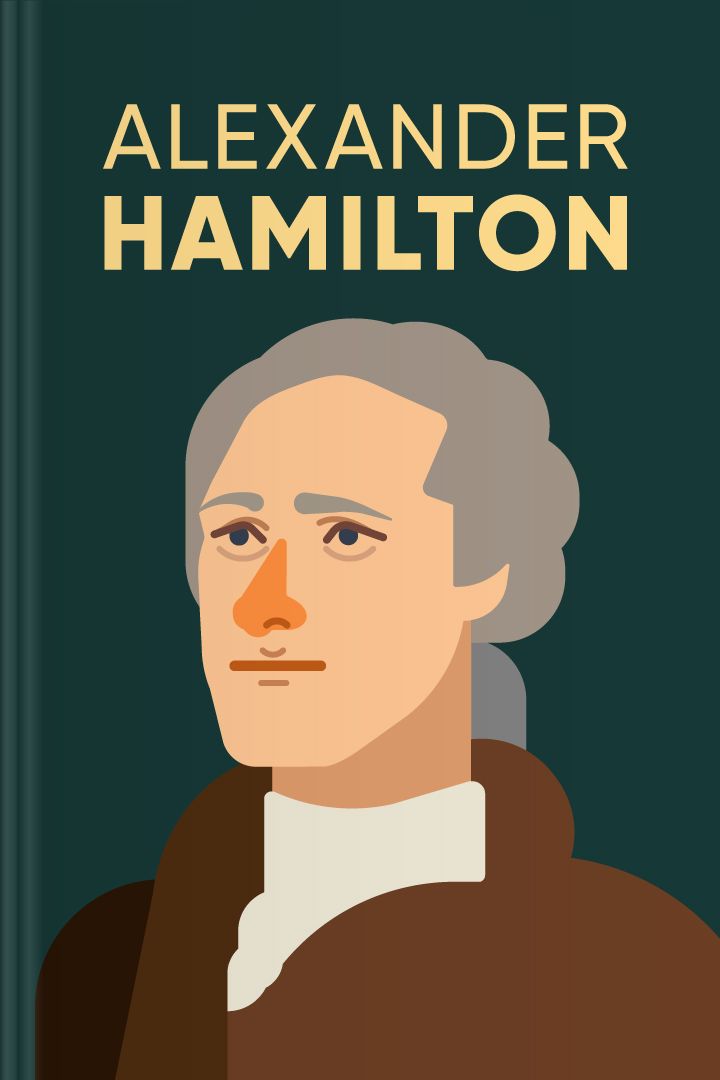
If You're Curious About These Questions...
You should listen to this audiobook
- Did you know that one of the most influential architects of the American government was actually a penniless immigrant who survived a tragic and unstable childhood in the Caribbean?
- Have you ever wondered why the United States evolved into a global financial powerhouse rather than a loose collection of farming states—and which Founding Father risked his reputation to make it happen?
- What’s the secret to building a lasting national legacy when your personal life is marked by explosive scandals and bitter political rivalries that eventually lead to a fatal end?
Listen to Alexander Hamilton — Free Audiobook
Key Takeaways from Alexander Hamilton
- Understand how America's unified, financial, and industrial future was not inevitable, but meticulously designed and relentlessly argued into existence by Alexander Hamilton.
- Discover why Hamilton's push for a strong central government created fierce enemies who attacked his character, burying his true legacy in generations of myth.
- Learn how a childhood marred by illegitimacy, poverty, and devastating loss fueled Hamilton's ambition, proving that a difficult start does not determine your ultimate success.
- Recognize how young Hamilton used books as a refuge from a harsh plantation society, shaping the intellect and early abolitionist convictions that would later define his leadership.
- Find out how Hamilton's unwavering perseverance and exceptional writing skills—specifically a vivid letter about a devastating hurricane—caught the attention of mentors and catalyzed his rise to greatness.
Learning Tools
Reinforce what you learned from Alexander Hamilton
Mind Map
Quiz — Test Your Understanding
Alexander Hamilton — Full Chapter Overview
- 1Recommendation
- 2Hamilton’s early life was difficult, but his intellect stood out from the start.
- 3The American colonies were nearing revolution when Hamilton arrived.
- 4Hamilton’s wit and energy impressed George Washington, who made him his right-hand man.
- 5Hamilton’s wartime experience was bound up with romance and his drive to make his name.
- 6As the war ended, Hamilton returned to writing and joined the Continental Congress.
- 7Hamilton played a key role in drafting and defending the new Constitution.
- 8Hamilton moved to the center of power when Washington became the new republic’s first president.
- 9Hamilton had long irritated others, but his debt-crisis plan made him powerful enemies.
- 10Hamilton oversaw the creation of a national coastguard and America’s first central bank.
- 11Hamilton faced an uncertain future as Washington’s presidency came to an end.
- 12Hamilton barely weathered a public scandal and rebounded by rejoining the army.
- 13The clash between Adams and Hamilton shaped the presidential election of 1800.
- 14After the 1800 election, Hamilton had to back an old enemy to stop a new threat.
- 15Hamilton endured a crushing personal loss soon after the 1800 election.
- 16Hamilton’s political and personal feud with Burr ended in a deadly duel.
- 17Final summary
Alexander Hamilton Summary & Overview
This summary follows Ron Chernow’s portrait of Alexander Hamilton: an immigrant who rose from an unstable Caribbean childhood to become one of the most influential architects of the early United States. In an era when many leaders imagined America as a loose, agricultural collection of states, Hamilton pushed for a stronger central government and the institutions needed to hold it together.
Across war, marriage, finance, political conflict, scandal, and tragedy, the story traces both Hamilton’s brilliance and his blind spots. It’s a reminder that history is shaped by people who are gifted, complicated, and sometimes costly to themselves and those they love—and that the work of preserving a legacy can fall to those left behind.
Who Should Listen to Alexander Hamilton?
- Listeners who want a clear, human story about how the early United States moved from fragile independence toward a functioning central government.
- Anyone interested in ambition, resilience, and the trade-offs public figures face when personal life and public mission collide.
- People curious about the political rivalries behind the Constitution, early banking, and the beginnings of America’s market economy.
Books Similar to Alexander Hamilton
Readers who enjoyed this also liked these titles.