If You're Curious About These Questions...
You should listen to this audiobook
- Have you ever wondered why our modern obsession with shopping is being compared to a contagious disease—and what it’s actually doing to your health?
- Did you know that the very lifestyle we've been taught to strive for might be the secret source of our collective stress and unhappiness?
- What if you could immunize yourself against the constant pressure to consume and finally reclaim your time, your money, and your peace of mind?
Listen to Affluenza — Free Audiobook
Loading player...
Key Takeaways from Affluenza
- Understand how the Industrial Revolution's promise of more free time was replaced by 'affluenza,' an addiction to consumption that has caused happiness levels to decline since 1957.
- Discover why we fall into the trap of 'cocooning' and social withdrawal, attempting to cure our loneliness and exhaustion by buying products instead of building meaningful relationships.
- Recognize the devastating environmental impact of our relentless demand for goods, which forces dangerous resource extraction and contributes to alarming ecological crises.
- Learn how our pursuit of cheap consumer goods disproportionately harms the poor through abysmal working conditions and exposure to toxic manufacturing environments.
- See how unrealistic, media-driven wealth standards fuel a vicious cycle of overconsumption and widen an income inequality gap that ultimately damages society as a whole.
Learning Tools
Reinforce what you learned from Affluenza
Mind Map
Affluenza
The Affliction+
Devastating Consequences+
Systemic Enablers+
The Cure+
Quiz — Test Your Understanding
Question 1 of 8
According to the text, what was the expected outcome of the massive increase in productivity brought about by the Industrial Revolution?
Question 2 of 8
What term does the book use to describe the modern process of social withdrawal where couples and families stay at home instead of socializing in their communities?
Question 3 of 8
How do popular American television shows contribute to 'affluenza' in developing countries?
Question 4 of 8
How do the authors respond to the argument that the desire for endless material goods is simply 'human nature'?
Question 5 of 8
What economic strategy, first promoted by General Motors, is used to ensure consumers continuously buy new versions of a product they already own?
Question 6 of 8
What is the primary purpose of corporate 'front groups' like the American Council on Science and Health?
Question 7 of 8
According to a 1995 survey by the Center for a New American Dream, what happened to the majority of Americans who voluntarily decreased their level of consumption?
Question 8 of 8
What method do the authors suggest is necessary to 'immunize' society, especially children, against the omnipresent advertisements driving affluenza?
Affluenza — Full Chapter Overview
- 1Recommendation
- 2Post-industrial productivity gains have fueled an addiction to consumption.
- 3We try to ease unhappiness by buying things, but it only leaves us feeling worse.
- 4The environmental costs of overconsumption are devastating.
- 5While affluenza affects the poor most, inequality harms everyone.
- 6Overconsumption isn’t “human nature,” and philosophers have long argued against it.
- 7Overconsumption has been systematically encouraged.
- 8Constant advertising and PR tactics keep tempting us to want more stuff.
- 9You can live more happily by consuming less.
- 10Media education and subversion are needed to protect us from the affluenza virus.
- 11Final summary
Affluenza Summary & Overview
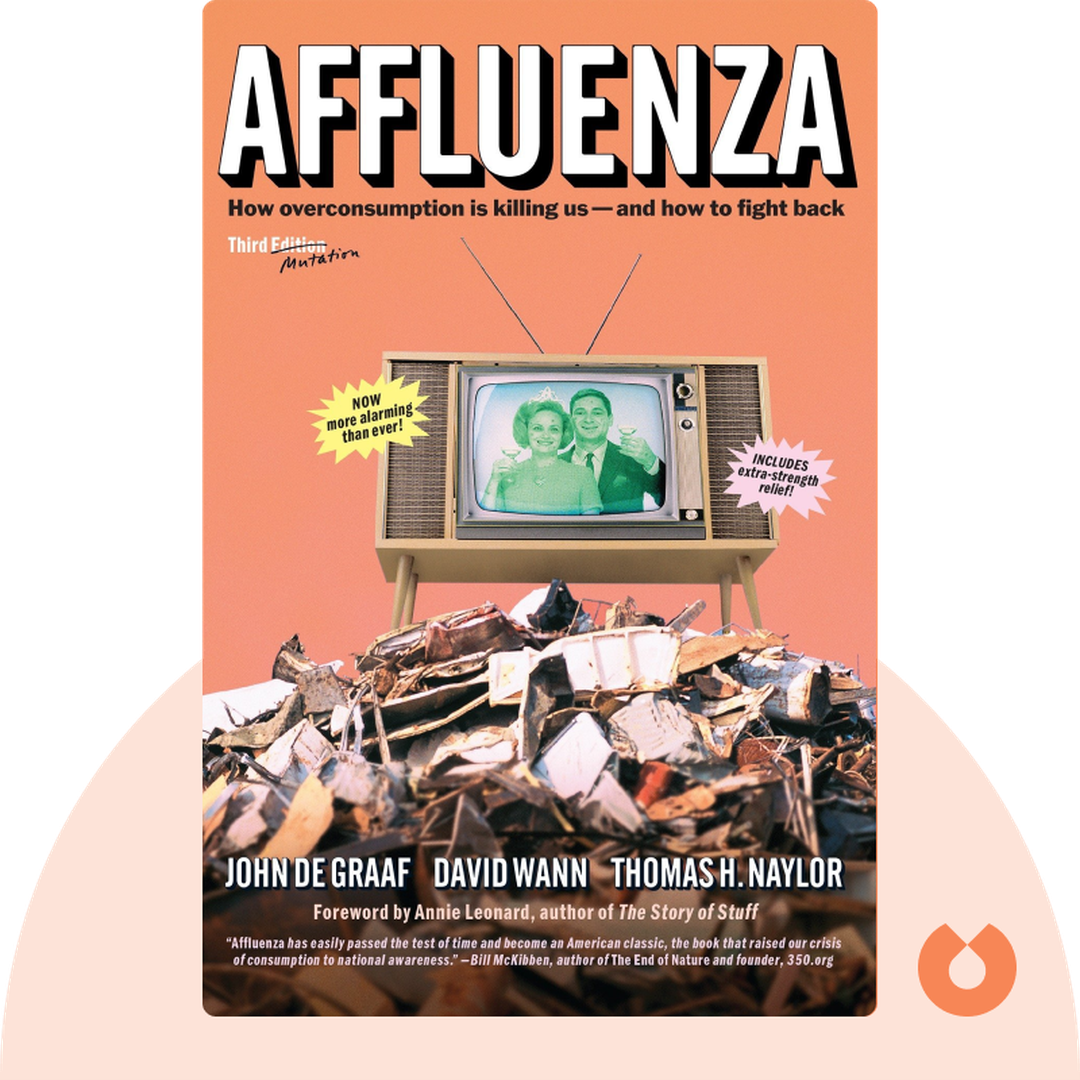
This book is about our serious addiction to consumption: affluenza. Since the Industrial Revolution, we’ve become addicted to shopping, believing we can buy happiness. Affluenza affects us and our society like a disease, and this book offers advice on how we can immunize ourselves against it.
Who Should Listen to Affluenza?
- Anyone interested in sociology
- Anyone interested in media
- Anyone interested in curing our addiction to consumption
Books Similar to Affluenza
Readers who enjoyed this also liked these titles.