If You're Curious About These Questions...
You should listen to this audiobook
- Did you know that ice is far more than just frozen water—it’s actually the silent engine that regulates our entire planet’s temperature?
- Have you ever wondered what the map of the world would look like—and how our daily lives would shift—if the Earth’s ice disappeared entirely?
- Are you curious about the critical steps we must take right now to navigate a warming climate and ensure a sustainable future for the next generation?
Listen to A World Without Ice — Free Audiobook
Loading player...
Key Takeaways from A World Without Ice
- Discover the surprising geographical differences between the North and South Poles, including why Antarctic ice is over 10,000 feet deep while Arctic ice is merely a thin, fast-moving frozen ocean.
- Understand how the unique reflective properties of polar ice act as Earth's natural cooling system, and why melting ice dangerously accelerates global warming by reflecting less solar energy away.
- Learn how a delicate one percent of natural greenhouse gases keeps our planet habitable, and how human-driven fossil fuel emissions are aggressively disrupting this vital balance.
- Explore how past ice ages functioned as massive landscape artists, wielding enough power to crush rocks, carve the Norwegian Fjords, and create thousands of Scandinavian lakes.
- Find out how scientists accurately reconstruct Earth's climate history by analyzing the chemical concentration in ancient sea shells and the thickness of historic tree rings.
Learning Tools
Reinforce what you learned from A World Without Ice
Mind Map
A World Without Ice
The Poles & Ice Properties+
Earth's Climate History+
Drivers of Climate Change+
Consequences of Melting Ice+
Mitigation and Management+
Quiz — Test Your Understanding
Question 1 of 7
What is a primary physical difference between the ice at the North Pole and the South Pole?
Question 2 of 7
How does ice play a crucial role in naturally regulating Earth's climate?
Question 3 of 7
According to the text, what would happen to Earth if the natural greenhouse effect did not exist?
Question 4 of 7
How do scientists use the chemistry of ancient sea shells to learn about past ice ages?
Question 5 of 7
What is one of the most immediate threats posed to humans by the loss of mountain glacial ice?
Question 6 of 7
Besides melting glacial water returning to the ocean, what else directly contributes to rising sea levels in a warmer world?
Question 7 of 7
Why does the author argue that some degree of climate change is ultimately unavoidable?
A World Without Ice — Full Chapter Overview
- 1Recommendation
- 2Not exactly twins: the Arctic and Antarctic are quite different.
- 3Two key forces shape our planet’s climate: ice and the greenhouse effect.
- 4Earth’s many ice ages have shaped our seas and landscapes.
- 5Scientific methods help us reconstruct past climate changes and confirm today’s global warming.
- 6Human activity has been driving climate change for centuries.
- 7Climate change has real impacts on human life today.
- 8Climate change is unavoidable, but we can learn to manage it.
- 9Final summary
A World Without Ice Summary & Overview
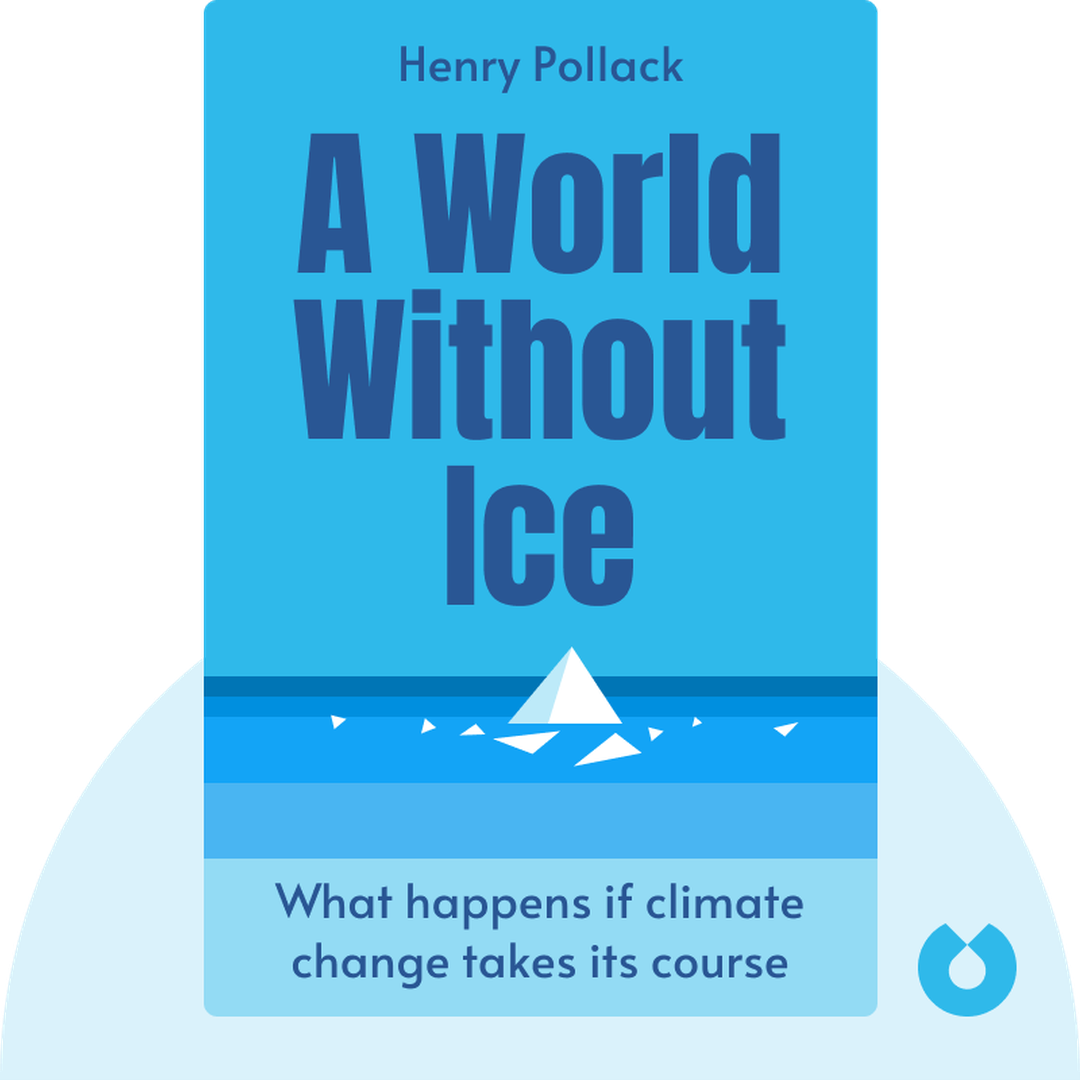
A World Without Ice (2009) is about our planet, its climate, its human residents – and ice. Ice has always been a major player in Earth’s climate. These blinks explain why we may soon see a world without ice, why that would have dramatic consequences for Earth and humans alike, and how we can cope with climate change.
Who Should Listen to A World Without Ice?
- Anyone hoping for a sustainable future on Earth
- Anyone interested in polar ice, icebergs, glacial ice and snow
- Anyone interested in geology or politics
Books Similar to A World Without Ice
Readers who enjoyed this also liked these titles.