If You're Curious About These Questions...
You should listen to this audiobook
- The title of the story is 'A Rose for Emily,' yet a physical rose never appears in the text. What does the 'rose' actually symbolize in the context of Faulkner's themes of decay and the Old South?
- After Miss Emily's funeral, townspeople discover a single strand of iron-gray hair on an indented pillow next to a decaying corpse. What chilling truth does this specific detail reveal about how Emily dealt with her sweetheart's sudden 'departure'?
- Faulkner purposefully uses a disjointed, nonlinear timeline to tell Miss Emily's story. How does this out-of-order narrative structure build suspense and mirror Emily's own tragic inability to cope with the passage of time?
Listen to A Rose for Emily — Cinematic Audio Edition
Loading player...
Key Takeaways from A Rose for Emily
- Faulkner uses a nonlinear timeline, jumping backward and forward through Miss Emily's life, to build suspense and slowly reveal the story's gruesome conclusion.
- Miss Emily Grierson serves as a tragic metaphor for the Old South, embodying an antiquated, aristocratic society that refuses to adapt to modern progress and ultimately decays.
- Homer Barron, a boisterous Northern day laborer, represents the unstoppable forces of industrialization and modernity that disrupt the traditional Southern way of life.
- Emily's extreme, violent resistance to change is foreshadowed early in the story by her three-day refusal to accept her father's death and her stubborn insistence on honoring obsolete tax agreements.
- The titular 'rose' never physically appears in the narrative; rather, the story itself acts as Faulkner's metaphorical offering of respect to a bygone, irrelevant era.
Learning Tools
Reinforce what you learned from A Rose for Emily
Mind Map
A Rose for Emily
Literary Style & Setting+
Emily as the Old South+
Denial of Death+
Homer Barron & The Murder+
The Shocking Conclusion+
Core Symbolism+
Quiz — Test Your Understanding
Question 1 of 7
How does William Faulkner's use of a nonlinear timeline serve the narrative of 'A Rose for Emily'?
Question 2 of 7
According to the text, what does Miss Emily primarily symbolize in the story?
Question 3 of 7
How does Emily react immediately after her father's death, which foreshadows her behavior at the end of the story?
Question 4 of 7
In the context of the story's metaphors, what does Homer Barron represent?
Question 5 of 7
When purchasing the arsenic, how does Emily handle the druggist's legal requirement that she provide a reason for buying poison?
Question 6 of 7
What is the significance of the single strand of iron-gray hair found on the pillow next to Homer's remains?
Question 7 of 7
Based on the provided text, what is the meaning of the title 'A Rose for Emily'?
A Rose for Emily — Full Chapter Overview
- 1Recommendation
- 2At Miss Emily’s Funeral
- 3Madness Runs in the Family
- 4What Is the Poison For?
- 5When Homer Left
- 6The Strand of Hair
- 7Final summary
A Rose for Emily Summary & Overview
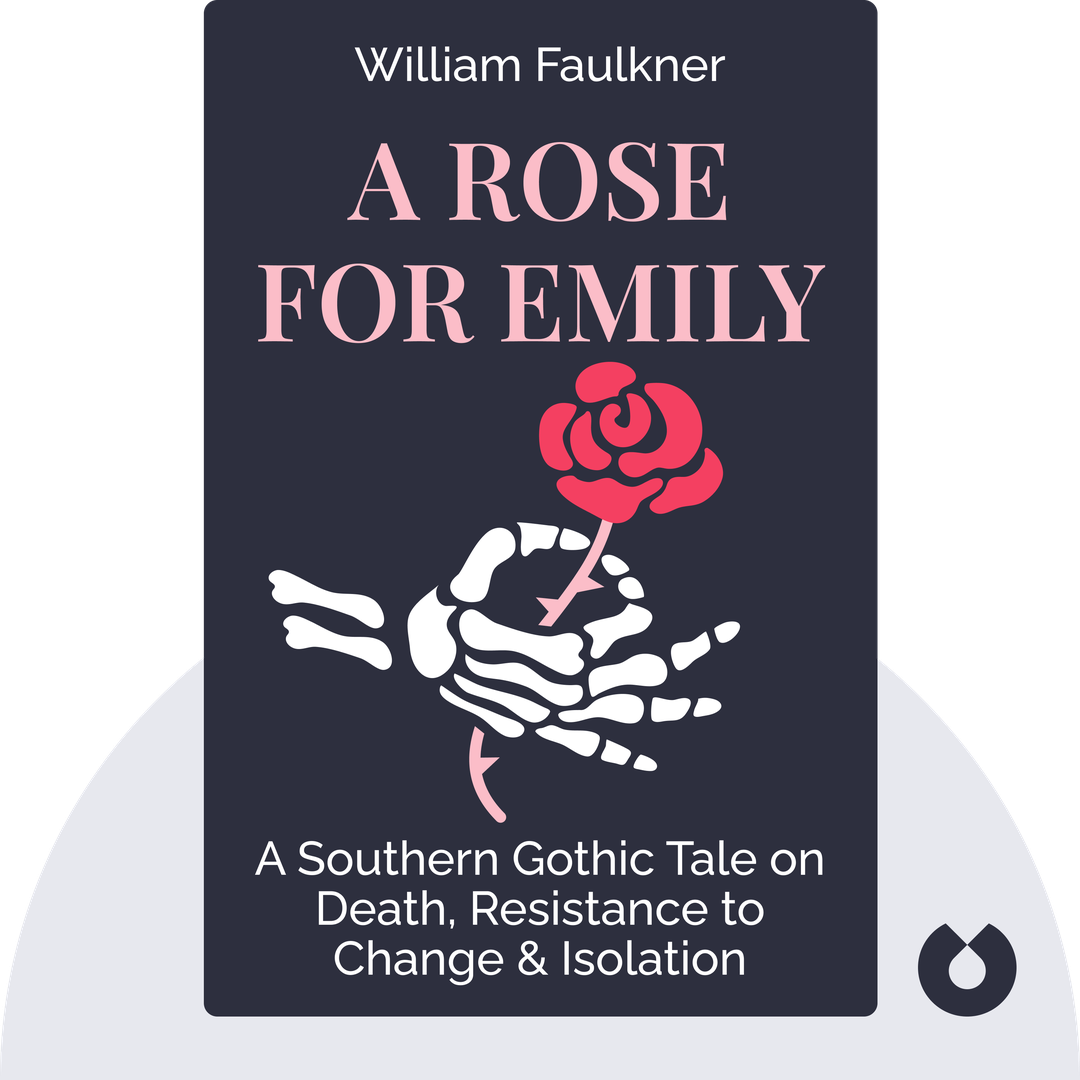
A Rose for Emily (1930) was first published in Forum magazine. Told in a nonlinear style, it starts with the funeral of Emily, a fixture in the fictional Jefferson County. It then goes back in time to trace moments of her life, and the decline in her health and status.
Who Should Listen to A Rose for Emily?
- Faulkner fans
- Lovers of Southern Gothic literature
- Anyone curious to learn more about a complex classic
Books Similar to A Rose for Emily
Readers who enjoyed this also liked these titles.