If You're Curious About These Questions...
You should listen to this audiobook
- Have you ever wondered why presenting the facts is often the least effective way to win a debate, and what you should be doing instead?
- What if you could master the same rhetorical tricks used by world-class politicians to turn any high-pressure confrontation in your favor?
- Are you curious about the ancient Greek secrets and modern neuroscientific hacks that can make your arguments virtually bulletproof?
Listen to Win Every Argument — Cinematic Audio Edition
Loading player...
Key Takeaways from Win Every Argument
- Learn how to win disputes by treating your opponent not as an enemy, but as an audience you must persuade and rally to your side.
- Master the art of instantly commanding the spotlight by opening your arguments with a provocative hook, a compelling question, or an engaging story.
- Discover why the 'Rule of Three' is a magical communication tool that adds rhythm, depth, and a powerful sense of completeness to your speeches.
- Understand how to apply verbal 'Judo Moves' like concession, preemption, and reframing to strategically use your opponent's momentum against them.
- Find out how to craft and deploy 'zingers'—short, pre-planned witty remarks—to destabilize your rival, while learning when to avoid them to protect personal relationships.
Learning Tools
Reinforce what you learned from Win Every Argument
Mind Map
Win Every Argument
The Value of Arguing+
Aristotle's Modes of Persuasion+
The Role of Emotion+
The Power of Storytelling+
Strategic Ad Hominem+
Quiz — Test Your Understanding
Question 1 of 5
What is the core philosophical and practical value of arguing, according to the text?
Question 2 of 5
According to the text, what is the most effective relationship between pathos (emotion) and logos (reason) in a debate?
Question 3 of 5
What did neuroscientist Antonio Damasio conclude about people who suffered damage to the emotional processing centers of their brains?
Question 4 of 5
Based on Deborah Small's study mentioned in the text, why are people more likely to donate to a charity when told a story about a single, identifiable child?
Question 5 of 5
How does Mehdi Hasan view the use of ad hominem (attacking the person) arguments in a debate?
Win Every Argument — Full Chapter Overview
- 1Recommendation
- 2Persuasive arguments engage both facts and feelings
- 3If you hope to persuade people, tell stories
- 4Sometimes it’s fine to play the man, not the ball
Win Every Argument Summary & Overview
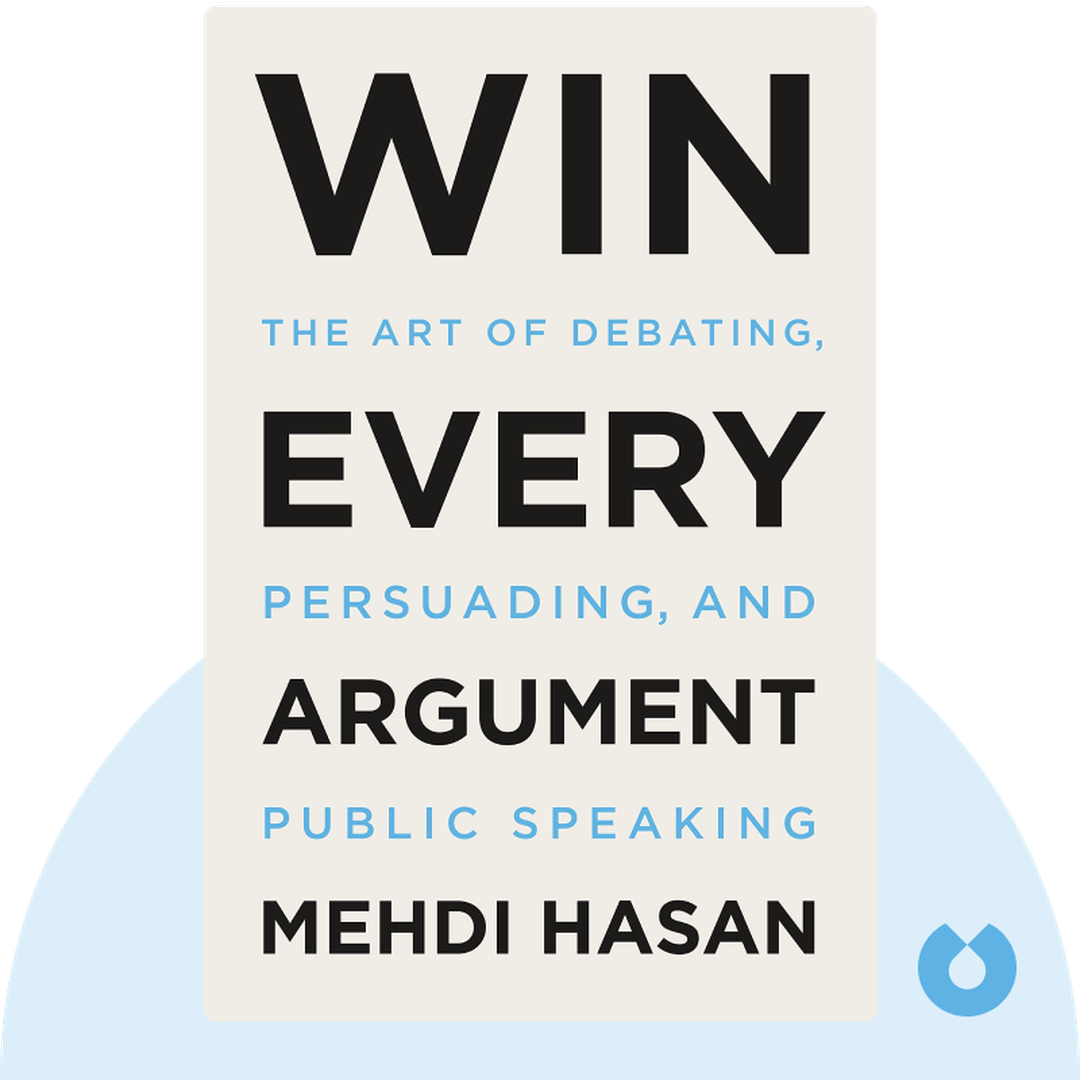
Win Every Argument (2023) is a guide to the art of argument by one of the world’s most combative debaters: journalist, anchor, and writer Mehdi Hasan. Drawing on ancient theories of persuasion, neuroscientific theories of cognition, and the rhetorical tricks of contemporary politicians, Hasan reveals the secrets to winning arguments in today’s post-factual world.
Who Should Listen to Win Every Argument?
- Natural-born arguers and debaters
- Anyone interested in the art of persuasion
- Public speakers and politicos
Books Similar to Win Every Argument
Readers who enjoyed this also liked these titles.