If You're Curious About These Questions...
You should listen to this audiobook
- Did you know that the initial design for one of the world’s most vital vaccines was completed in just a few short days, long before the virus had even been declared a global pandemic?
- Have you ever wondered what it’s truly like to lead a high-stakes race against time while the entire world watches—and critiques—your every move in the lab?
- What’s the secret to condensing a decade’s worth of vaccine development into less than a year, and how could this breakthrough prepare us for the next 'Disease X'?
Listen to Vaxxers — Free Audiobook
Loading player...
Key Takeaways from Vaxxers
- Discover how years of prior research on viral outbreaks like SARS, MERS, and Ebola laid the essential groundwork for the rapid development of the COVID-19 vaccine.
- Understand how global health organizations learned from the shortcomings of past crises like the 2014 Ebola outbreak to better prioritize and prepare for future pandemics.
- Learn how scientists safely engineered a chimpanzee adenovirus to create a specialized vaccine vector that teaches the human body to fight viruses without causing sickness.
- Explore the concept of vaccine 'platform technology,' a predesigned scientific framework that allows researchers to rapidly customize and produce vaccines for newly emerging diseases.
- Find out why the Oxford-AstraZeneca COVID-19 vaccine was developed safely in record time by seeing how an earlier MERS vaccine served as its direct, ready-to-use blueprint.
Learning Tools
Reinforce what you learned from Vaxxers
Mind Map
Vaxxers
Foundation & Preparation+
ChAdOx1 Vaccine Technology+
Rapid COVID-19 Development+
Scaling & Distribution+
Rigorous Clinical Testing+
Preparing for Disease Y+
Quiz — Test Your Understanding
Question 1 of 7
Why was a vaccine for the 2002 SARS outbreak never fully developed and distributed?
Question 2 of 7
What is the primary advantage of the 'platform technology' (like the ChAdOx1 framework) developed by the Oxford scientists?
Question 3 of 7
How were the Oxford scientists able to design the exact DNA sequence for the COVID-19 vaccine in less than two days?
Question 4 of 7
In the context of the Oxford COVID-19 vaccine's development, what did it mean for the scientists to proceed 'at risk'?
Question 5 of 7
Aside from the scale of manufacturing, what was a major logistical advantage of the Oxford-AstraZeneca vaccine compared to many other COVID-19 vaccines?
Question 6 of 7
What was the primary purpose of conducting animal trials for the COVID-19 vaccine before moving to human trials?
Question 7 of 7
According to the book's conclusion, which of the following is identified as a potential source for 'Disease Y' (a future hypothetical virus)?
Vaxxers — Full Chapter Overview
- 1Recommendation
- 2Scientists had been studying viral outbreaks and creating vaccines long before COVID-19 emerged.
- 3Progress on an Ebola vaccine opened the door to more advanced vaccine technology.
- 4The ChAdOx1 MERS vaccine became the model for the SARS-CoV-2 vaccine.
- 5Moving from one step to the next “at risk” dramatically shortened the timeline for creating the COVID-19 vaccine.
- 6Teaming up with AstraZeneca and others delivered the money and infrastructure to produce hundreds of millions of vaccine doses.
- 7Careful, extensive trials guaranteed the vaccine was safe and effective before it reached the public.
- 8To get ready for Disease Y, the world must strengthen research and manufacturing, public health systems, and global collaboration.
Vaxxers Summary & Overview
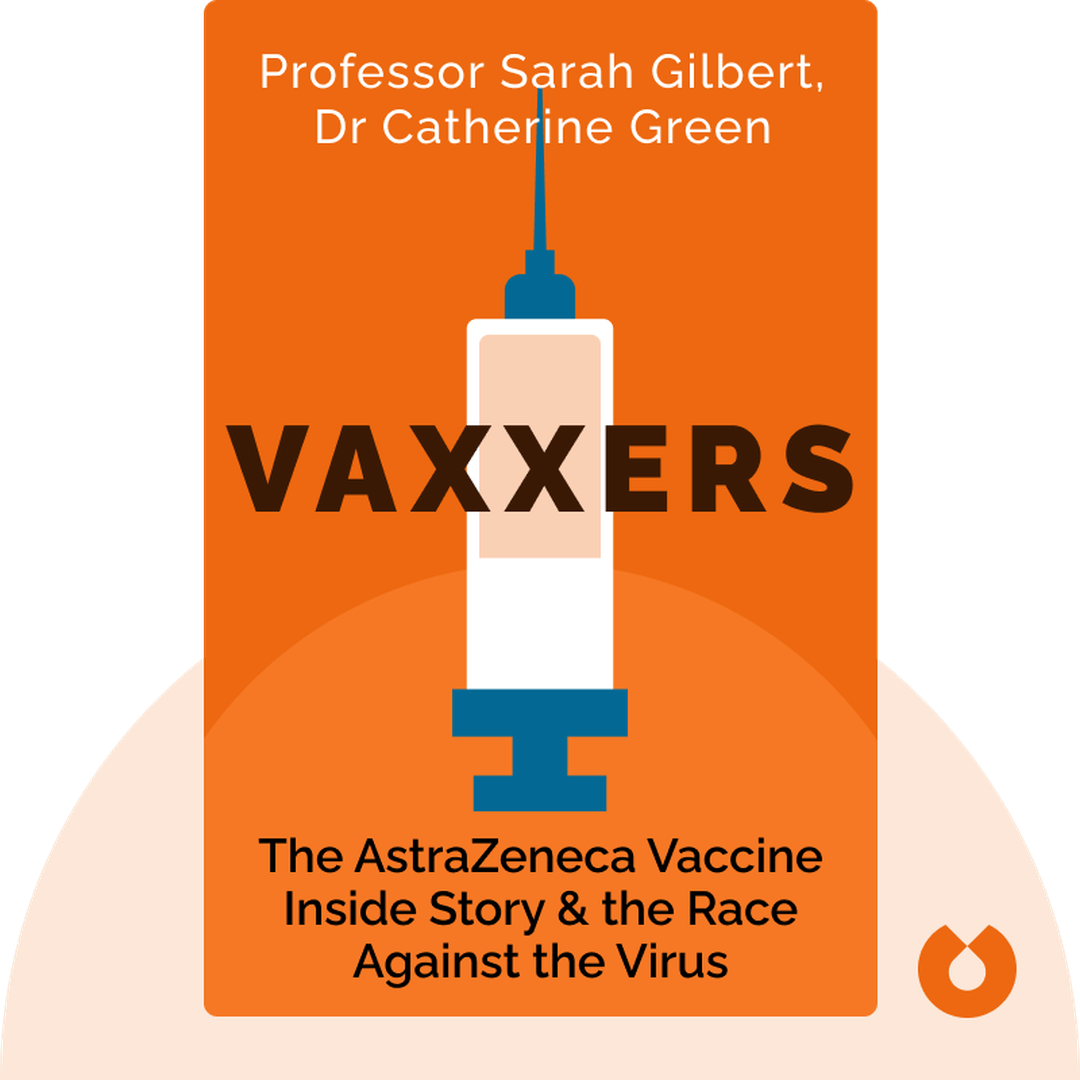
Vaxxers (2021) follows the race to develop a functional vaccine to curb the spread of the COVID-19 virus. Professor Sarah Gilbert and Dr. Catherine Green, of the University of Oxford, deliver captivating and informative insight into the process of designing, testing, and manufacturing the Oxford-AstraZeneca vaccine in record time. They recount exciting moments of innovation, as well as the hurdles faced along the way.
Who Should Listen to Vaxxers?
- Anyone fascinated by vaccine development
- Public health enthusiasts
- Futurists looking to prepare for the next big pandemic
Books Similar to Vaxxers
Readers who enjoyed this also liked these titles.