If You're Curious About These Questions...
You should listen to this audiobook
- Have you ever wondered why we feel more connected through our screens yet more isolated and angry in our actual communities?
- Did you know that a hidden 'loneliness epidemic' might be the real engine driving our country’s most intense political hostilities?
- What's the secret to moving past the 'us versus them' mentality and finding a true sense of belonging in a fractured world?
Listen to Them — Free Audiobook
Loading player...
Key Takeaways from Them
- Explore the devastating consequences of an extreme 'us-versus-them' mentality and see how media and institutions are stoking rage across American communities.
- Discover how the human brain processes social rejection just like physical pain, leading to severe long-term health issues like weakened immune systems and accelerated aging.
- Understand why adult men are uniquely vulnerable to the fatal consequences of loneliness, as they tend to stop building new social networks after marriage and career advancement.
- Learn how the rapid shift toward freelance work and the impending automation of driving jobs threaten to destroy the close-knit communities traditionally built in the workplace.
- Recognize why today's constant stream of smartphone notifications and 24/7 news cycles fail to provide the in-depth analysis necessary to make well-informed civic decisions.
Learning Tools
Reinforce what you learned from Them
Mind Map
Them
The Epidemic of Loneliness+
Collapse of Community Work+
Broken Media Landscape+
Campus Intolerance+
Rebuilding the American Team+
Quiz — Test Your Understanding
Question 1 of 7
Why are men considered particularly at risk for loneliness compared to women, according to the text?
Question 2 of 7
What major technological advancement does the author warn could devastate American communities in a way similar to the collapse of the Appalachian coal sector?
Question 3 of 7
How does the author characterize the shift in news consumption brought about by television and Twitter?
Question 4 of 7
What is the media tactic referred to as 'nutpicking'?
Question 5 of 7
According to sociological research mentioned in the text, why do viewers continue to tune into anger-driven news programs despite knowing they are unproductive?
Question 6 of 7
Why does the author argue that the creation of 'safe spaces' on university campuses is deeply un-American?
Question 7 of 7
What is one of the key steps the author suggests Americans take to help the country 'play as a national team again'?
Them — Full Chapter Overview
- 1Recommendation
- 2Loneliness kills, and men face especially high risk.
- 3American jobs are more fragile than ever, endangering communities.
- 4Today’s news is mostly trivial and badly oversimplified.
- 5Pundits spotlight fools to help Americans invent enemies.
- 6US campuses now nurture intolerance and self-sorting.
- 7Every citizen can help America act like one national team again.
Them Summary & Overview
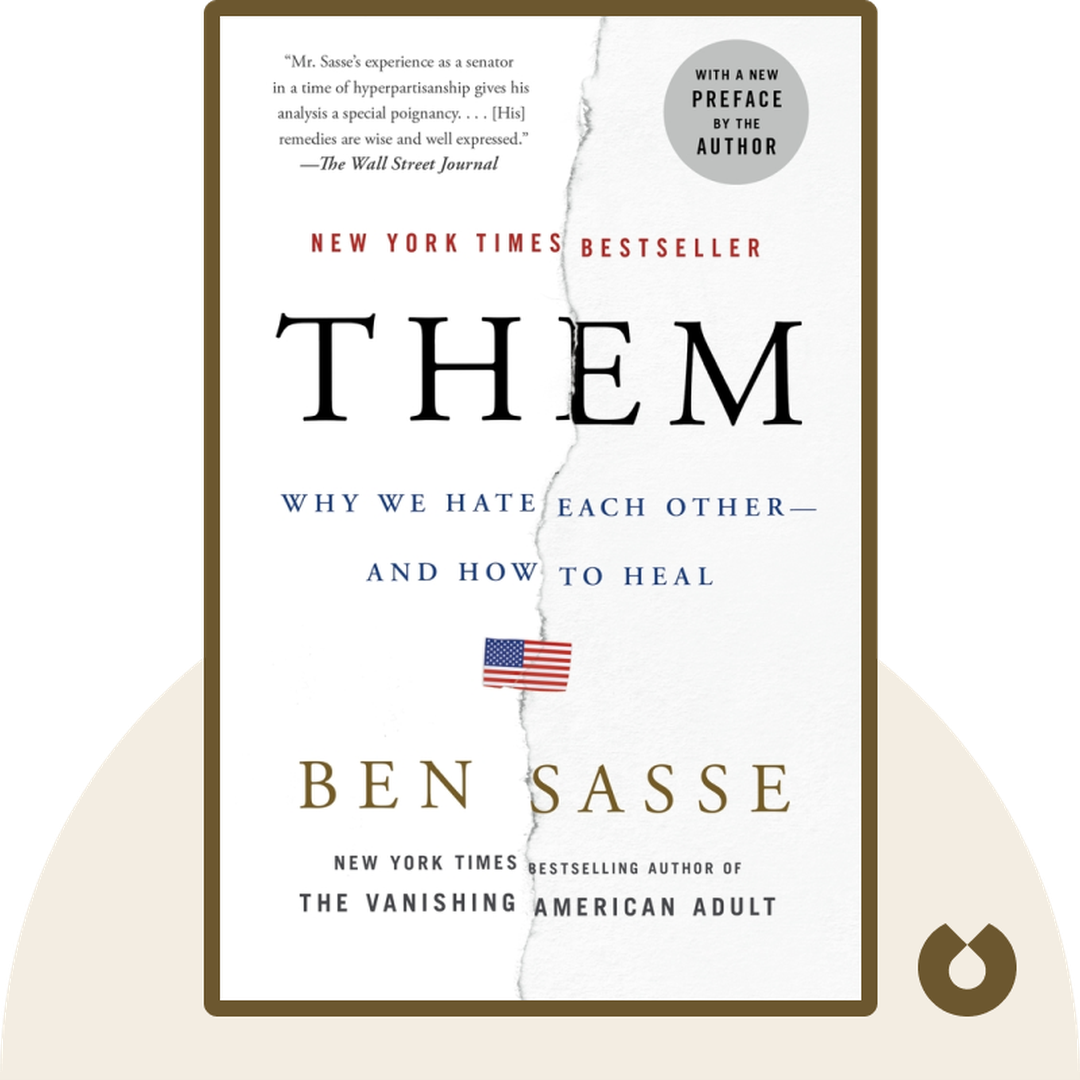
Them (2018) explores the social, political and economic challenges facing the United States of America. Drawing on insights from psychology, politics and contemporary media, the blinks investigate the current climate of hostility in public life and explains how Americans can get back to a more harmonious way of life.
Who Should Listen to Them?
- Political animals looking for a fresh perspective
- Democrats open to listening to the other side
- Current-affairs junkies wanting new insights
Books Similar to Them
Readers who enjoyed this also liked these titles.