If You're Curious About These Questions...
You should listen to this audiobook
- Have you ever wondered how a legendary navigator known for his precision and calm could unravel so spectacularly during his final, most dangerous voyage?
- Did you know that the high-stakes search for a fabled shortcut through the ice would lead to discoveries that forever altered the map of the world—and sealed the fate of its explorer?
- Are you curious about the hidden tensions and cultural misunderstandings that turned a mission of scientific discovery into a tragic flashpoint of history?
Listen to The Wide Wide Sea — Free Audiobook
Loading player...
Key Takeaways from The Wide Wide Sea
- Understand the dual legacy of Captain James Cook's third voyage, which achieved monumental feats in cartography while heralding the devastating impacts of European colonization on Indigenous Pacific cultures.
- Discover how Cook transformed maritime exploration by pioneering the use of the marine chronometer for accurate mapping and implementing early medical interventions to prevent scurvy.
- Uncover the hidden commercial motives behind Cook's final expedition, which was secretly tasked by the British Admiralty to find the Northwest Passage from the Pacific side.
- Learn how Cook demonstrated remarkable cultural empathy and leadership by choosing peace and de-escalation over revenge when investigating the killing of his former crewmen by a Māori tribe.
- Follow the tragic, real-life story of Mai to see firsthand the unintended consequences of European contact, as a Polynesian man's triumphant return home ends in cultural displacement and early death.
Learning Tools
Reinforce what you learned from The Wide Wide Sea
Mind Map
The Wide Wide Sea
Complex Legacy+
Captain Cook's Profile+
The Third Voyage (1776)+
Cultural Encounters+
Arctic Exploration+
Tragedy in Hawaii+
Aftermath & Return+
Quiz — Test Your Understanding
Question 1 of 8
What was the primary, somewhat secret strategic goal of Captain Cook’s third voyage?
Question 2 of 8
Why was the young Polynesian man named Mai traveling aboard Cook’s ship?
Question 3 of 8
How did Captain Cook respond when he investigated the Māori chief Kahura, who had led a massacre against English sailors on a previous voyage?
Question 4 of 8
What significant realization did Cook have upon encountering the people of the Hawaiian Islands?
Question 5 of 8
What erroneous scientific theory, championed by Lord Sandwich, was disproven during the expedition's time in the Arctic?
Question 6 of 8
What specific action by Captain Cook directly precipitated the violent skirmish that resulted in his death in Hawaii?
Question 7 of 8
Which of the following best describes the fate of the expedition's leadership after Captain Cook's death?
Question 8 of 8
According to the book's summary, how has the modern historical view of Captain Cook shifted?
The Wide Wide Sea — Full Chapter Overview
- 1Recommendation
- 2The glory of Great Britain
- 3A questionable plan
- 4A complex return home
- 5An unanticipated visit
- 6An elusive route
- 7The killing of Captain Cook
- 8A crew returns without its captains
The Wide Wide Sea Summary & Overview
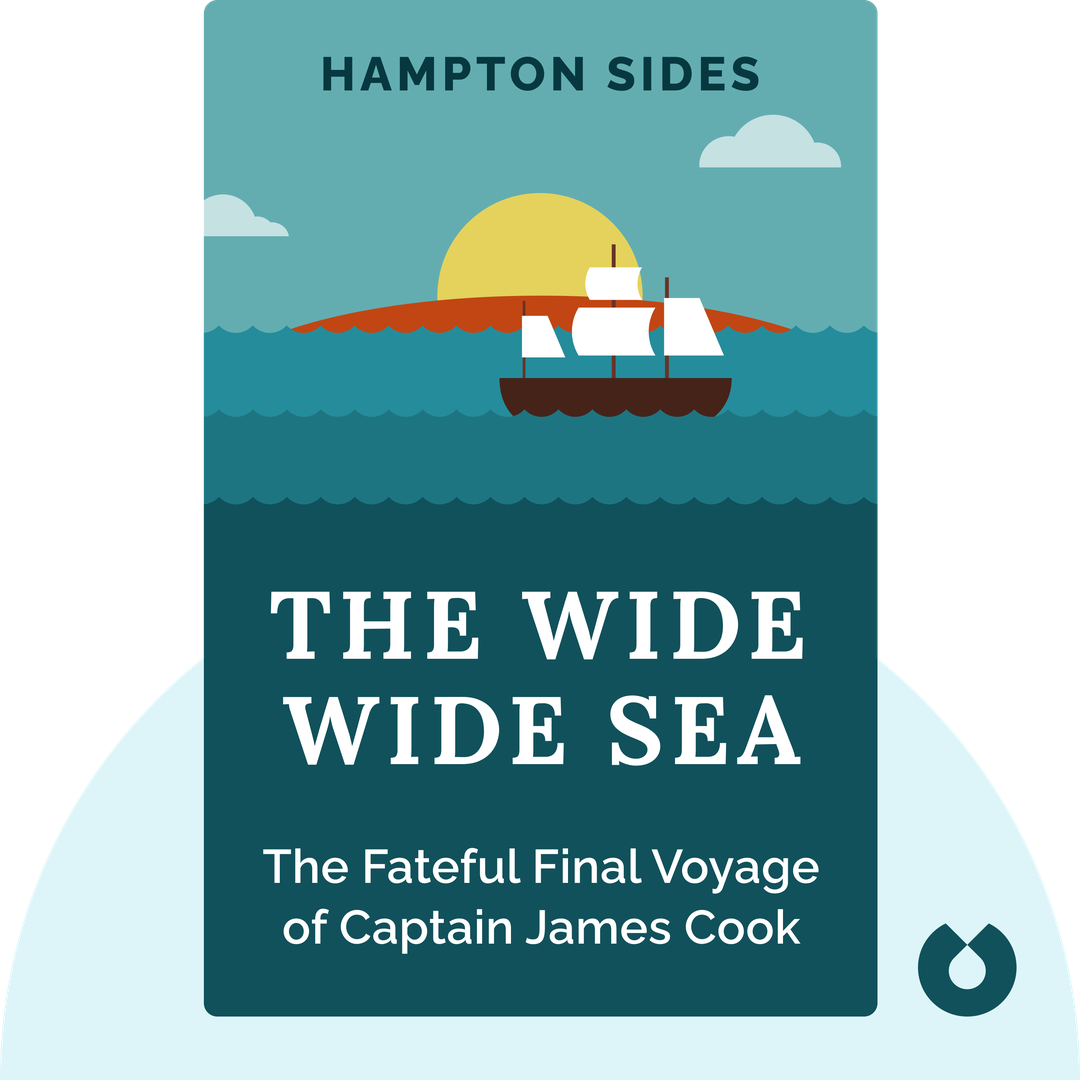
The Wide Wide Sea (2024) recounts the final expedition of Captain James Cook, the legendary European “first navigator.” His exploration of a vast uncharted sea led to amazing discovery as well as tragedy. It encapsulates the thrills of scientific advancement while also revealing the perils of colonization.
Who Should Listen to The Wide Wide Sea?
- History enthusiasts
- Adventure seekers
- People interested in cross-cultural encounters
Books Similar to The Wide Wide Sea
Readers who enjoyed this also liked these titles.