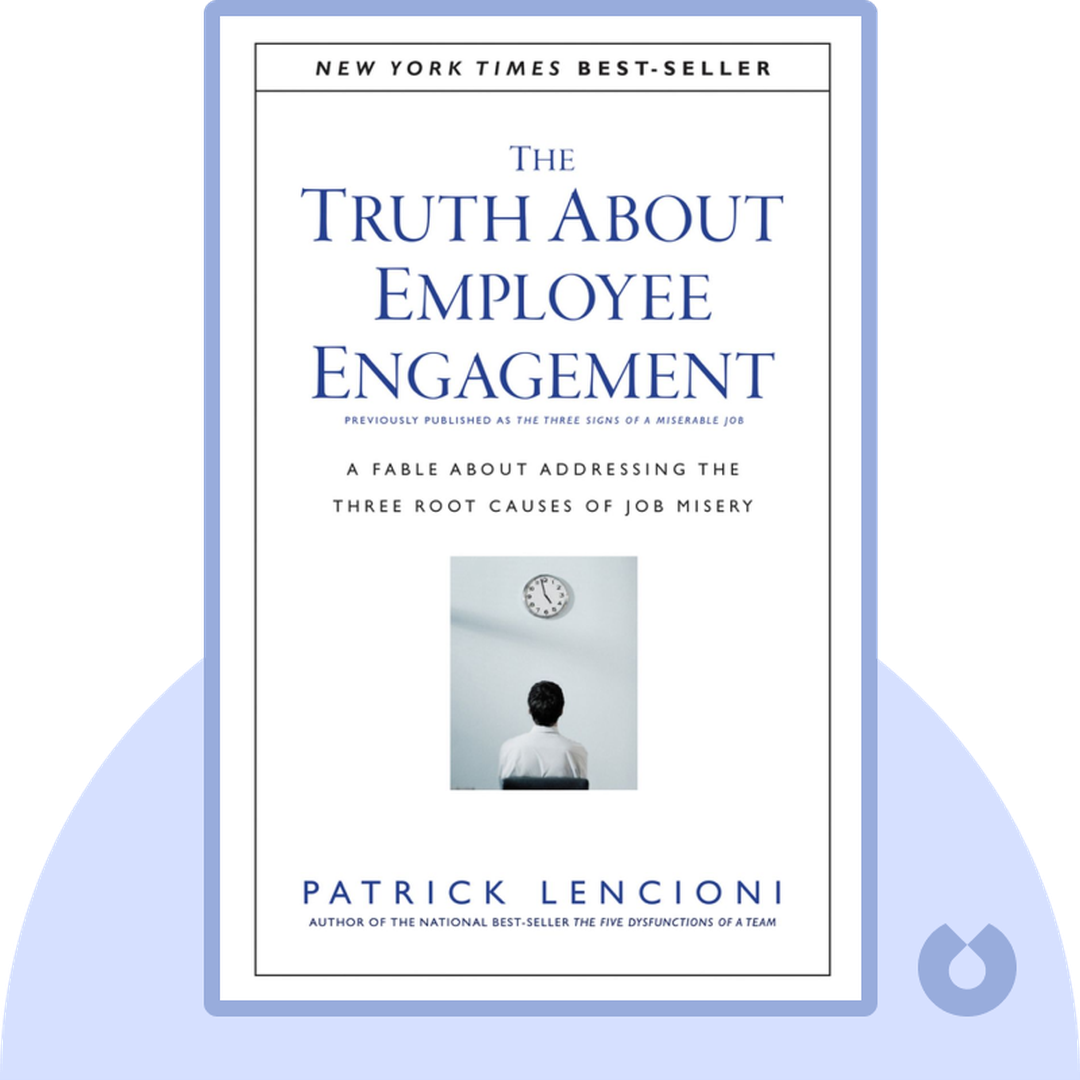
The Truth About Employee Engagement
Start ListeningDownload Try free on iPhoneScan to start in 5 seconds
Categories:
If You're Curious About These Questions...
You should listen to this audiobook
- Did you know there are three specific, hidden factors that can make any job—from CEO to entry-level—feel utterly miserable?
- Have you ever wondered why some employees stay motivated and happy while others with the same salary and perks feel completely disconnected?
- What if you could turn even the most mundane task into a source of genuine satisfaction and meaning using a simple management framework?
Listen to The Truth About Employee Engagement — Cinematic Audio Edition
Loading player...
Key Takeaways from The Truth About Employee Engagement
- Understand why salary and job titles alone cannot guarantee job satisfaction, and how workplace misery negatively impacts both company efficiency and personal well-being.
- Discover the three root causes of job misery—anonymity, irrelevance, and immeasurement—and how they can drain motivation from anyone, regardless of their rank.
- Learn how to foster employee loyalty and boost productivity by creating a workplace culture that prioritizes personal development rather than just focusing on financial incentives.
- Find out how to eliminate the deep-seated fear of irrelevance by consistently identifying exactly who your work is helping.
- Master the awkward but essential skill of emotional communication as a manager to break down workplace barriers and keep your team actively engaged.
Learning Tools
Reinforce what you learned from The Truth About Employee Engagement
Mind Map
The Truth About Employee Engagement
The Cost of Job Misery+
Three Root Causes of Misery+
Solving Anonymity+
Solving Irrelevance+
Solving Immeasurement+
Manager as Servant+
Actionable Advice for Employees+
Quiz — Test Your Understanding
Question 1 of 8
According to the text, what is a less obvious consequence of an employee being miserable at their job?
Question 2 of 8
What is the root cause of job misery described by Lencioni as 'anonymity'?
Question 3 of 8
How does the book define the problem of 'irrelevance' in the workplace?
Question 4 of 8
Why is it detrimental to measure an employee's success solely based on how happy their superior is with their work?
Question 5 of 8
What is identified as the main obstacle employers face when trying to increase employee engagement?
Question 6 of 8
How does the book suggest a hotel worker delivering breakfast trays can find more satisfaction in their task?
Question 7 of 8
According to the text, how should the concept of 'service' be viewed in a corporate organization?
Question 8 of 8
What actionable advice does the author give to job-seekers during the interview stage?
The Truth About Employee Engagement — Full Chapter Overview
- 1Recommendation
- 2Job fulfillment isn’t determined by pay alone, and unhappy employees impose significant costs on their companies.
- 3Three root causes of job misery exist, and they can affect anyone anywhere.
- 4Boosting employee engagement brings benefits, but there are obstacles to overcome.
- 5Employers must know their people and make clear what those employees contribute each day.
- 6Employees must know precisely what they contribute and possess a reliable method for measuring it over time.
- 7A box boy’s job or a star athlete’s career can both be made more meaningful for them.
- 8Managers ought to serve their employees; simple, practical steps are available to managers to do so.
The Truth About Employee Engagement Summary & Overview
The Truth About Employee Engagement (2007) tells you how to turn any type of job from miserable to meaningful. Using three key tips, you’ll find joy and satisfaction in your work. The blinks offer guidance for employers on creating an environment in which employees can thrive, and advice for job seekers on how to find the job that will be the perfect fit for them.
Who Should Listen to The Truth About Employee Engagement?
- Managers who want to motivate their employees
- Employees seeking to improve their work experience
- Job seekers looking for more than a paycheck
Books Similar to The Truth About Employee Engagement
Readers who enjoyed this also liked these titles.