If You're Curious About These Questions...
You should listen to this audiobook
- Have you ever wondered why a handful of specific people hold the secret power to turn a small idea into a global trend almost overnight?
- What if you could trigger a massive social epidemic by making just one tiny, counterintuitive change to the way you present your message?
- Did you know that the difference between a total flop and a viral sensation often comes down to a single, hidden 'tipping point' that anyone can learn to trigger?
Listen to The Tipping Point — Free Audiobook
Loading player...
Key Takeaways from The Tipping Point
- Understand how social epidemics reach a dramatic 'tipping point' where minor, rapid changes suddenly transform unknown ideas into viral trends.
- Discover the three key factors that drive massive change in business and society: the Law of the Few, the Stickiness Factor, and the Power of Context.
- Learn the crucial roles of Connectors, Mavens, and Salesmen, and see how these three unique types of people turn simple messages into powerful word-of-mouth phenomena.
- Master the art of creating memorable messages by making small, seemingly trivial adjustments that ensure your ideas stick in your audience's minds.
- Recognize the profound impact of context and environment on human behavior, revealing how minor shifts in a setting can rapidly accelerate the spread of an idea.
Learning Tools
Reinforce what you learned from The Tipping Point
Mind Map
The Tipping Point
The Epidemic Nature of Ideas+
The Law of the Few+
The Stickiness Factor+
The Power of Context+
Quiz — Test Your Understanding
Question 1 of 9
What defines the 'Tipping Point' in the context of social epidemics?
Question 2 of 9
How does the 80-20 Rule apply to the spread of social epidemics?
Question 3 of 9
According to the text, what is the most valuable asset of a 'Connector'?
Question 4 of 9
What is a key characteristic of 'Salesmen' that helps them persuade others?
Question 5 of 9
How do 'Mavens' primarily differ from 'Connectors'?
Question 6 of 9
What lesson about 'stickiness' can be learned from the success of Sesame Street and Winston cigarettes?
Question 7 of 9
What did the study involving students and a collapsed man demonstrate about human behavior?
Question 8 of 9
How did New York City authorities successfully reverse the crime epidemic in the mid-1990s?
Question 9 of 9
What is the significance of the 'Rule of 150' in creating social epidemics?
The Tipping Point — Full Chapter Overview
- 1Recommendation
- 2Only after crossing the Tipping Point threshold does it become a true epidemic.
- 3Often, a select few key people spark the onset of epidemics.
- 4Ideas spread particularly fast with Connectors, people with a vast personal social network.
- 5Some individuals are born with persuasive gifts and an innate knack for brilliantly selling ideas.
- 6In every network, Mavens gather information and willingly pass it along to others around them.
- 7An idea must stick before it can truly spread.
- 8External circumstances have far greater influence on our behavior than we often think.
- 9Even the tiniest changes in context can determine whether an epidemic truly takes off.
The Tipping Point Summary & Overview
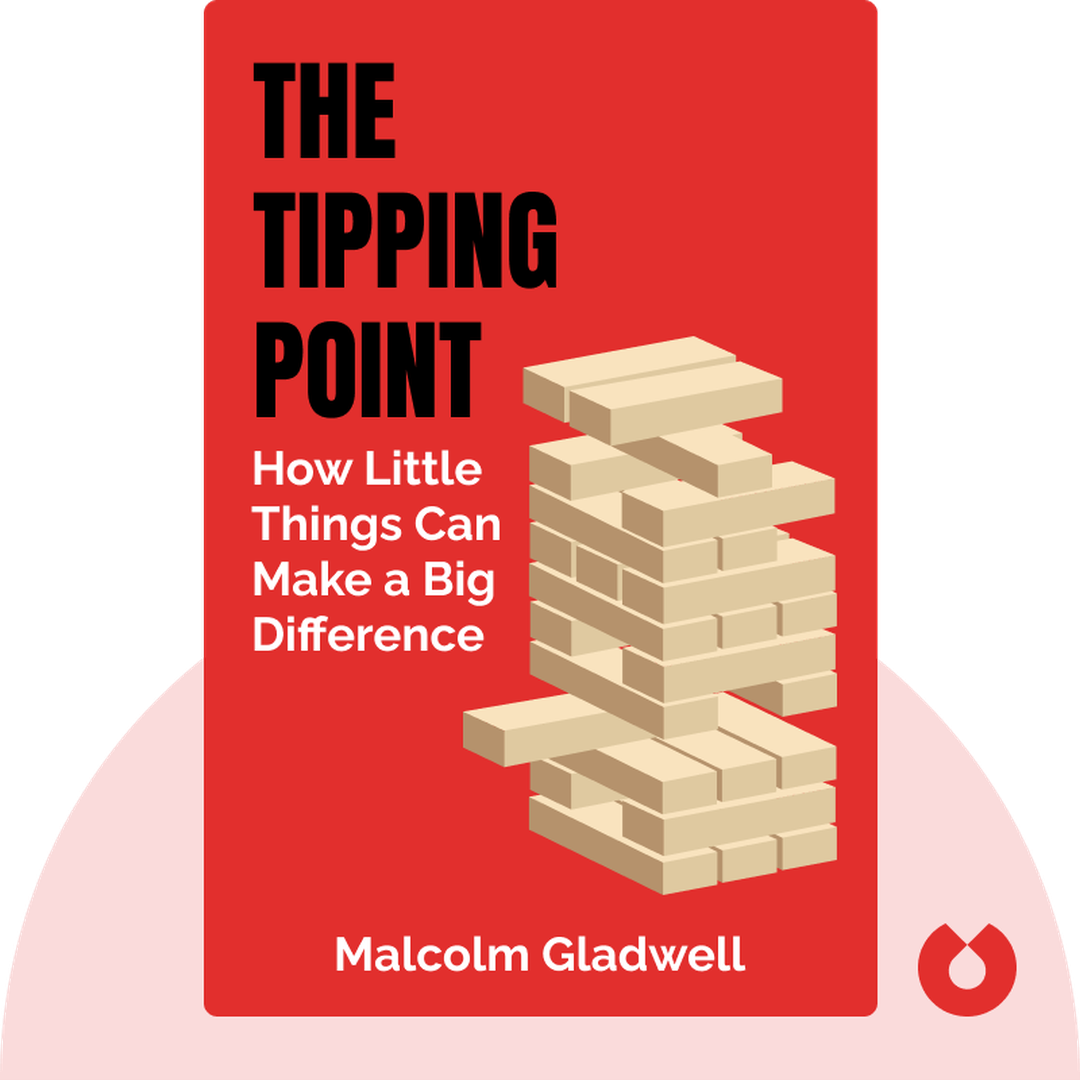
The Tipping Point discusses why certain ideas, products and behaviors spread like epidemics and what we can do to consciously trigger and have control over such epidemics.
Who Should Listen to The Tipping Point?
- Anyone who is interested in the way ideas spread
- Anyone who wants to learn how social epidemics break out
- Anyone who works in marketing, advertising or a related field
Books Similar to The Tipping Point
Readers who enjoyed this also liked these titles.