If You're Curious About These Questions...
You should listen to this audiobook
- Have you ever wondered if you’re actually just a highly sophisticated 'survival machine' built to protect and preserve something far more ancient than yourself?
- Did you know that even the most selfless acts of kindness in the animal kingdom might actually be driven by the cold, calculated 'selfishness' of genes?
- Are you curious about how a simple shift in perspective—from the individual to the gene—can suddenly explain the most mysterious behaviors in the natural world?
Listen to The Selfish Gene — Cinematic Audio Edition
Loading player...
Key Takeaways from The Selfish Gene
- Understand how viewing evolution through a gene-centered lens explains biological behavior without invalidating human experiences like love and meaning.
- Discover why natural selection acts as a quiet filter where 'survival of the fittest' means being best suited to the environment, not necessarily the strongest.
- Learn how seemingly selfless acts, such as a mother protecting her child, carry an underlying biological logic designed to ensure shared DNA persists into the future.
- Explore the crucial role of copying mistakes in the origin of life, and how these genetic mutations create the essential variations required for natural selection.
- Find out how early replicating molecules built biological bodies as 'survival machines,' programming them much like computers to protect and pass on their genetic code.
Learning Tools
Reinforce what you learned from The Selfish Gene
Mind Map
The Selfish Gene
Mechanics of Evolution+
Phenotypes & Environments+
Organisms as Survival Machines+
Behavioral Strategies+
The Illusion of Altruism+
Memes & Cultural Evolution+
Overcoming Genetic Selfishness+
Quiz — Test Your Understanding
Question 1 of 8
Why does Dawkins argue that the gene, rather than the individual organism, is the basic unit of evolution?
Question 2 of 8
According to the text, why is a gene considered 'selfish' by definition?
Question 3 of 8
How is a gene's 'phenotype' defined in the context of the book?
Question 4 of 8
If genes are fundamentally selfish, why do tens of thousands of them cooperate to build complex organisms like human bodies?
Question 5 of 8
In the example of behavioral strategies, why is the 'Retaliator' considered an evolutionarily stable strategy compared to 'Hawks' or 'Doves'?
Question 6 of 8
How does the 'selfish gene' theory explain apparent altruism, such as a mother bird feigning a broken wing to protect her young?
Question 7 of 8
What is a 'meme' as described in the text?
Question 8 of 8
According to the text, what unique capability allows humans to potentially overcome the downsides of biological gene selfishness?
The Selfish Gene — Full Chapter Overview
- 1Recommendation
- 2The basic unit of evolution is the gene, because it can exist as many copies and is therefore almost immortal.
- 3Genes are selfish by nature: their success in surviving comes at the cost of other genes.
- 4A gene’s phenotype – how its code shows up in its environment – determines whether it survives.
- 5A gene’s survival success depends on its specific environment – both physical and genetic.
- 6Organisms are machines assembled by groups of genes that cooperate only because they share reproduction.
- 7Genes design the brains they create with behavioral strategies that support their survival.
- 8Competition between strategies produces a stable behavior pattern within a population.
- 9The selfish drive of genes to survive accounts for seemingly altruistic acts like parental care.
- 10Mutually altruistic behaviors often succeed because they help the host’s genes more than pure selfishness does.
- 11Human culture also evolves, and its fundamental unit is the meme.
- 12Conscious human foresight can enable us to rise above the harms of selfish genes.
The Selfish Gene Summary & Overview
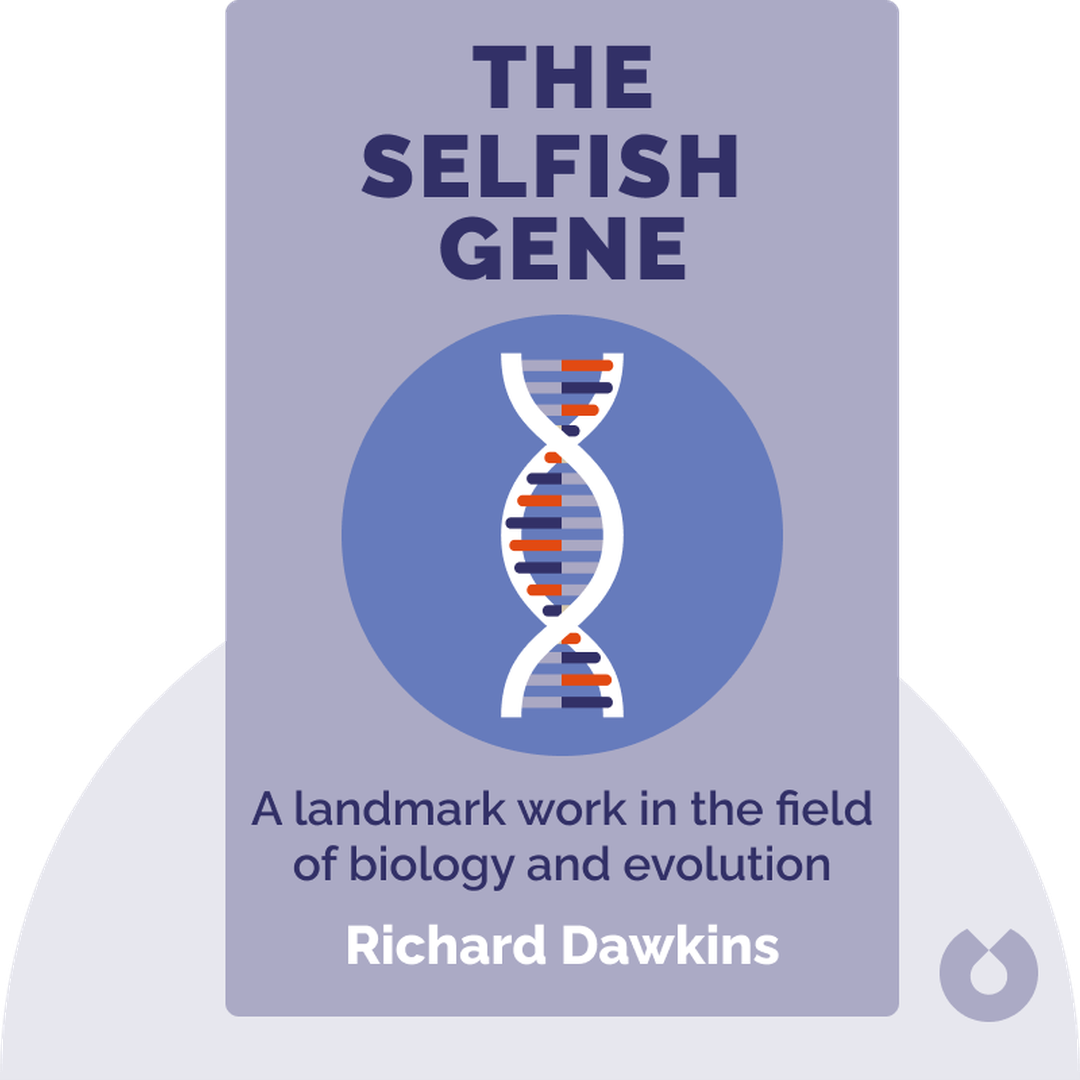
The Selfish Gene is a landmark 1976 work in the field of biology: It puts the gene at the center of the process of evolution and explains how, when this is taken into account, genes must be seen as “selfish.” Author Richard Dawkins then uses this theory of gene selfishness to explain the massive variety of animal behavior observable on Earth.
Who Should Listen to The Selfish Gene?
- ‘Everyone interested in the universe and their place in it.’
- Any student of biology or anyone with an interest in biology
Books Similar to The Selfish Gene
Readers who enjoyed this also liked these titles.