Theme Song
If You're Curious About These Questions...
You should listen to this audiobook
- Have you ever wondered why man has historically been treated as the universal standard of humanity while woman is defined only as his secondary 'Other'?
- Did you know that according to one of history's greatest philosophers, one is not born a woman, but rather becomes one through social conditioning?
- Are you curious about the specific biological and historical myths that have been used for centuries to justify the subjugation of the 'second sex'?
Listen to The Second Sex — Cinematic Audio Edition
Loading player...
Key Takeaways from The Second Sex
- Understand the foundational feminist concept that womanhood is a cultural construct rather than an innate quality, historically positioning women as the passive 'Other'.
- Explore the opposing concepts of 'immanence' and 'transcendence' to see how society confined women to a static existence while encouraging men to actively conquer the world.
- Discover why biological differences and early psychological theories fail to justify gender inequality, as they mistakenly treat the male perspective as the default norm.
- Learn how human history transitioned from early matriarchal societies that revered female fertility to patriarchal systems that systematically stripped away women's power.
- Find out how the historical development of private property, inheritance laws, and marriage dehumanized women by turning them into controllable familial assets.
Learning Tools
Reinforce what you learned from The Second Sex
Mind Map
The Second Sex
Core Philosophy+
Debunking Justifications+
Historical Subjugation+
Cultural & Religious Forces+
Becoming 'Woman'+
Mechanisms of Oppression+
The Path to Liberation+
Quiz — Test Your Understanding
Question 1 of 10
What is the central thesis of Simone de Beauvoir's 'The Second Sex' regarding womanhood?
Question 2 of 10
How does de Beauvoir define the concepts of 'immanence' and 'transcendence'?
Question 3 of 10
Why does de Beauvoir reject Sigmund Freud's theory of 'penis envy' as an explanation for gender inequality?
Question 4 of 10
According to the text, how did the transition from communal to private property affect the status of women?
Question 5 of 10
In the context of religion, how does the biblical story of Adam and Eve contribute to the concept of woman as the 'Other'?
Question 6 of 10
What does the dual meaning of the French word 'poupée' (meaning both 'doll' and 'band-aid') illustrate about a girl's childhood?
Question 7 of 10
According to the text, what is a paradoxical effect of motherhood on a woman's status?
Question 8 of 10
How can old age potentially serve as a liberating force for women, according to de Beauvoir?
Question 9 of 10
How does the text characterize the reality of prostitution compared to how it is sometimes perceived?
Question 10 of 10
What does de Beauvoir argue is absolutely necessary for true equality between the sexes to be achieved?
The Second Sex — Full Chapter Overview
- 1Recommendation
- 2Across species, females differ from males, but this doesn’t have to mean a difference in status.
- 3Humanity moved from matriarchal to patriarchal society that centers woman’s role as the Other.
- 4Over time, patriarchy was reinforced by systems such as inheritance and marriage.
- 5In recent history women’s status has improved, yet woman remains subordinated to man.
- 6Religion is central in constructing women as the Other.
- 7Myths about women have reinforced their position as the Other.
- 8The journey of becoming “woman” begins in early childhood.
- 9As girls reach adolescence, they become more “woman,” sinking deeper into Otherness.
- 10Sexuality and sexual initiation complete the passage into the role of woman.
- 11Motherhood completes the girl’s transition to “woman,” yet can also be freeing.
- 12The institution of marriage persists, giving women security while keeping them confined.
- 13Women’s clothing serves as subjugation until old age finally brings release.
- 14Prostitution props up marriage yet is simply another kind of female bondage.
- 15Women’s circumstances make it especially difficult for them to rebel.
- 16Narcissism and love help women rationalize their submission to men.
- 17Men and women will remain unequal until each sex regards the other as an equal.
The Second Sex Summary & Overview
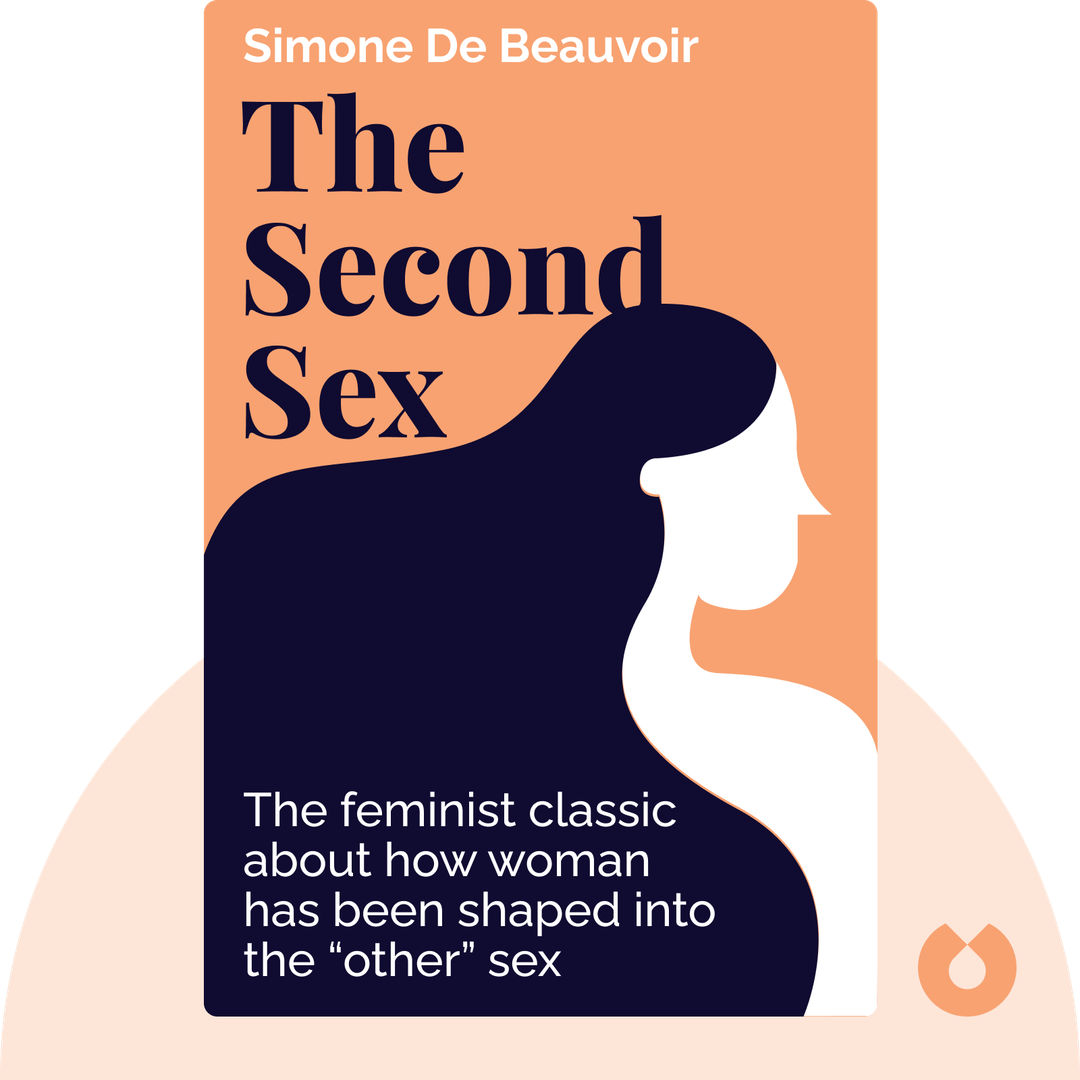
The Second Sex (1949), an 800-page feminist classic, explains how woman has been shaped into the “Other,” second sex – the negative counterpart to man. By examining history, myths, biology and life experience, de Beauvoir paints a clear picture of why woman is subjugated to man, and how womankind should respond.
Who Should Listen to The Second Sex?
- Feminists
- People interested in philosophy
- Anyone who loves classics
Books Similar to The Second Sex
Readers who enjoyed this also liked these titles.