If You're Curious About These Questions...
You should listen to this audiobook
- Did you know that almost every groundbreaking invention in history relies on just three simple mental tools?
- Have you ever wondered why humans are the only species on Earth driven to constantly reinvent the world around them?
- What if the secret to your next big idea isn’t about waiting for inspiration, but about mastering the specific ways your brain reshapes reality?
Listen to The Runaway Species — Free Audiobook
Loading player...
Key Takeaways from The Runaway Species
- Understand why revolutionary innovations like the iPhone aren't sudden bolts from the blue, but rather brilliant reinventions of inherited ideas from predecessors.
- Discover how to 'bend' existing templates to solve complex problems, just as doctors revolutionized artificial hearts by replacing nature's design with a continuous-flow mechanism.
- Learn why true innovation requires reaching backward and forward simultaneously to put a daring new spin on the raw materials the world already provides.
- Master the creative process of 'breaking' objects and ideas into smaller, fractured components to build powerful new works, as demonstrated by Picasso's art and modern filmmaking.
- Explore how altering conventional structures, such as reversing a story's chronological timeline, can subvert expectations and transform a familiar concept into a unique masterpiece.
Learning Tools
Reinforce what you learned from The Runaway Species
Mind Map
The Runaway Species
The Nature of Creativity+
The Three Creative Functions+
Generating Ideas+
Fostering Innovation+
Quiz — Test Your Understanding
Question 1 of 7
What is the fundamental premise of human creativity according to the book?
Question 2 of 7
How did doctors Billy Cohn and Bud Frazier apply the concept of 'bending' to improve the artificial heart?
Question 3 of 7
Which of the following artistic innovations is cited as an example of the 'breaking' technique?
Question 4 of 7
What problem did geneticist Randy Lewis solve using the creative principle of 'blending'?
Question 5 of 7
What lesson about creativity is demonstrated by Thomas Edison's concrete piano and George Washington Carver's peanut products?
Question 6 of 7
How does Microsoft's experiment with underwater data centers illustrate a key characteristic of creative organizations?
Question 7 of 7
How does art teacher Lindsay Esola measure her students' creative development over the semester?
The Runaway Species — Full Chapter Overview
- 1Recommendation
- 2Even radical creators rely on inherited ideas.
- 3Creative breakthroughs often succeed by reshaping an existing model.
- 4Breaking objects and ideas into smaller parts is a key creative process.
- 5Combining diverse elements in surprising ways is a mainstay of human creativity.
- 6Rather than chasing one perfect idea, generate many fallible options.
- 7Creative organizations look to the future and promote experimentation.
The Runaway Species Summary & Overview
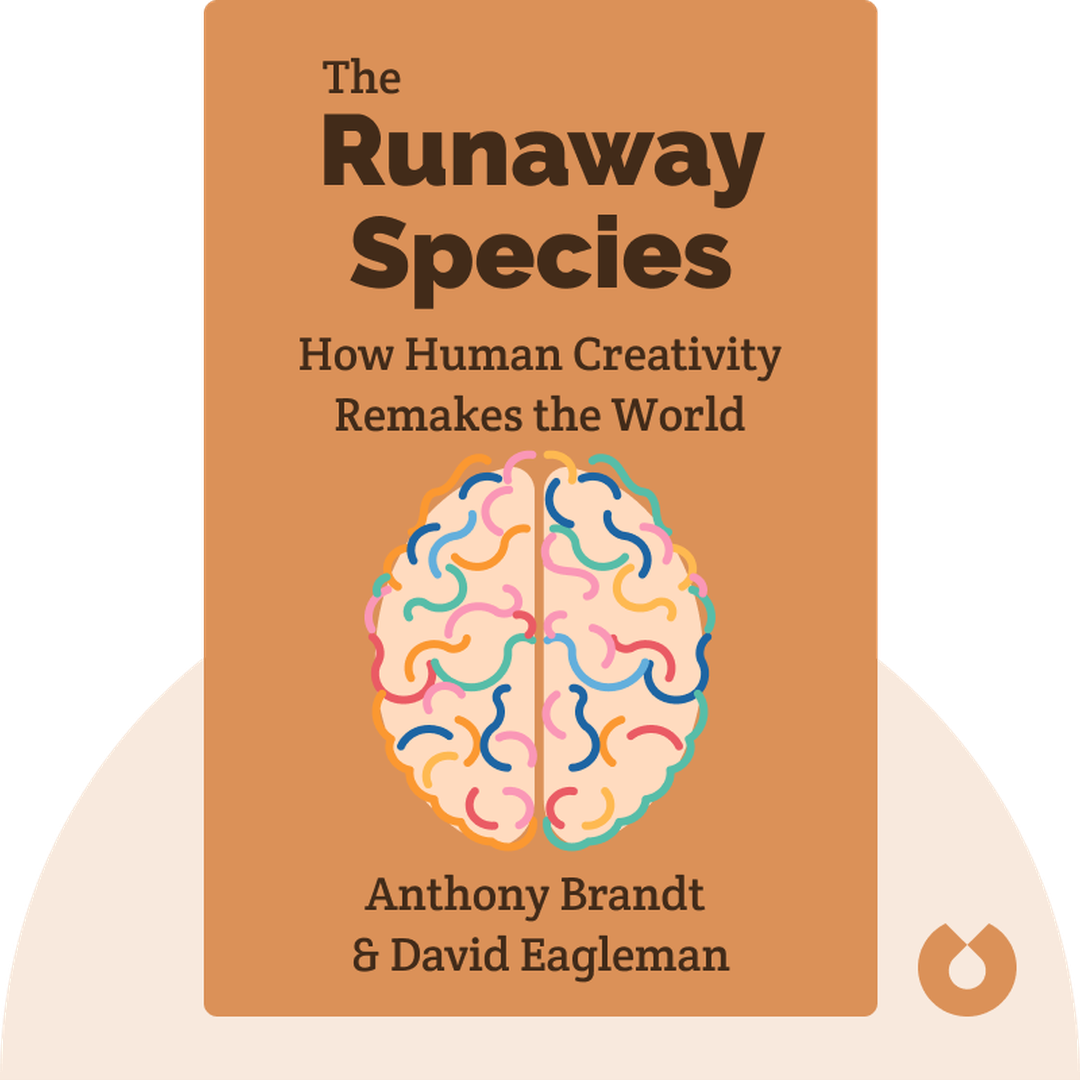
The Runaway Species (2017) is a gripping account of human creativity. Examining the principles that underlie our inventiveness, as well as real-world examples of creative breakthroughs, it offers a novel account of the abilities that make our species unique.
Who Should Listen to The Runaway Species?
- Artistic types wondering how creativity works
- Entrepreneurs trying to develop the next big thing
- Anyone who wants to become a bit more inventive
Books Similar to The Runaway Species
Readers who enjoyed this also liked these titles.