If You're Curious About These Questions...
You should listen to this audiobook
- Have you ever wondered why even the most powerful empires seem destined to collapse after just a few generations?
- What is the secret social force that allows small groups to overthrow massive civilizations, and why does it always eventually disappear?
- Did you know that the fundamental laws of modern economics and sociology were actually discovered by a 14th-century scholar centuries before they were officially recognized?
Listen to The Muqaddimah — Cinematic Audio Edition
Loading player...
Key Takeaways from The Muqaddimah
- Understand how human vulnerability birthed social organization, as our unique ability to think and cooperate allowed us to outsmart predators and build civilizations.
- Find out why strong royal authority is considered essential to human success, acting as a necessary force to restrain our primal aggression and maintain peace within communities.
- Discover why fourteenth-century Islamic scholars believed temperate climates produced the greatest civilizations, and how temperature dictates a society's overall mood and behaviors.
- Learn how diet shapes both physical and mental character, revealing why Ibn Khaldūn argued that frugal diets create sharper minds while an abundance of rich foods dulls the intellect.
- Explore the historical Islamic perspective on divine leadership, detailing how chosen prophets enter a transcendent state of 'angelicity' to receive holy revelations and guide humanity.
Learning Tools
Reinforce what you learned from The Muqaddimah
Mind Map
The Muqaddimah
Human Nature & Society+
Environment & Biology+
Power & Politics+
Economics & Labor+
Religion & Spirituality+
Quiz — Test Your Understanding
Question 1 of 9
According to Ibn Khaldūn, what is the primary reason humans were able to dominate the Earth despite being physically weaker than many animals?
Question 2 of 9
How did Ibn Khaldūn believe climate influenced human behavior and society?
Question 3 of 9
In the context of the 14th-century Islamic thought presented in the text, how was an abundance of high-moisture foods like butter and seasonings viewed?
Question 4 of 9
Why did Ibn Khaldūn consider the Qur'an to be the greatest miracle ever experienced compared to other religious scriptures?
Question 5 of 9
What happens to a defeated group that loses its 'group feeling' according to the text?
Question 6 of 9
What is the typical lifespan of royal authority within a single family or tribe, according to Ibn Khaldūn's model?
Question 7 of 9
What characterizes the final stage ('squander') of a dynasty's life cycle?
Question 8 of 9
Which craft did Ibn Khaldūn consider to be the most useful and distinguished as 'noble' because it enhances critical thinking skills?
Question 9 of 9
According to the text, how does Ibn Khaldūn differentiate human behavior from animal behavior?
The Muqaddimah — Full Chapter Overview
- 1Recommendation
- 2Social organization sets humans apart from animals and builds human civilization.
- 3Varied climates exert varied effects on individuals and societies.
- 4The scarcity or abundance of food shapes our bodies and character.
- 5Some individuals are chosen by God to serve as His prophets, the greatest among them being Muhammad himself.
- 6Group solidarity is the force that determines a civilization’s success in warfare.
- 7Royal authority is required to preserve order and restrain the evil within us.
- 8Urbanization is characteristic of sedentary civilizations and indeed is ultimately self-destructive.
- 9Everyone is striving to make a profit.
- 10Humans are superior to all other living beings thanks to their capacity to think and amass knowledge.
The Muqaddimah Summary & Overview
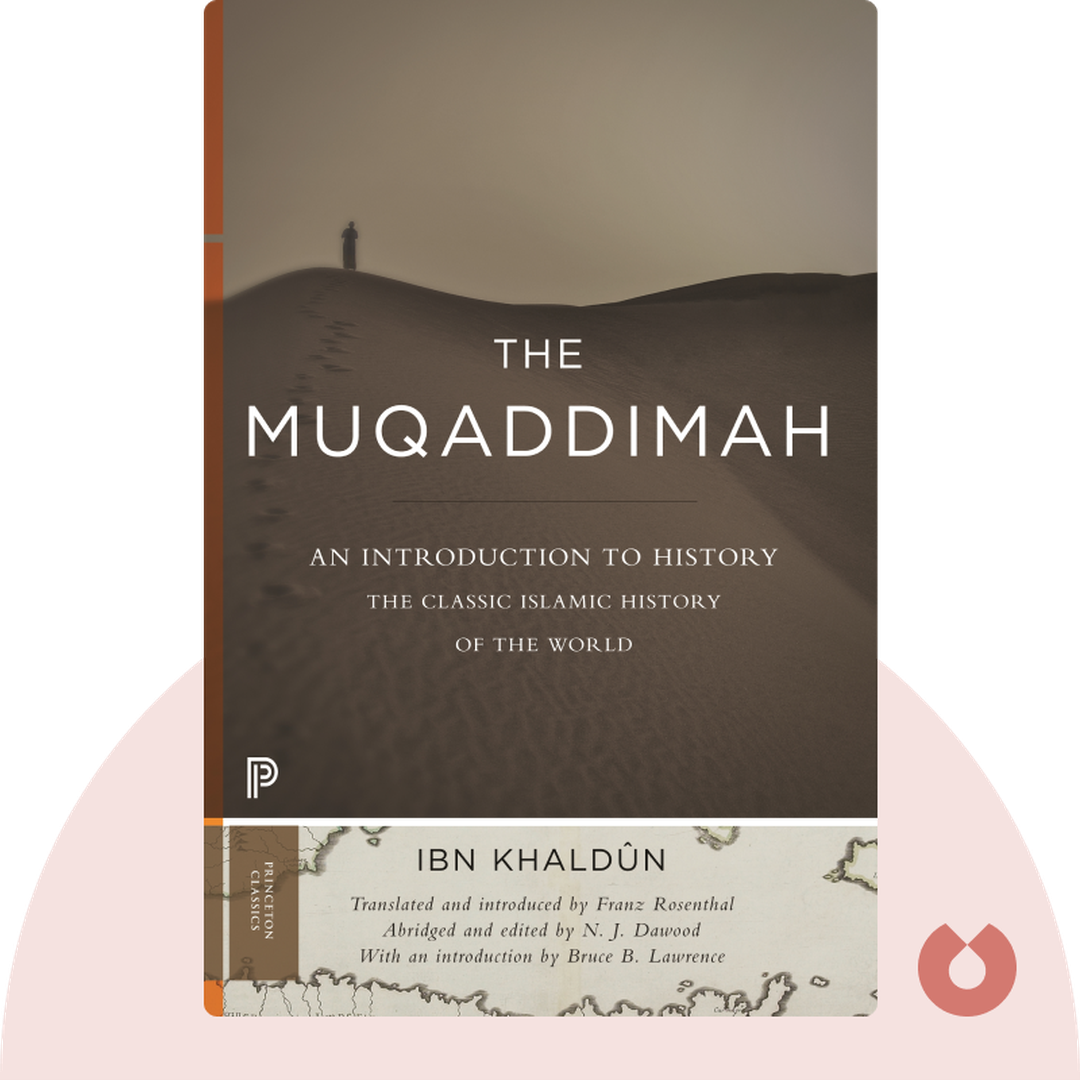
The Muqaddimah (fourteenth century, first English edition 1958), a classic text on the Islamic history of the world, focuses on the rise and fall of civilizations. It offers a unique glimpse into the world of the fourteenth-century Arab Muslim, and is regarded as a foundational text in several academic disciplines.
Who Should Listen to The Muqaddimah?
- History enthusiasts
- People interested in social organization
- Participants in Mark Zuckerberg’s A Year of Books
Books Similar to The Muqaddimah
Readers who enjoyed this also liked these titles.