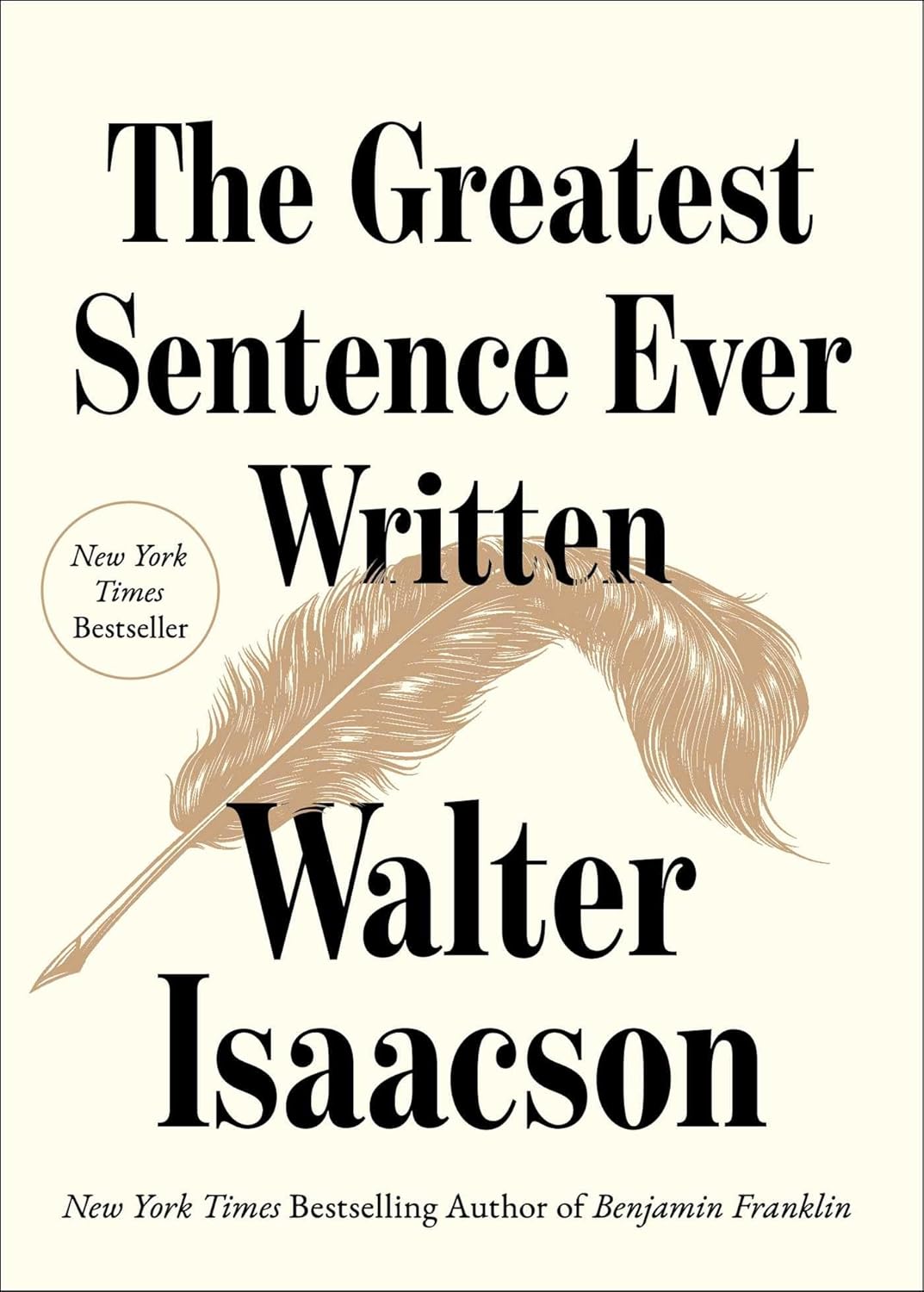
The Greatest Sentence Ever Written audiobook cover - What if America’s most famous line isn’t a monument—but a living argument, edited word-by-word by Jefferson, Franklin, and Adams, and still fighting today inside debates over equality, faith, rights, the commons, and the American Dream?

The Greatest Sentence Ever Written

What if America’s most famous line isn’t a monument—but a living argument, edited word-by-word by Jefferson, Franklin, and Adams, and still fighting today inside debates over equality, faith, rights, the commons, and the American Dream?

Walter Isaacson

4.0 / 5(3 ratings)
Start ListeningDownloadQR code that opens AudiobookHub on the App StoreTry free on iPhoneScan to start in 5 seconds

If You're Curious About These Questions...

You should listen to this audiobook

Listen to The Greatest Sentence Ever Written — Free Audiobook

Loading player...

Key Takeaways from The Greatest Sentence Ever Written

Learning Tools

Reinforce what you learned from The Greatest Sentence Ever Written

Mind Map

The Greatest Sentence Ever Written
Crafting Legitimacy+
Reason, Religion, and Truth+
The Contradiction of Equality+
Unalienable Rights+
The Commons and Civic Ground+
The Modern American Dream+

Quiz — Test Your Understanding

Question 1 of 10
According to the book, what was the primary significance of Benjamin Franklin changing the word 'sacred' to 'self-evident' in the Declaration of Independence?
  • A. It shifted the foundation of rights from religious revelation to human reason.
  • B. It made the language more poetic and memorable for future generations.
  • C. It was a compromise to appease delegates who were not religious.
  • D. It was a minor stylistic change that had little philosophical impact.
Question 2 of 10
What core principle does the book argue is established by the very first word of the sentence, 'We'?
  • A. That the delegates in Philadelphia were a unified, homogenous group.
  • B. That authority and legitimate governance rise from the consent of the people.
  • C. That the new nation would be a direct democracy rather than a republic.
  • D. That the Declaration was a personal statement from Thomas Jefferson.
Question 3 of 10
The book connects the term 'self-evident' to the philosophy of David Hume. How does it define a 'self-evident' truth in this context?
  • A. A truth that is obvious to every person regardless of their education.
  • B. A truth that has been proven through scientific experiments and observation.
  • C. A truth that can be confirmed by looking at historical precedents.
  • D. A truth that is true by definition and discoverable by reason alone, without external evidence.
Question 4 of 10
How does the book characterize the Founders' intended meaning of the phrase 'all men'?
  • A. They used it as a universal term for all humankind, including women and enslaved people, in a forward-thinking way.
  • B. It was intentionally ambiguous to allow for future expansion of rights.
  • C. In practice, it excluded women, enslaved people, and Native Americans from the political community.
  • D. It was meant to include all property-owning individuals, regardless of gender or race.
Question 5 of 10
According to Isaacson, what is the 'founding contradiction' at the heart of the claim that 'all men are created equal'?
  • A. The tension between individual talent and the idea of equal outcomes.
  • B. The conflict between the radical claim of political equality and the existence of chattel slavery.
  • C. The disagreement between Jefferson's philosophical equality and Adams's religious equality.
  • D. The difference in wealth between the northern and southern colonies.
Question 6 of 10
How does the book present Benjamin Franklin's personal journey regarding slavery?
  • A. He was a lifelong, outspoken abolitionist from a young age.
  • B. He consistently defended slavery as an economic necessity for the colonies.
  • C. His views mirrored a moral arc, moving from owning enslaved people to becoming an active abolitionist late in life.
  • D. He remained neutral on the issue of slavery, believing it was too divisive to address publicly.
Question 7 of 10
How does the book interpret the inclusion of the phrase 'endowed by their Creator'?
  • A. As proof that all the Founders were devoutly religious Christians.
  • B. As a purely rationalist phrase consistent with Jefferson's Deism.
  • C. As a carefully negotiated balance between Deist philosophy and more traditional religious belief.
  • D. As a last-minute addition to satisfy the British monarchy.
Question 8 of 10
What is the significance of Jefferson substituting 'the pursuit of Happiness' for John Locke's more traditional 'property'?
  • A. It was a mistake, as he intended to write 'property' but was overruled.
  • B. It narrowed the scope of rights to only emotional well-being.
  • C. It broadened the concept of rights to include personal fulfillment and self-chosen life paths.
  • D. It was meant to specifically exclude the ownership of enslaved people as a right.
Question 9 of 10
The book uses Benjamin Franklin as the prime example of someone who actively built 'common ground.' How did he do this?
  • A. By writing philosophical essays about the importance of community.
  • B. By donating his entire fortune to the government to fund public works.
  • C. By leading protests to turn private land into public parks.
  • D. By forming a club that launched concrete civic projects like a library, hospital, and fire corps.
Question 10 of 10
What modern trend does the book describe as a threat to the 'commons' and the American Dream, using the term 'skyboxification'?
  • A. The increasing popularity of online gaming and virtual reality.
  • B. The decline of traditional manufacturing in favor of a service economy.
  • C. The segmentation of society, where shared spaces are replaced by exclusive, separate experiences for different classes.
  • D. The government's takeover of formerly private industries.

The Greatest Sentence Ever Written — Full Chapter Overview

The Greatest Sentence Ever Written Summary & Overview

Walter Isaacson builds an entire, vivid guided tour around one line in the Declaration of Independence: “We hold these truths to be self-evident…” He starts inside Jefferson’s Market Street lodgings, where the draft is written, then shows how Franklin and Adams reshape it—swapping “sacred” for “self-evident,” and tightening Jefferson’s logic into unforgettable rhythm.

From there, the book unpacks each phrase as both philosophy and fuel: the Enlightenment roots of social contract theory; the meaning of “self-evident” as a claim about reason; the explosive promise—and original exclusions—inside “all men”; and the moral contradiction of slavery that haunted the Founding. Isaacson then carries the sentence forward into modern America, arguing that its core ideals—common ground and the pursuit of happiness—still offer a framework for repairing polarization, protecting opportunity, and renewing democracy.

Who Should Listen to The Greatest Sentence Ever Written?

  • Listeners who want a fast, story-driven understanding of the Declaration’s key sentence and why each word matters.
  • Anyone interested in Enlightenment ideas—Locke, Hume, Rousseau—and how philosophy becomes political action.
  • People wrestling with modern polarization who want a values-based lens for debates about equality, opportunity, and the “commons.”

About the Author: Walter Isaacson

Walter Isaacson is a biographer and historian known for books on figures such as Benjamin Franklin, Albert Einstein, Steve Jobs, Leonardo da Vinci, Jennifer Doudna, Henry Kissinger, and Elon Musk. He has served as editor of Time, CEO of CNN, and CEO of the Aspen Institute, and he received the National Humanities Medal in 2023. He teaches as the Leonard Lauder Professor of American History and Values at Tulane University and lives in New Orleans.

🎧
Listen in the AppOffline playback & background play
Get App