If You're Curious About These Questions...
You should listen to this audiobook
- Have you ever wondered why our schools and workplaces are designed for a "perfectly average" person who doesn't actually exist?
- Did you know that measuring yourself against standardized benchmarks might be the very thing holding you back from your full potential?
- What if the secret to true success isn't about being well-rounded, but about embracing the unique "jaggedness" of your individual talents?
Listen to The End of Average — Free Audiobook
Loading player...
Key Takeaways from The End of Average
- Discover how the mathematical concept of averages originated in nineteenth-century astronomy and why applying it to measure human traits is fundamentally flawed.
- Understand why designing for the 'average' human body fails entirely, as proven by a 1950s US Air Force standard cockpit that famously fit zero pilots.
- Learn why there is no correlation between the speed at which you acquire knowledge and your actual retention, debunking the myth of the 'above average' intellect.
- Realize that there is no single, standard path for acquiring skills or reaching developmental milestones, meaning any deviation from the norm is completely natural.
- Find out why human character traits are fluid and context-dependent, proving that workplaces must embrace individuality rather than rely on static, standardized evaluations.
Learning Tools
Reinforce what you learned from The End of Average
Mind Map
The End of Average
The Fallacy of Average+
Physical Individuality+
Learning and Intelligence+
Fluidity of Character+
Modernizing the Workplace+
Reforming Education+
Maximizing Potential+
Quiz — Test Your Understanding
Question 1 of 6
How did the concept of the 'average person' originally begin?
Question 2 of 6
What was the result of the US Air Force designing airplane cockpits based on the average dimensions of 4,000 pilots in 1950?
Question 3 of 6
According to educational expert Benjamin Bloom's experiments in the 1980s, what is the relationship between the speed of learning and knowledge retention?
Question 4 of 6
How does the book describe human character traits in relation to different environments?
Question 5 of 6
How did the media company IGN change its hiring process to find uniquely talented people?
Question 6 of 6
What alternative to broadly designed college degree programs does the author suggest for educational institutions?
The End of Average — Full Chapter Overview
- 1Recommendation
- 2The mathematical idea of averages has its uses, but it doesn’t matter when it’s applied to human nature.
- 3There is no single body shape, and averages cannot describe human anatomy.
- 4Personality traits don’t determine how we learn, and there is no average route to mastering skills and knowledge.
- 5Human character traits are changeable, and workplaces should nurture their employees’ individuality.
- 6Companies must look beyond averages and actively seek individuality in their candidates.
- 7We must abandon outdated, average-based models – especially in our education systems.
The End of Average Summary & Overview
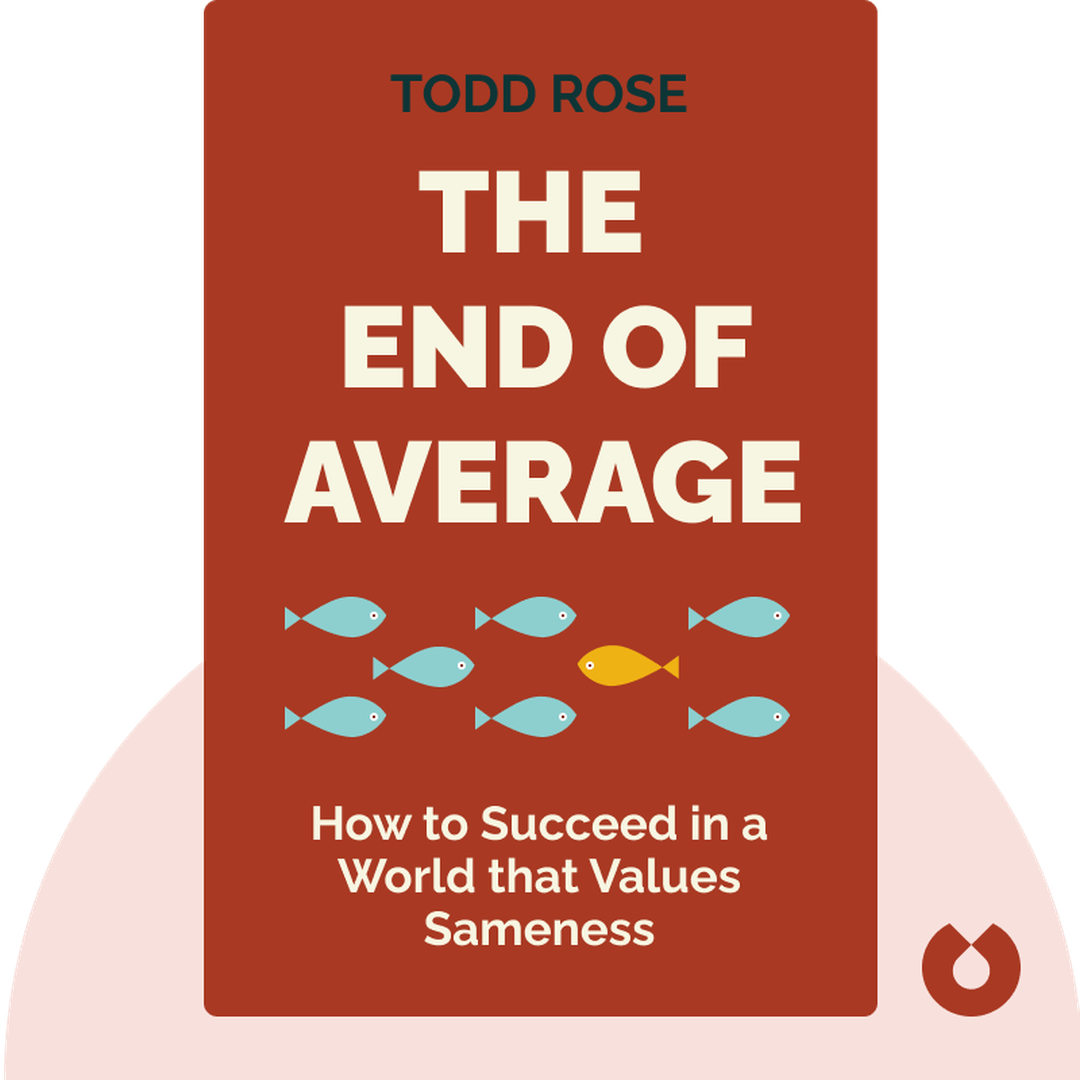
The End of Average (2016) reveals how people are measured against an abstract and misguided conception of the average human being, and how their individuality is more or less ignored. Learn about the first misapplications of averages to human nature, and how your company or school can lead the way in recognizing and embracing individuality. And reap the rewards!
Who Should Listen to The End of Average?
- Teachers and educators
- Employers and HR specialists
- People who want to realize their full potential
Books Similar to The End of Average
Readers who enjoyed this also liked these titles.