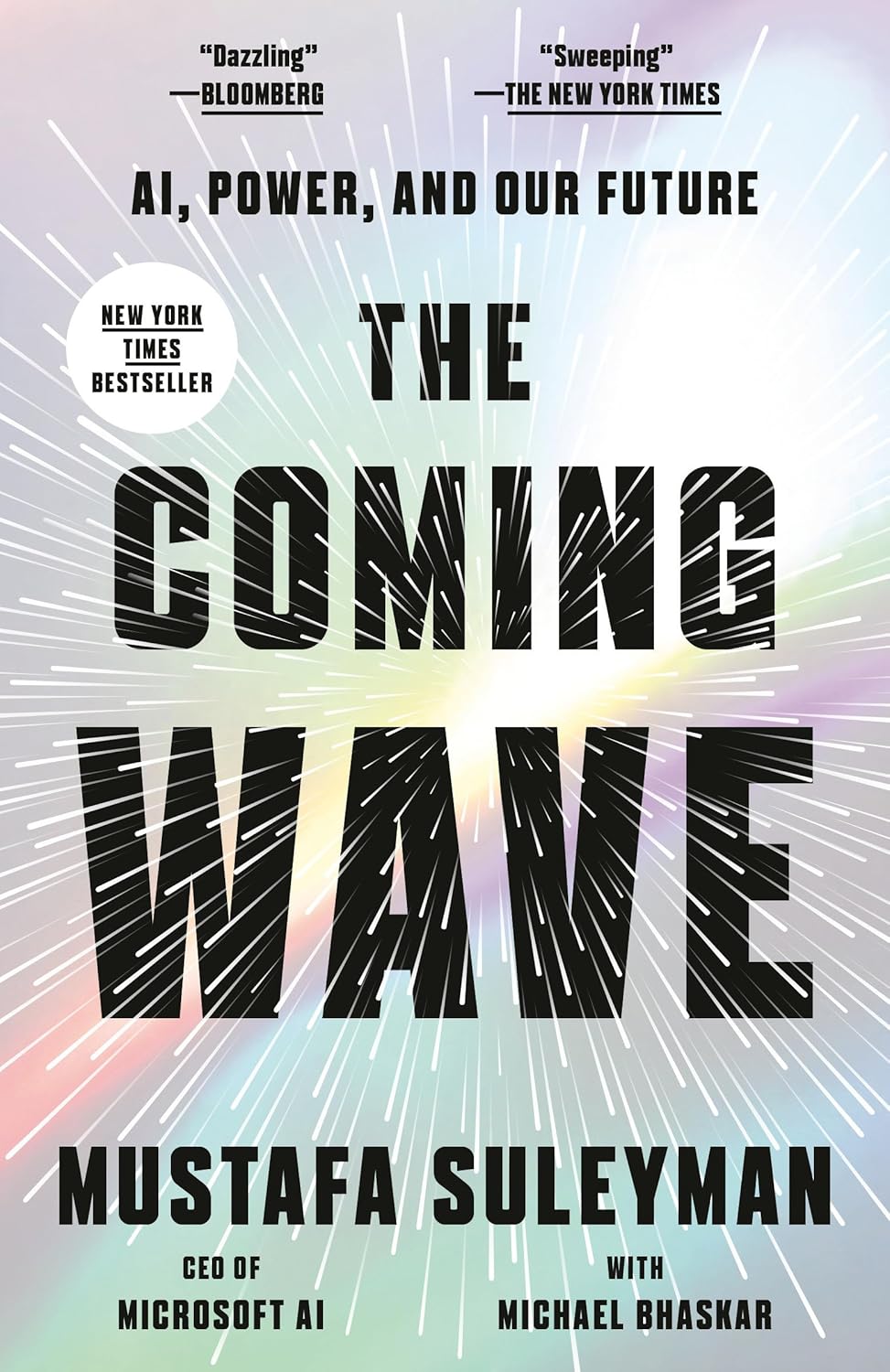
The Coming Wave audiobook cover - A former DeepMind co-founder argues that AI and synthetic biology will spread faster than any prior technology wave—bringing miraculous abundance and unprecedented catastrophic risk—and asks whether humanity can build real containment without sliding into permanent surveillance.

The Coming Wave

A former DeepMind co-founder argues that AI and synthetic biology will spread faster than any prior technology wave—bringing miraculous abundance and unprecedented catastrophic risk—and asks whether humanity can build real containment without sliding into permanent surveillance.

Mustafa Suleyman and Michael Bhaskar

4.1 / 5(8 ratings)
Start ListeningDownloadQR code that opens AudiobookHub on the App StoreTry free on iPhoneScan to start in 5 seconds

If You're Curious About These Questions...

You should listen to this audiobook

Listen to The Coming Wave — Free Audiobook

Loading player...

Key Takeaways from The Coming Wave

Learning Tools

Reinforce what you learned from The Coming Wave

Mind Map

The Coming Wave
I. Core Concepts & The Dilemma+
II. Why Technology Spreads+
III. The Technologies of the Wave+
IV. Unstoppable Incentives & Fragile States+
V. A Path to Containment+

Quiz — Test Your Understanding

Question 1 of 9
According to the book, what is the fundamental "dilemma" humanity faces with the coming wave of technology?
  • A. The choice between risking catastrophe by pursuing powerful new technologies and risking authoritarianism by trying to contain them.
  • B. The choice between funding AI research or synthetic biology research, as resources are too scarce for both.
  • C. The choice between open-source development that spreads risk and corporate-owned technology that concentrates wealth.
  • D. The choice between rapid economic growth driven by technology and protecting the natural environment from its side effects.
Question 2 of 9
The book argues that the coming wave of AI and synthetic biology will spread faster than previous technologies. What is the primary reason given for this accelerated diffusion?
  • A. They are less expensive to invent than older technologies like the printing press.
  • B. Governments are mandating their use to improve public services.
  • C. They utilize existing global networks, open research cultures, and massive capital investment.
  • D. They do not require any specialized hardware, unlike the internal combustion engine.
Question 3 of 9
Why does the author consider the containment of nuclear weapons an "instructive but not reassuring" example for the coming wave?
  • A. Because the coming wave of technology is cheaper, more accessible, and more adaptable than nuclear tech, making it harder to contain.
  • B. Because the international treaties used for nuclear non-proliferation have completely failed.
  • C. Because nuclear technology has been successfully contained and therefore provides a perfect model for controlling AI.
  • D. Because non-state actors have already acquired nuclear weapons, proving containment is impossible.
Question 4 of 9
What is the key distinction of "Artificial Capable Intelligence" (ACI) as a near-term milestone proposed by Suleyman?
  • A. ACI is an AI that has achieved human-level consciousness and self-awareness.
  • B. ACI focuses on an AI's practical ability to plan and execute complex real-world tasks with minimal oversight.
  • C. ACI refers specifically to an AI's ability to defeat a human champion in a complex game like Go.
  • D. ACI is a theoretical AI that can only exist within a simulated environment.
Question 5 of 9
How does the book characterize the relationship between AI and synthetic biology?
  • A. As two competing fields, where advances in one hinder progress in the other.
  • B. As a "superwave" where the two technologies converge and mutually accelerate each other.
  • C. As largely separate domains with little to no interaction or impact on one another.
  • D. As a relationship where synthetic biology provides the hardware for AI software to run on.
Question 6 of 9
Which of the following is NOT one of the "four features" that the book claims makes the coming wave uniquely difficult to contain?
  • A. Asymmetry
  • B. Omni-use
  • C. High Cost
  • D. Autonomy
Question 7 of 9
The book argues that there are "unstoppable incentives" pushing the wave forward. Which of the following is identified as a primary incentive?
  • A. International laws that mandate all nations must develop AI.
  • B. The human desire for entertainment and leisure above all else.
  • C. A widespread public belief that technology has no downsides.
  • D. Geopolitical competition between states, creating a fear of being left behind.
Question 8 of 9
How does the coming wave threaten the "grand bargain" between the state and its citizens?
  • A. By making the state so powerful that citizens no longer need to provide consent.
  • B. By creating technologies that increase state fragility and erode its ability to provide security and order.
  • C. By solving all major social problems, making the state's role obsolete.
  • D. By proving that corporations are better at providing public services like security and welfare.
Question 9 of 9
In proposing ten steps toward containment, the author argues for a layered approach. What method is described as necessary, but ultimately "too slow and fragmented" on its own?
  • A. Investing in technical safety research.
  • B. Establishing a culture of safety that shares failures.
  • C. Relying solely on traditional government regulation.
  • D. Using chokepoints like chip manufacturing to buy time.

The Coming Wave — Full Chapter Overview

The Coming Wave Summary & Overview

The Coming Wave is a high-stakes, deeply researched argument about a new technological supercycle centered on advanced AI and synthetic biology. Mustafa Suleyman—an AI builder and policy insider—frames the core challenge as “containment”: keeping exponentially improving, widely diffusing tools under meaningful human control. He explains why technology historically proliferates, why this wave is different, and why traditional governance is lagging just as the risks grow.

The book maps how AI, DNA engineering, robotics, and related technologies amplify power for everyone—governments, corporations, and individuals—creating destabilizing “fragility amplifiers” like cyberweapons, deepfakes, lethal autonomy, lab-leak risk, and labor disruption. Suleyman argues this drives a grim dilemma between catastrophe (open proliferation) and dystopia (surveillance-heavy control). He ends by proposing a layered containment agenda—technical safety, audits, choke points, better corporate and state governance, international alliances, cultural norms, and public movements—to keep society on a narrow path.

Who Should Listen to The Coming Wave?

  • Policy makers, regulators, and national security analysts who need a structured framework for AI/biotech governance and risk.
  • Technology leaders, researchers, and founders who want a containment-focused view beyond hype, ethics slogans, or narrow safety debates.
  • General readers concerned about deepfakes, pandemics, automation, and geopolitical instability—and what practical steps could reduce risk.

About the Author: Mustafa Suleyman and Michael Bhaskar

Mustafa Suleyman is the co-founder and CEO of Inflection AI and previously co-founded DeepMind, later serving as VP of AI product management and AI policy at Google. Michael Bhaskar is a UK-based writer and publisher, author of The Content Machine, Curation, and Human Frontiers.

🎧
Listen in the AppOffline playback & background play
Get App