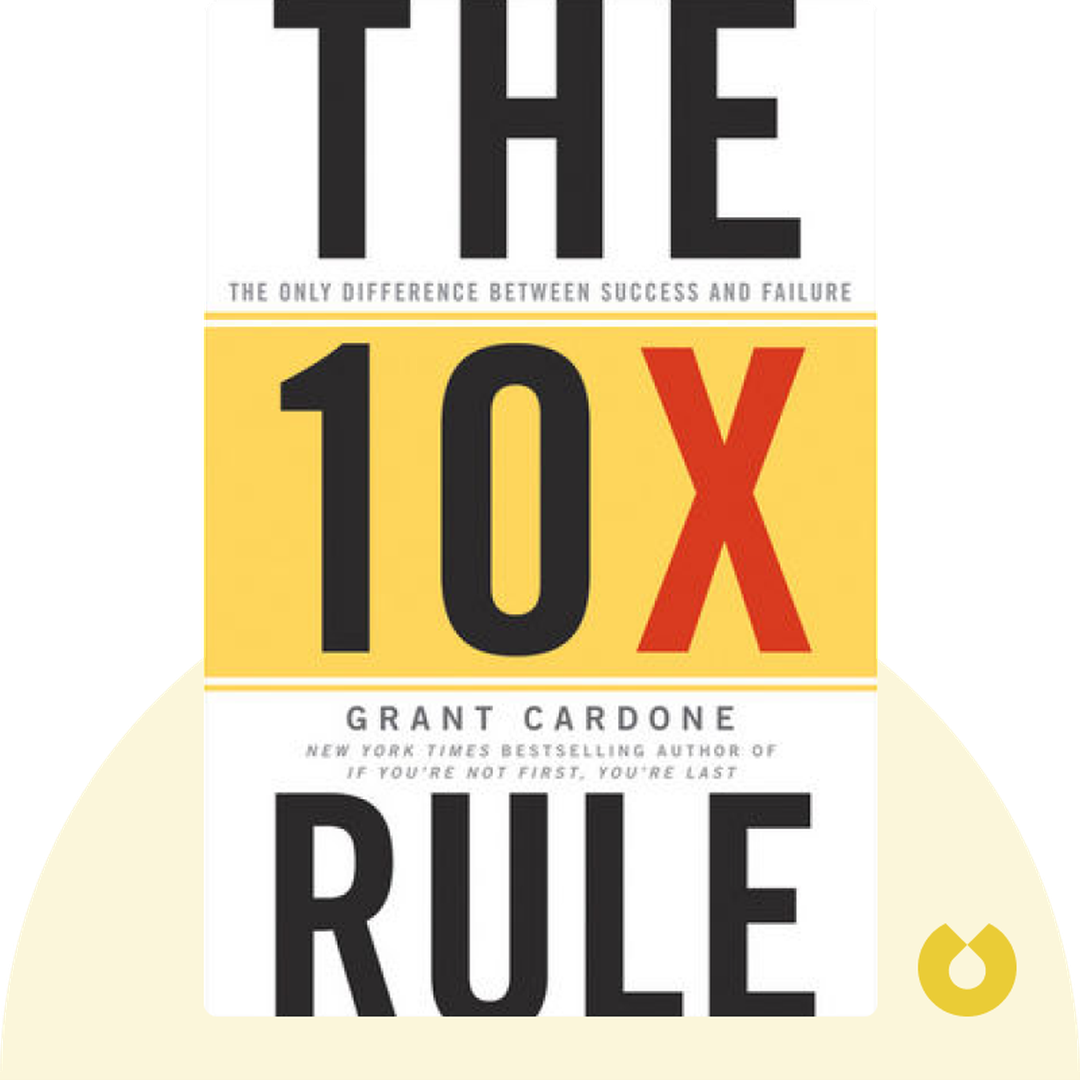
If You're Curious About These Questions...
You should listen to this audiobook
- Have you ever wondered why most people fail not because they lack talent, but because they fundamentally underestimate the exact amount of action required to succeed?
- Did you know that setting 'realistic' goals might be the single biggest trap preventing you from reaching your full potential?
- What if you could learn to use your fear as a high-performance compass to dominate your industry and leave your competition behind?
Listen to The 10X Rule — Cinematic Audio Edition
Loading player...
Key Takeaways from The 10X Rule
- Discover why achieving extraordinary results requires shifting your mindset and multiplying your planned effort by ten, rather than just relying on talent or a lucky break.
- Learn how to avoid the common trap of underestimating the volume of action required to reach your targets, which is the true reason most goals and resolutions fail.
- Understand why treating success as a personal duty and an abundant resource will help you overcome the deep frustration of living below your true potential.
- Find out how to intentionally direct your time, energy, and focus toward your own dreams so you aren't simply used as a resource to build someone else's.
- Master the continuous skill-building needed to overcome 'Peter's Plateau,' ensuring your ambition is always matched by the competence required to keep growing.
Learning Tools
Reinforce what you learned from The 10X Rule
Mind Map
The 10X Rule
The Core Concept+
Taking Massive Action+
The 10X Mindset+
Overcoming Obstacles+
Business & Market Strategy+
Quiz — Test Your Understanding
Question 1 of 8
What are the two foundational components of the 10X Rule?
Question 2 of 8
According to the text, what are the four degrees of action a person can take when faced with a situation?
Question 3 of 8
Why does the author suggest we should emulate children when faced with a challenge?
Question 4 of 8
How does the author view the concept of success in relation to others?
Question 5 of 8
What does the 2008 financial crisis illustrate about aiming for an 'average' or middle-class life?
Question 6 of 8
How should someone applying the 10X Rule view the risk of 'overexposure'?
Question 7 of 8
When facing limited time and multiple priorities (like work and family), what is the 10X strategy?
Question 8 of 8
Why does the author argue against obsessing over customer satisfaction in the early stages of a business?
The 10X Rule — Full Chapter Overview
- 1Recommendation
- 2the hidden multiplier behind extraordinary results
- 3defining success in a way that actually fits your life
- 4Trading Blame for Responsibility and Regaining Your Power
- 5Let Action Be the Proof, Not Just the Plan
- 6choosing consistent momentum over perfect timing
- 7Big Goals is a Map, Not a Fantasy
- 8Bringing the 10X Life Down to One Daily Practice
The 10X Rule Summary & Overview
The 10X Rule (2011) provides clear indications for how to best plan your road to success. These blinks will teach you why this little-known strategy works and how to put it into action, while also giving you the tools you need to become more successful than you ever thought possible.
Who Should Listen to The 10X Rule?
- Entrepreneurs looking for the recipe for success
- Managers who need a little extra motivation
- Anyone who is scared to think big
Books Similar to The 10X Rule
Readers who enjoyed this also liked these titles.