If You're Curious About These Questions...
You should listen to this audiobook
- Have you ever wondered why our brains instinctively choose to add more tasks and objects to our lives, even when we know we're already overwhelmed?
- What if the secret to solving your most complex problems isn't about what you can add, but what you can take away?
- Are you curious about how our evolutionary history has programmed us to overlook the power of subtraction in favor of 'more'?
Listen to Subtract — Free Audiobook
Loading player...
Key Takeaways from Subtract
- Discover why human beings are biologically and psychologically wired to add rather than subtract when trying to improve a situation.
- Understand why subtraction is a powerful, yet overlooked force for positive change that can transform everything from daily habits to urban landscapes.
- Learn what a simple Lego building block experiment reveals about mental accessibility, and why taking things away rarely occurs to us as a solution.
- Find out how simply reminding yourself that subtraction is an option can drastically improve your decision-making and problem-solving skills.
- Explore how our evolutionary drive to acquire resources and display competence makes it difficult to eliminate physical clutter and unnecessary work.
Learning Tools
Reinforce what you learned from Subtract
Mind Map
Subtract
The Bias to Add+
Why We Constantly Add+
The Hidden Power of Subtraction+
Mastering Subtraction+
Quiz — Test Your Understanding
Question 1 of 7
What does the story of Sue Bierman and the San Francisco freeway illustrate about human behavior?
Question 2 of 7
When the author conducted experiments asking participants to improve things like a mini-golf course or a travel itinerary, what was the primary reason they chose to add rather than subtract?
Question 3 of 7
According to the book, what evolutionary and psychological purpose does adding serve for humans, similar to the behavior of the male bowerbird?
Question 4 of 7
What surprising conclusion did archaeologists draw from the ancient stone temple at Göbekli Tepe?
Question 5 of 7
How did post-WWII Keynesian economics and President Truman's policies influence our modern relationship with addition?
Question 6 of 7
In the context of fighting systemic oppression, why does the author argue that subtraction is more effective than addition?
Question 7 of 7
Economist Herbert Simon coined the term 'satisficing' to describe our tendency to leave things at 'good enough.' How does the Lexington, Kentucky creek redesign illustrate the antidote to satisficing?
Subtract — Full Chapter Overview
- 1Recommendation
- 2Subtraction is a neglected driver of change.
- 3Subtracting is harder to call to mind than adding.
- 4Adding helps us feel capable and content.
- 5Addition came first; civilization followed.
- 6Keynesian theory suggests we grow wealthy by adding.
- 7Structural oppression can be reduced through subtraction.
- 8Subtraction repays the extra work it demands.
Subtract Summary & Overview
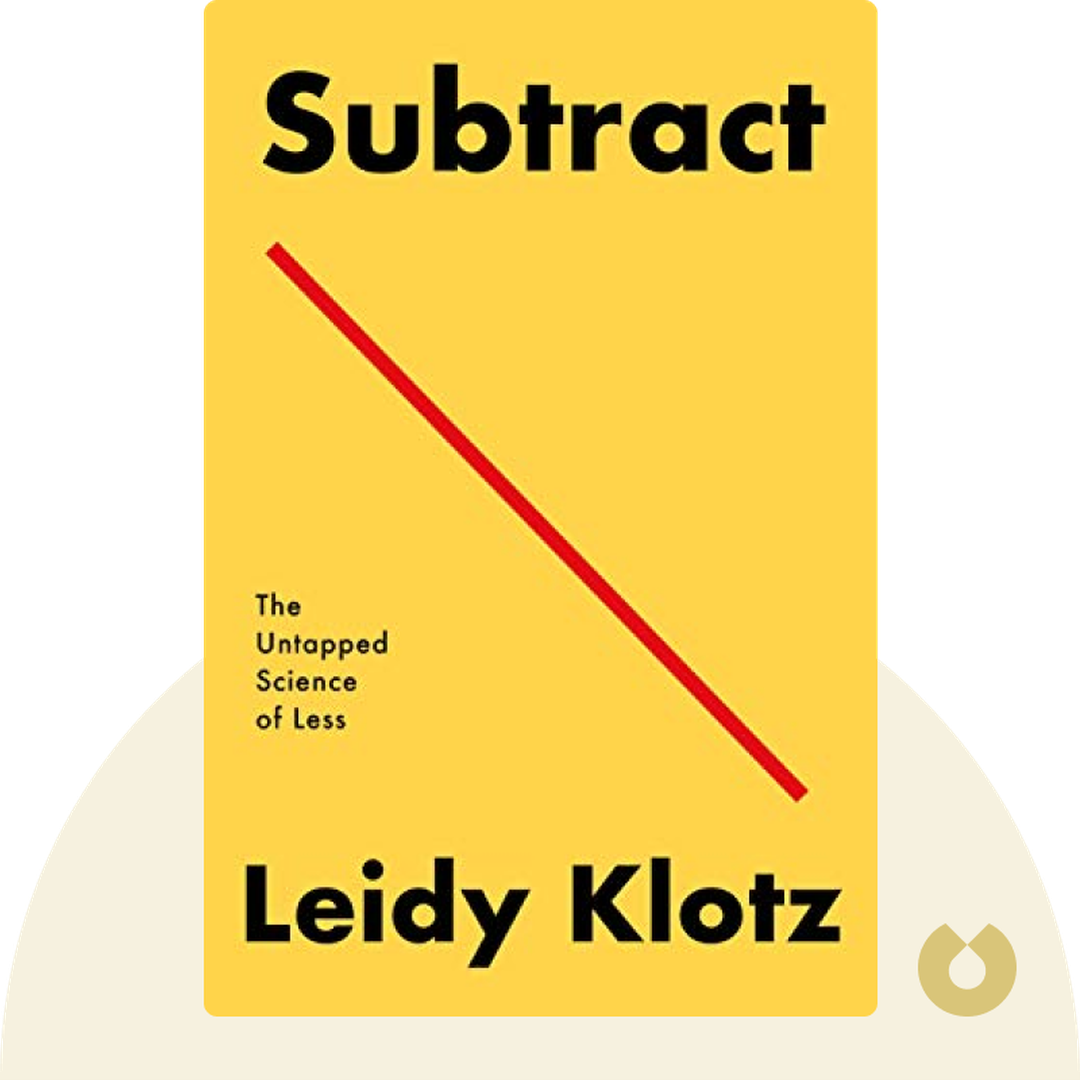
Subtract (2021) explores subtraction as a way to make positive change. It examines the human love affair with adding and having “more” – and it explains how our brains and environments work against subtraction.
Who Should Listen to Subtract?
- Design professionals looking for a fresh perspective
- Psychology buffs wanting new insights
- Anthropology enthusiasts
Books Similar to Subtract
Readers who enjoyed this also liked these titles.