If You're Curious About These Questions...
You should listen to this audiobook
- Have you ever wondered why our global economy treats the Earth's finite resources as an endless supply of income rather than irreplaceable capital?
- What if the secret to a more stable and fulfilling society isn't massive industrial growth, but a return to a much smaller, human scale?
- Are you curious about how 'intermediate technology' could bridge the gap between modern efficiency and meaningful human work?
Listen to Small is Beautiful — Cinematic Audio Edition
Loading player...
Key Takeaways from Small is Beautiful
- Understand why treating finite natural resources, like fossil fuels, as a limitless stream of income rather than precious capital inevitably threatens the foundation of our global economy.
- Discover why the pursuit of universal prosperity through endless economic growth and greed will only lead to environmental ruin and societal alienation, rather than lasting world peace.
- Learn how the modern obsession with profitability leads us to devalue human life, turning people into mere cogs in an economic machine while ignoring the catastrophic environmental damage of our consumption.
- Find out why true societal progress relies on an education system that goes beyond teaching scientific facts to instilling the moral and ethical values necessary for a meaningful life.
- Recognize the danger of a purely economic mentality that prizes cheap bargains over ethical production, and discover how to start valuing our planet and humanity above mere financial profit.
Learning Tools
Reinforce what you learned from Small is Beautiful
Mind Map
Small is Beautiful
Critique of Modern Economics+
Illusion of Universal Prosperity+
Technology & Energy+
Education & Values+
Developmental Aid+
Organizational Structure+
Quiz — Test Your Understanding
Question 1 of 9
How does the modern economic system dangerously mischaracterize fossil fuels?
Question 2 of 9
Why does Schumacher argue that universal prosperity, in the modern sense, cannot ensure lasting peace?
Question 3 of 9
According to the prevailing economic mentality described in the book, how is an 'uneconomic' action typically viewed?
Question 4 of 9
What does Schumacher believe is the fundamental flaw in relying solely on scientific and technological education?
Question 5 of 9
What is the primary critique Schumacher levels against the widespread adoption of nuclear energy?
Question 6 of 9
How has modern technology negatively impacted the human experience of work?
Question 7 of 9
According to the book, what is the primary cause of poverty in developing nations?
Question 8 of 9
To maximize the effectiveness of developmental aid, where does Schumacher suggest it should primarily be directed?
Question 9 of 9
How should large-scale organizations be structured to maintain creativity and innovation?
Small is Beautiful — Full Chapter Overview
- 1Recommendation
- 2Today's global economic system relies on depleting the planet's natural resources.
- 3Universal prosperity alone cannot guarantee lasting peace.
- 4Today's dominant economic mindset prizes profitable actions above all, often sacrificing people and the environment in pursuit of monetary gains.
- 5Education is the greatest resource of all, but only if it instills the right values.
- 6Nuclear power may be humanity’s most perilous invention, yet it's discussed only in economic terms.
- 7Modern technology has stripped people of the work we find most fulfilling.
- 8Developmental aid should not consist of money alone, and it must be directed primarily to rural areas.
- 9Large-scale organizations must foster loyalty and truly strike a healthy balance between order and creative freedom.
Small is Beautiful Summary & Overview
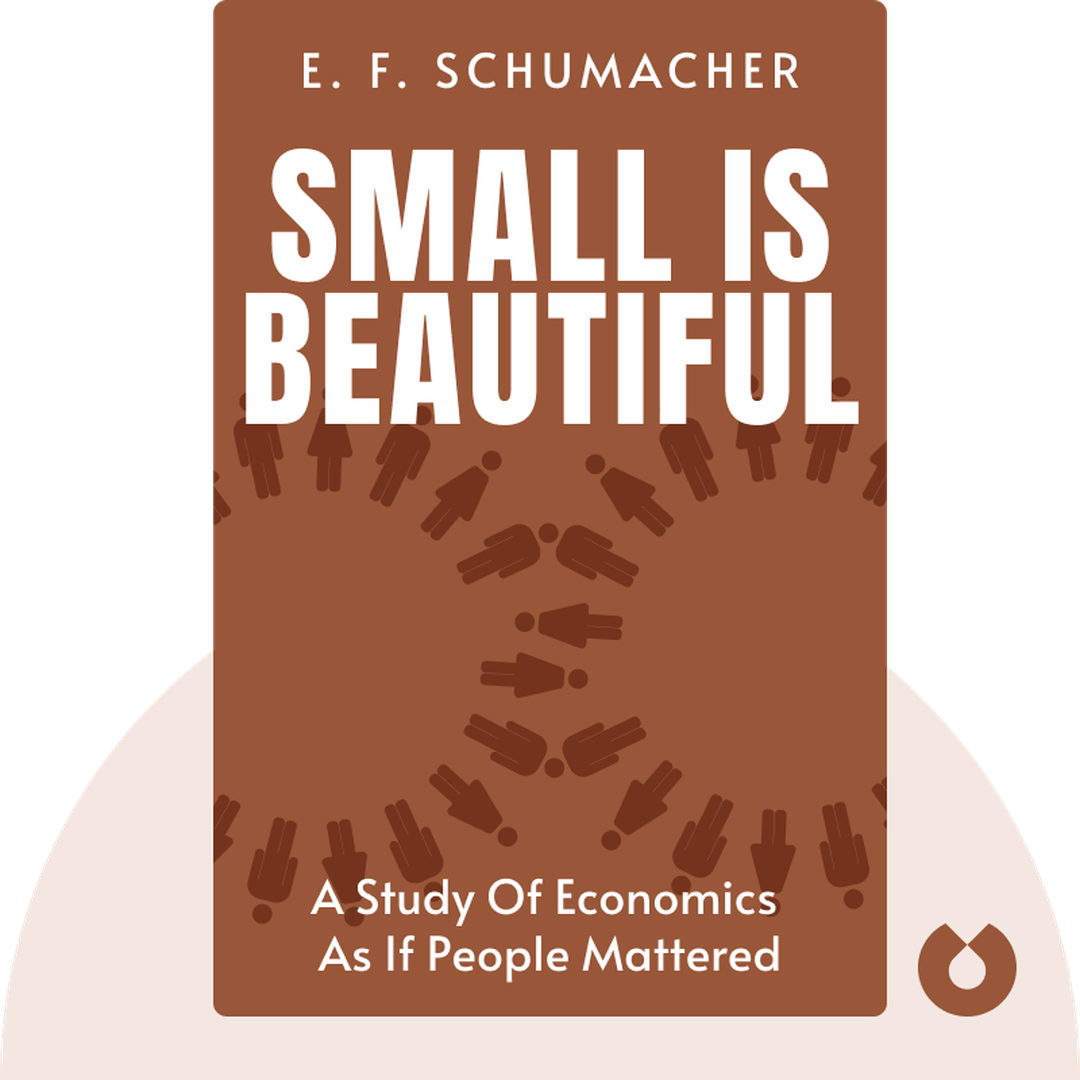
Small is Beautiful (1973) is a collection of essays by renowned British economist E. F. Schumacher outlining his critique of the Western economic system. First published in 1973, this classic collection, which is now considered to be one of the most influential books published since World War II, is as relevant today as it was in the ‘70s.
Who Should Listen to Small is Beautiful?
- People interested in politics and economics
- Mindful citizens who want to understand how our economic system affects the earth
Books Similar to Small is Beautiful
Readers who enjoyed this also liked these titles.