If You're Curious About These Questions...
You should listen to this audiobook
- Billy Pilgrim's alien abduction closely mirrors the plot of a Kilgore Trout science fiction novel he reads and a magazine headline he sees. Are the Tralfamadorians a genuine extraterrestrial encounter, or are they a complex psychological coping mechanism designed to help Billy process his severe wartime PTSD?
- The Tralfamadorians view time as fixed, seeing all moments simultaneously like 'bugs in amber,' and claim Earth is the only place that believes in free will. How does adopting this deterministic philosophy, along with the mantra 'So it goes,' alter Billy's perception of the atrocities he witnessed during the Dresden firebombing?
- Edgar Derby miraculously survives the catastrophic destruction of Dresden, only to be swiftly executed by a firing squad for pilfering a teapot from the rubble. How does this darkly absurd climax encapsulate Vonnegut's overarching message about the senselessness of war and the illusion of human dignity?
Listen to Slaughterhouse-Five — Free Audiobook
Loading player...
Key Takeaways from Slaughterhouse-Five
- Billy Pilgrim’s unpredictable, nonlinear journey through time mirrors the inescapable and fragmented nature of severe psychological trauma.
- The Tralfamadorian perspective views time not as a progression but as a static landscape, suggesting that free will is merely an Earthling illusion.
- The recurring phrase 'So it goes' acts as a dark, resigned acknowledgment of death's inevitability, equalizing all tragedies regardless of their scale or nature.
- The execution of Edgar Derby for stealing a teapot amidst the catastrophic ruins of Dresden perfectly captures the profound absurdity and lack of dignity inherent in war.
- The novel ultimately suggests that the true horrors of mass violence defy coherent articulation, symbolized by a bird's nonsensical chirp in the silent aftermath of destruction.
Learning Tools
Reinforce what you learned from Slaughterhouse-Five
Mind Map
Slaughterhouse-Five
Narrative & Meta-Fiction+
Tralfamadorian Philosophy+
The Absurdity of War+
Trauma & Coping Mechanisms+
Quiz — Test Your Understanding
Question 1 of 10
Why does Vonnegut utilize a fragmented, nonlinear narrative structure in the novel?
Question 2 of 10
What prompts Vonnegut to give his novel the subtitle 'The Children’s Crusade'?
Question 3 of 10
How do the Tralfamadorians view the concept of time and free will?
Question 4 of 10
What is the thematic significance of the phrase 'So it goes' throughout the novel?
Question 5 of 10
When Billy watches a World War II movie in reverse, what underlying theme does this subtly illustrate?
Question 6 of 10
What event precedes Billy Pilgrim publicly announcing his abduction by the Tralfamadorians?
Question 7 of 10
What triggers Billy to experience a moment of heightened self-awareness and recall the distressing aftermath of Dresden?
Question 8 of 10
In a stark portrayal of wartime justice, what is Edgar Derby ultimately executed for?
Question 9 of 10
How does the text contrast Billy Pilgrim with the biblical figure of Lot's wife?
Question 10 of 10
What does the bird's chirp, 'Poo-tee-weet?', at the end of the novel symbolize?
Slaughterhouse-Five — Full Chapter Overview
- 1Recommendation
- 2Short, jumbled, and jangling
- 3Unstuck in the flow of time
- 4No start, no finish, no suspense – only a beautiful picture of life
- 5Reverberations of Dresden
Slaughterhouse-Five Summary & Overview
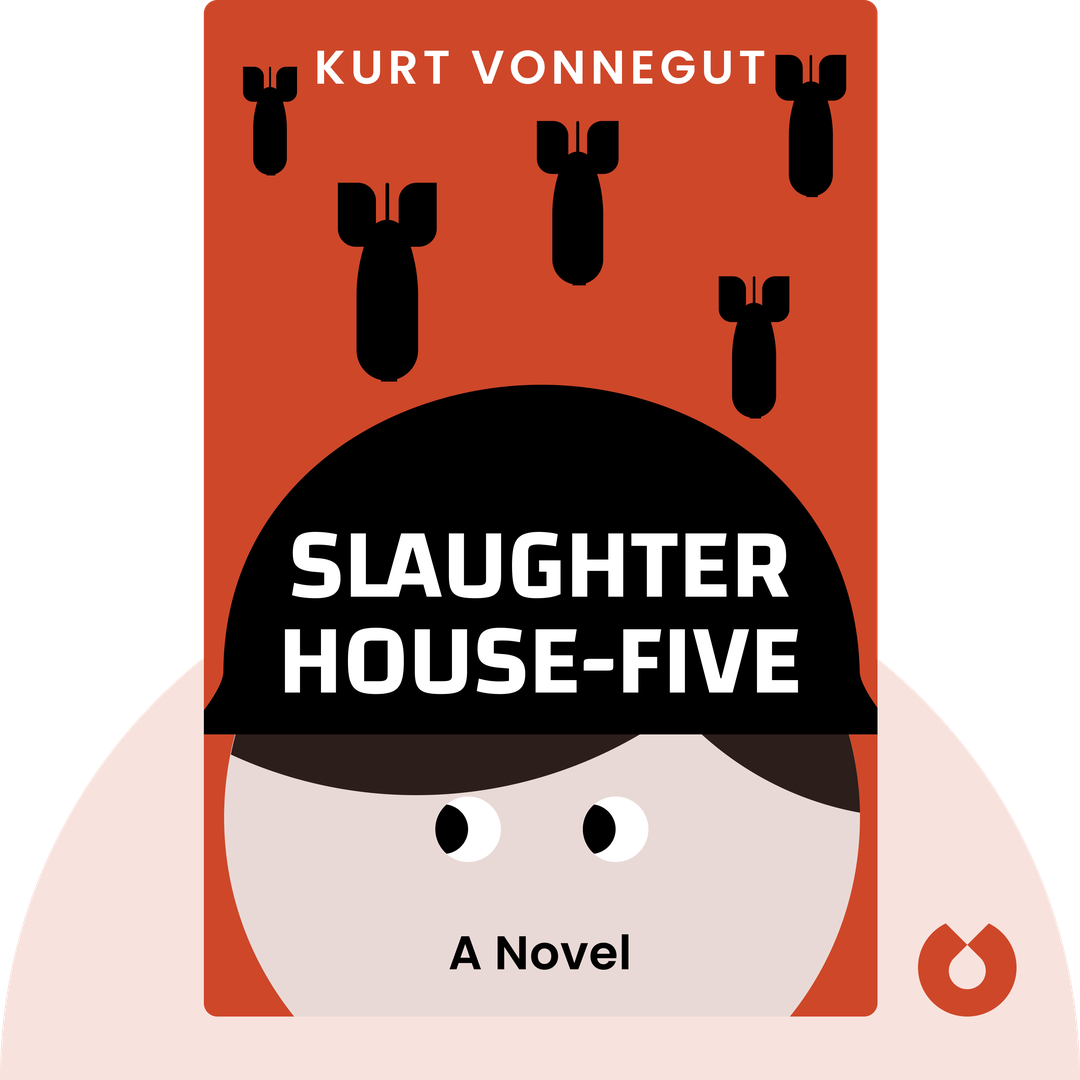
Slaughterhouse-Five (1969) is a seminal work that delves into the experiences of Billy Pilgrim, a soldier who becomes unstuck in time after surviving the devastating bombing of Dresden in World War II. It intricately interweaves themes of fate, free will, and the nature of time, using a nonlinear narrative that reflects the protagonist's time-traveling episodes. Through dark humor and poignant commentary, it critiques the horrors of war and the absurdities of human existence.
Who Should Listen to Slaughterhouse-Five?
- Pacifists looking for works that offer a profound exploration of the horrors of conflict
- Historians interested in semi-autobiographical tales of Vonnegut’s war experiences
- Fans of novels that challenge traditional narrative structures through nonlinear storytelling
Books Similar to Slaughterhouse-Five
Readers who enjoyed this also liked these titles.