If You're Curious About These Questions...
You should listen to this audiobook
- Have you ever wondered how two reporters convinced some of the world’s most famous women to risk everything and break decades of silence?
- What’s the secret to dismantling a system of abuse that was protected for years by elite lawyers and high-stakes intimidation?
- Are you curious about how a handful of determined journalists turned a wall of 'off-the-record' whispers into the most explosive news story of the decade?
Listen to She Said — Cinematic Audio Edition
Loading player...
Key Takeaways from She Said
- Discover how the collective courage of 87 women proved that sharing personal stories can dismantle even the most heavily protected and powerful systems of abuse.
- Learn how investigative journalists overcame a lack of physical evidence by focusing on protecting future victims, a strategy that successfully convinced hesitant sources to step forward.
- Understand why powerful predators are able to hide in plain sight by using philanthropic acts and public feminist credentials to deflect suspicion from their crimes.
- Find out how non-disclosure agreements and the fear of career destruction were weaponized by Hollywood elites to isolate victims and bury public records.
- Recognize the crucial role of internal whistleblowers by seeing how insiders, unwilling to continue enabling a predator, provided the vital internal evidence needed to break the story.
Learning Tools
Reinforce what you learned from She Said
Mind Map
She Said
The Investigation Begins+
Uncovering the Pattern+
Weinstein's Defense Machine+
Finding Hard Evidence+
Publication & Immediate Fallout+
The #MeToo Era+
Legacy and Healing+
Quiz — Test Your Understanding
Question 1 of 9
How did the New York Times investigation into Harvey Weinstein initially begin?
Question 2 of 9
What legal mechanism did Kantor and Twohey discover was primarily used by Weinstein to keep his victims from speaking out?
Question 3 of 9
Why was Laura Madden's account particularly vital to the journalists' investigation?
Question 4 of 9
Which of the following tactics did Weinstein use in his attempt to derail the New York Times investigation?
Question 5 of 9
Why did Weinstein Company insiders, like accountant Irwin Reiter and Bob Weinstein, ultimately help the journalists?
Question 6 of 9
Who was the first high-profile actress to finally agree to go on the record for the initial New York Times exposé?
Question 7 of 9
According to the text, what was one of the criticisms or shortcomings of the #MeToo movement as it expanded?
Question 8 of 9
What motivated psychology professor Christine Blasey Ford to come forward with her allegations against Brett Kavanaugh?
Question 9 of 9
What was a key takeaway from the 2019 gathering of #MeToo survivors at Gwyneth Paltrow's house?
She Said — Full Chapter Overview
- 1Recommendation
- 2Harvey Weinstein's investigation started with a simple initial email exchange.
- 3Kantor and Twohey uncovered dozens of victims, but none agreed to go on record.
- 4Kantor and Twohey suspected numerous Weinstein victims were silenced by strict confidentiality agreements for years.
- 5Weinstein built a sizable team to derail and discredit Kantor and Twohey’s investigation.
- 6Weinstein’s business partners were willing to cooperate, largely to save their company from his reckless behavior overall.
- 7O’Connor’s memo sparked a frenzied few days of intensive work at the Times.
- 8After repelling last-minute legal threats from Weinstein, Kantor and Twohey’s explosive article published online that day.
- 9The Weinstein saga popularized #MeToo, an international conversation about sexual assault that traveled all the way to the Supreme Court.
- 10Ford delivered powerful testimony to the Senate, yet it didn’t halt Kavanaugh’s nomination in time.
- 11In January 2019, Kantor and Twohey convened many women central to #MeToo for one last collective interview in the Hamptons.
She Said Summary & Overview
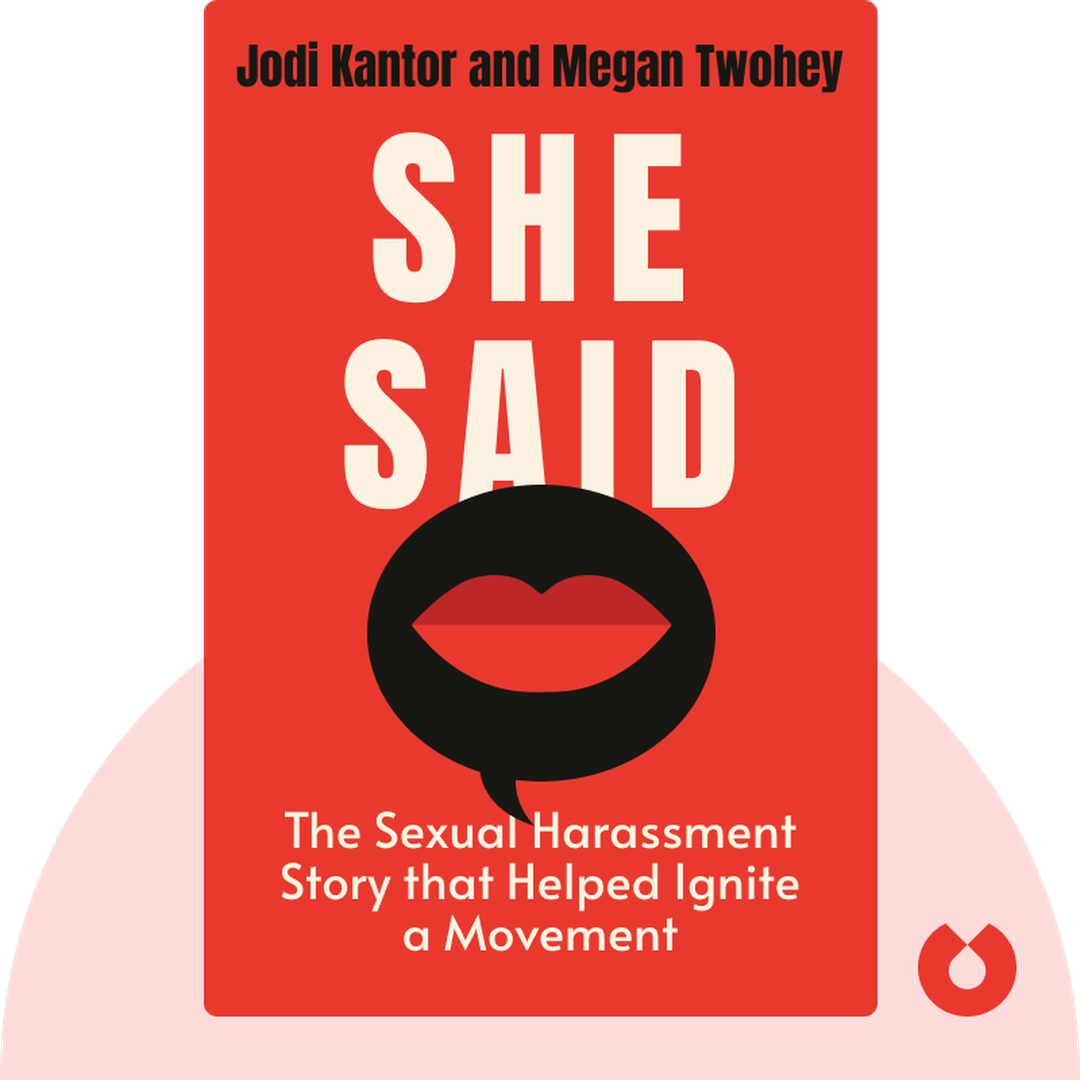
On October 5, 2017, the New York Times ran an exposé detailing years of sexual misconduct by famed film producer Harvey Weinstein. She Said (2019) tells the story behind the story, tracing how two investigative journalists, Jodi Kantor and Megan Twohey, uncovered one of the biggest news events of the decade and helped galvanize the #MeToo moment. Told by the journalists themselves, this book recounts how tenacious reporting can transform decades of abuse into a worldwide movement.
Who Should Listen to She Said?
- Anyone interested in the story behind the #MeToo movement
- People intrigued by the world of investigative journalism
- Those seeking inspiration on how to fight abuses of power and other injustices
Books Similar to She Said
Readers who enjoyed this also liked these titles.