If You're Curious About These Questions...
You should listen to this audiobook
- Why does the author argue that labeling someone as 'evil' is actually a weak and circular explanation for human cruelty?
- How does the distinction between 'cognitive' and 'affective' empathy explain the stark behavioral differences between a psychopathic serial killer and someone on the autism spectrum?
- What specific combination of genetic factors, such as the MAOA 'warrior gene,' and early childhood experiences ultimately creates the neurological recipe for psychopathy?
Listen to Science of Evil — Free Audiobook
Loading player...
Key Takeaways from Science of Evil
- Discover why using 'evil' to explain extreme cruelty is a flawed argument, and how measuring empathy provides a concrete, scientific alternative.
- Learn how human cruelty stems from 'empathy erosion,' a psychological state where we stop treating people as complete beings and start treating them as mere objects.
- Understand the 'double focus' of true empathy, which requires you to step into another person's perspective while simultaneously maintaining your own.
- Grasp the vital difference between cognitive empathy, which is recognizing how someone feels, and affective empathy, which is the inner drive to respond appropriately.
- Find out why empathy operates on a spectrum like a dimmer switch, fluctuating temporarily based on intense self-focus, stress, or everyday preoccupations.
Learning Tools
Reinforce what you learned from Science of Evil
Mind Map
Science of Evil
Moving from Evil to Empathy+
The Dual Nature of Empathy+
The Empathy Spectrum+
Biological Roots of Psychopathy+
Early Relationships and Development+
Quiz — Test Your Understanding
Question 1 of 10
Why does the author argue that using the concept of 'evil' to explain extraordinary cruelty is problematic?
Question 2 of 10
According to the text, what distinguishes empathy from sympathy?
Question 3 of 10
How does Martin Buber's 'I-it' mode relate to the concept of empathy erosion?
Question 4 of 10
How do the empathy profiles of individuals with psychopathic personality disorders typically differ from those with autism spectrum conditions?
Question 5 of 10
Which analogy is used in the text to describe how empathy functions in our everyday lives?
Question 6 of 10
What role did cognitive empathy play in the crimes of psychopathic serial killer Ted Bundy?
Question 7 of 10
Based on the research of psychologist Avshalom Caspi, what is the significance of the MAOA-L 'warrior gene' variant?
Question 8 of 10
According to a 2009 Cambridge University study, how does early exposure to testosterone affect empathy development?
Question 9 of 10
According to clinical psychologist Peter Fonagy, what causes a child to abandon the developmental process of 'mentalization'?
Question 10 of 10
In John Bowlby's attachment theory, what is the purpose of a 'secure base'?
Science of Evil — Full Chapter Overview
- 1Recommendation
- 2Cruelty arises when we reduce people to objects
- 3Empathy combines reason and emotion at once
- 4Empathy comes in shades rather than absolutes
- 5How a psychopath is formed
- 6How our earliest bonds mold empathy
Science of Evil Summary & Overview
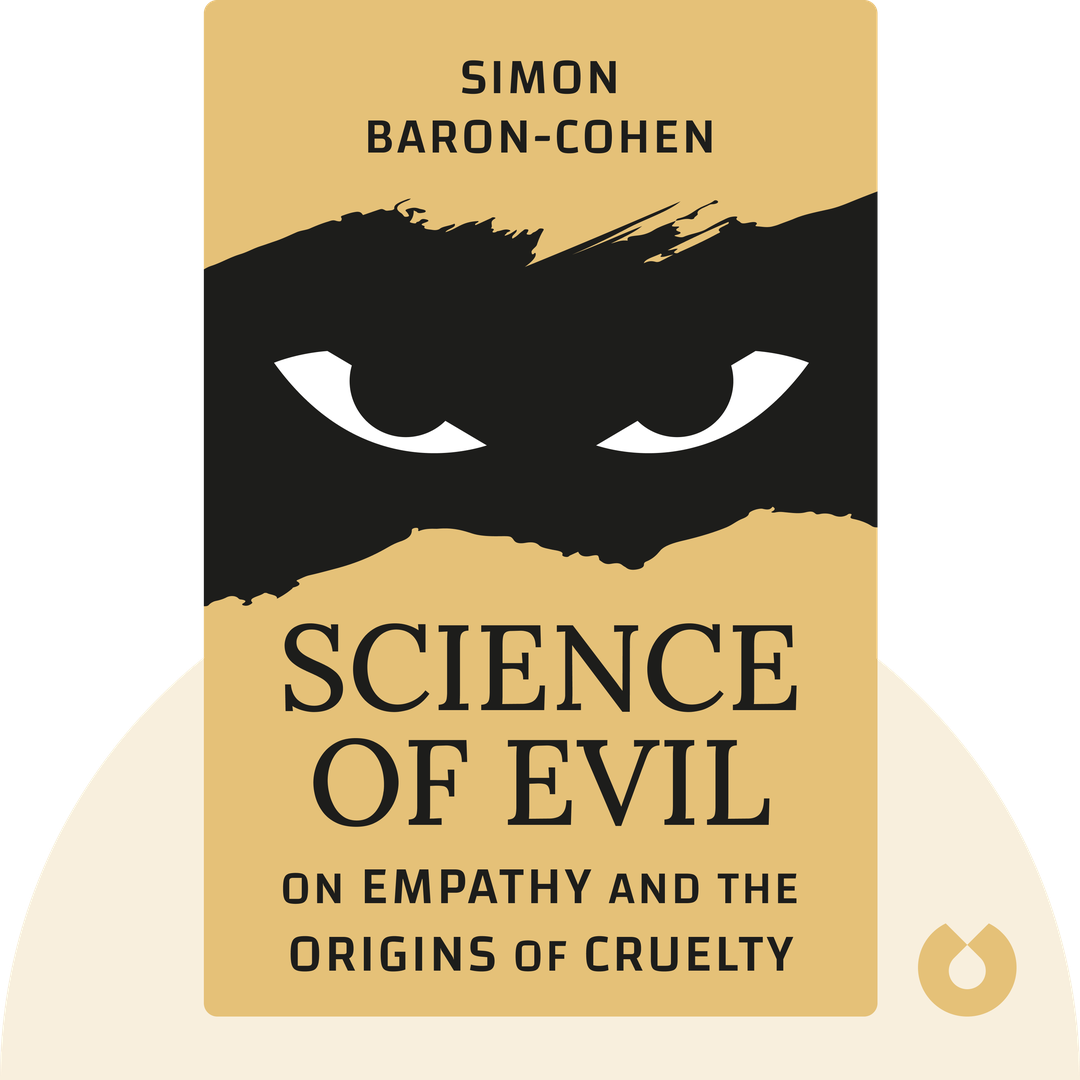
The Science of Evil (2011) seeks to understand what causes people to be cruel to one another. Doing away with the unscientific concept of “evil,” it suggests that the deeds we commonly associate with that word can be better explained by an absence of empathy. Cruelty, it argues, becomes possible when we lose sight of others’ humanity and treat them as mere objects.
Who Should Listen to Science of Evil?
- Anyone interested in empathy and interpersonal relationships
- Professionals in mental health and therapeutic fields
- Curious minds seeking to understand the science behind moral behavior
Books Similar to Science of Evil
Readers who enjoyed this also liked these titles.