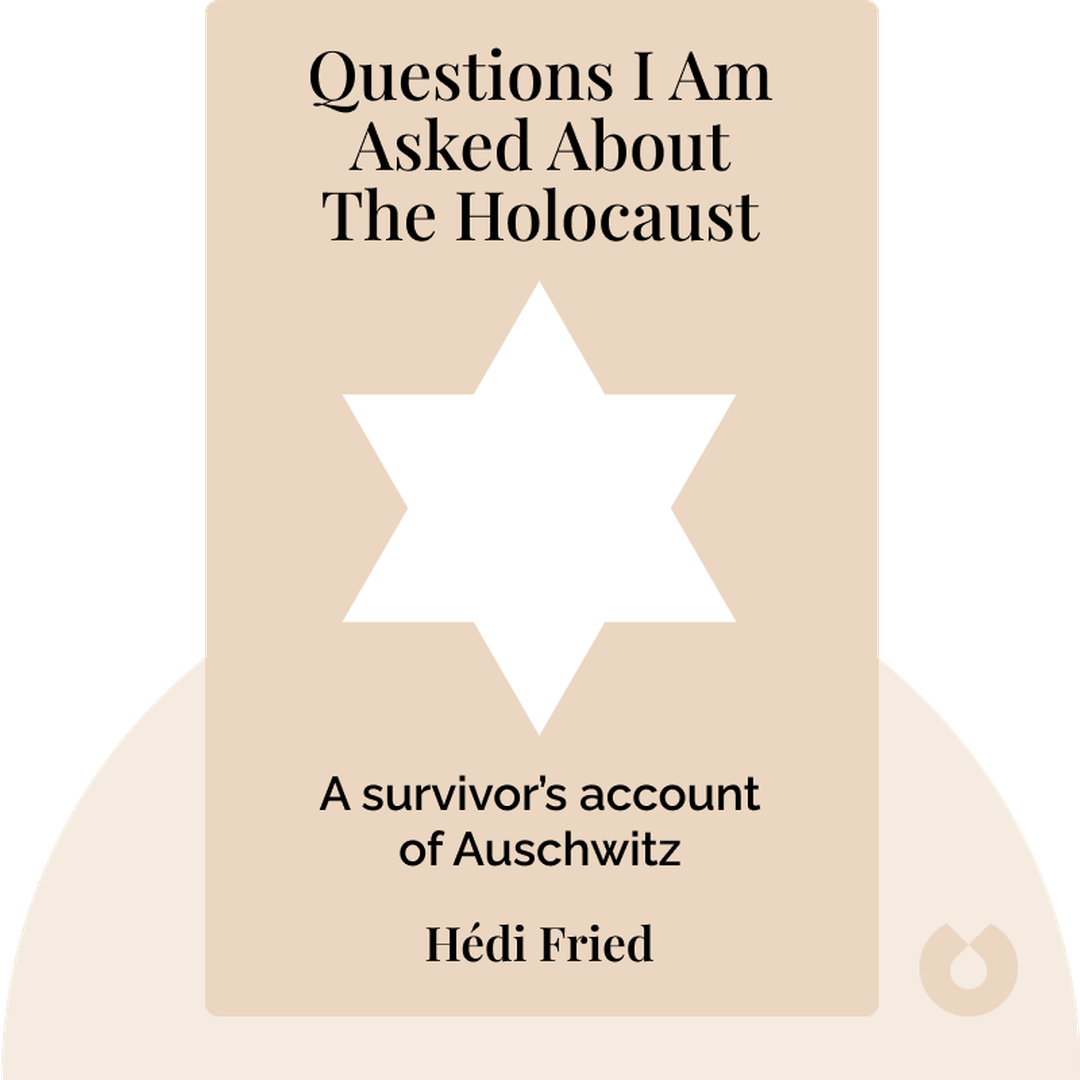
Questions I Am Asked About The Holocaust
Start ListeningDownload Try free on iPhoneScan to start in 5 seconds
Categories:
If You're Curious About These Questions...
You should listen to this audiobook
- Have you ever wondered how a Holocaust survivor answers the raw, unfiltered questions that children ask but adults are often too afraid to voice?
- Did you know that the warning signs of history’s darkest chapters often begin with subtle societal shifts that we might be overlooking today?
- Are you curious about what it truly takes to maintain your humanity and find the will to survive when faced with the most extreme cruelty imaginable?
Listen to Questions I Am Asked About The Holocaust — Free Audiobook
Loading player...
Key Takeaways from Questions I Am Asked About The Holocaust
- Understand why you must never grow accustomed to prejudice, as the gradual normalization of minor injustices paves the way for unimaginable horrors.
- Discover the three central, historical myths that fueled European anti-Semitism and created an environment where the Holocaust became possible.
- Recognize the dangerous warning signs of today's rising nationalism, where charismatic leaders scapegoat vulnerable minorities with simple solutions to complex problems.
- Learn about the immediate, disorienting terror of arriving at Auschwitz and the cruel reality of families being arbitrarily separated by Dr. Mengele.
- Explore firsthand answers to profound questions about the Holocaust, from the daily survival of women in camps to the complex emotions survivors felt toward their captors.
Learning Tools
Reinforce what you learned from Questions I Am Asked About The Holocaust
Mind Map
Questions I Am Asked About The Holocaust
The Creep of Injustice+
Roots of European Anti-Semitism+
Camp Experience & Terror+
Liberation & Aftermath+
Processing Trauma & Hatred+
Vigilance & "Never Again"+
Quiz — Test Your Understanding
Question 1 of 8
What is Hédi Fried's central message regarding the early signs of prejudice and injustice?
Question 2 of 8
According to the text, which of the following is ONE of the three central myths that fueled European anti-Semitism?
Question 3 of 8
How did Dr. Mengele determine the immediate fate of the new arrivals at Auschwitz?
Question 4 of 8
How did extreme hunger affect the relationships among the women in the concentration camps?
Question 5 of 8
What specific, often overlooked difficulty did women face in the concentration camps?
Question 6 of 8
Why did Hédi receive lashes with a reed on her very first day of school in Romania?
Question 7 of 8
What profound realization did Hédi eventually have regarding her intense hatred for her captors?
Question 8 of 8
According to Hédi Fried, what is the most effective way to ensure the message of 'Never Again' truly resonates with new generations?
Questions I Am Asked About The Holocaust — Full Chapter Overview
- 1Recommendation
- 2Injustice must be crushed right from the very start.
- 3European antisemitism arose from three core myths.
- 4The terror of the concentration camp was evident even upon arrival.
- 5Prisoners in the camps endured severe and relentless hunger.
- 6For a woman, life in the concentration camp posed special challenges.
- 7The immediate aftermath of the Holocaust was disorienting, with many desperately seeking their way back to homes that now no longer existed.
- 8Holocaust survivors have long wrestled with questions of identity.
- 9Many Holocaust survivors felt justified hatred for their captors, yet found lasting hatred impossible.
- 10The slogan “Never Again” means nothing unless we’re truly vigilant.
Questions I Am Asked About The Holocaust Summary & Overview
Questions I Am Asked About The Holocaust (2019) is a survivor’s account of the darkest moment in recent European history. Hédi Fried has spent her life educating young people about the Holocaust and answering their questions. In this book, she considers those questions one by one, and paints a picture of her nightmarish experience that should act as a warning from history.
Who Should Listen to Questions I Am Asked About The Holocaust?
- Anyone worried about the rise of racism and nationalism today
- Those with relatives affected by the Holocaust
- People interested in modern European history
Books Similar to Questions I Am Asked About The Holocaust
Readers who enjoyed this also liked these titles.