If You're Curious About These Questions...
You should listen to this audiobook
- Did you know that companies can actually predict your next move—from what you'll buy to when you might quit your job—before you even realize it yourself?
- Have you ever wondered how a single line of code can help doctors save lives or stop a bank robbery before it even happens?
- What’s the secret to turning massive piles of raw data into a 'crystal ball' that can forecast the future of global markets and personal health?
Listen to Predictive Analytics — Free Audiobook
Loading player...
Key Takeaways from Predictive Analytics
- Understand how predictive analytics lowers business risks by using machine learning and backtesting to anticipate specific individual behaviors rather than general trends.
- Discover the ethical dilemmas and privacy concerns of data mining, including how predictive models can inadvertently enforce prejudice and racial profiling.
- Learn why an abundance of data requires careful balancing to avoid costly false correlations, like the statistical illusion that orange cars are less likely to break down.
- Explore how organizations leverage predictive scoring and everyday behavioral data to optimize targeted marketing, forecast investments, and even prevent localized crimes.
- Find out how machine learning empowers predictive models to continuously adapt and uncover disguised 'microrisks' that traditional analysis might overlook.
Learning Tools
Reinforce what you learned from Predictive Analytics
Mind Map
Predictive Analytics
Core Concepts & Functionality+
Ethics, Privacy & Prejudice+
Data Quality & Balance+
Machine Learning Risks & Rewards+
Ensemble Models & Crowdsourcing+
Natural Language Processing+
The Uplift Model & Persuasion+
Quiz — Test Your Understanding
Question 1 of 8
What is the primary purpose of predictive analytics (PA) in a business context, according to the text?
Question 2 of 8
How does 'backtesting' improve the accuracy of predictive tools?
Question 3 of 8
Why does the text suggest that using predictive analytics in the criminal justice system can be problematic?
Question 4 of 8
According to the text, what is a primary cause of false correlations in predictive analytics, such as the claim that orange cars are less likely to be faulty?
Question 5 of 8
What is the danger of 'overlearning' in machine learning models?
Question 6 of 8
How did the 2008 Netflix crowdsourcing competition significantly advance the field of predictive analytics?
Question 7 of 8
How did IBM's Watson differ from traditional predictive analytics models?
Question 8 of 8
What specific problem does the 'uplift model' attempt to solve in marketing?
Predictive Analytics — Full Chapter Overview
- 1Recommendation
- 2Predictive analytics helps you reduce risks and make smarter, safer decisions overall.
- 3Predictive efforts raise questions about responsibility, morality, and potential prejudice.
- 4Data is inherently predictive, but accuracy needs a well-balanced amount of data.
- 5Machine learning can reveal overlooked risks, yet risks to machine learning exist too and must be managed.
- 6Combining multiple data sources and models boosts accuracy and performance.
- 7Human language presents tough challenges, yet major advances have already arrived today.
- 8Predictive analytics identifies the imperceptible by measuring and quantifying persuasion.
Predictive Analytics Summary & Overview
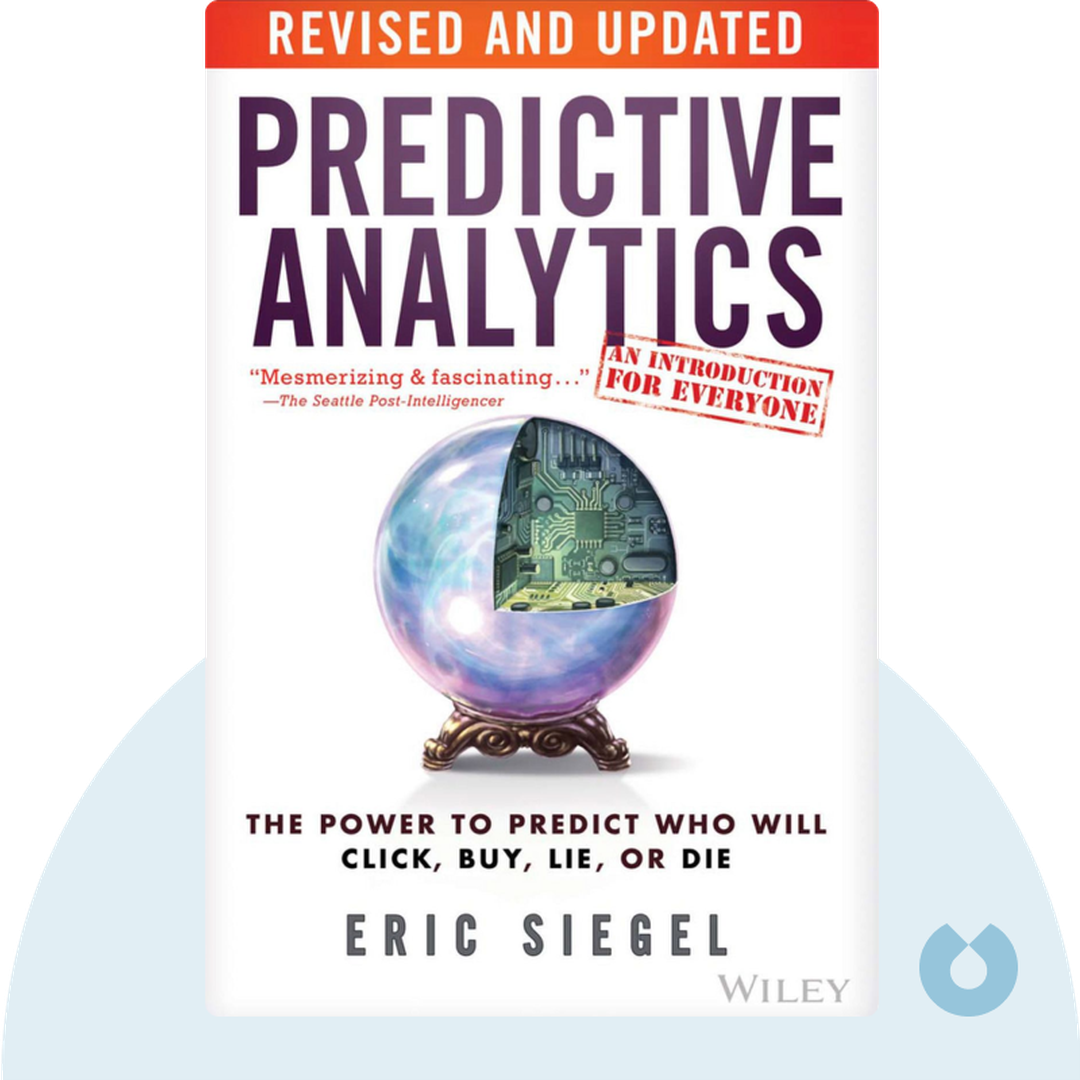
Predictive Analytics (2016) provides a helpful introduction to a complex and fascinating field. Learn how data gets crunched so that people can make more informed decisions, a practice that has drastically altered the way the world conducts its research and runs its businesses. Siegel offers an enlightening glimpse at the wide-ranging areas that have been forever changed, from marketing to health care, banking to artificial intelligence.
Who Should Listen to Predictive Analytics?
- Business students interested in applied analytics
- Readers interested in economics
- Tech geeks curious about artificial intelligence
Books Similar to Predictive Analytics
Readers who enjoyed this also liked these titles.