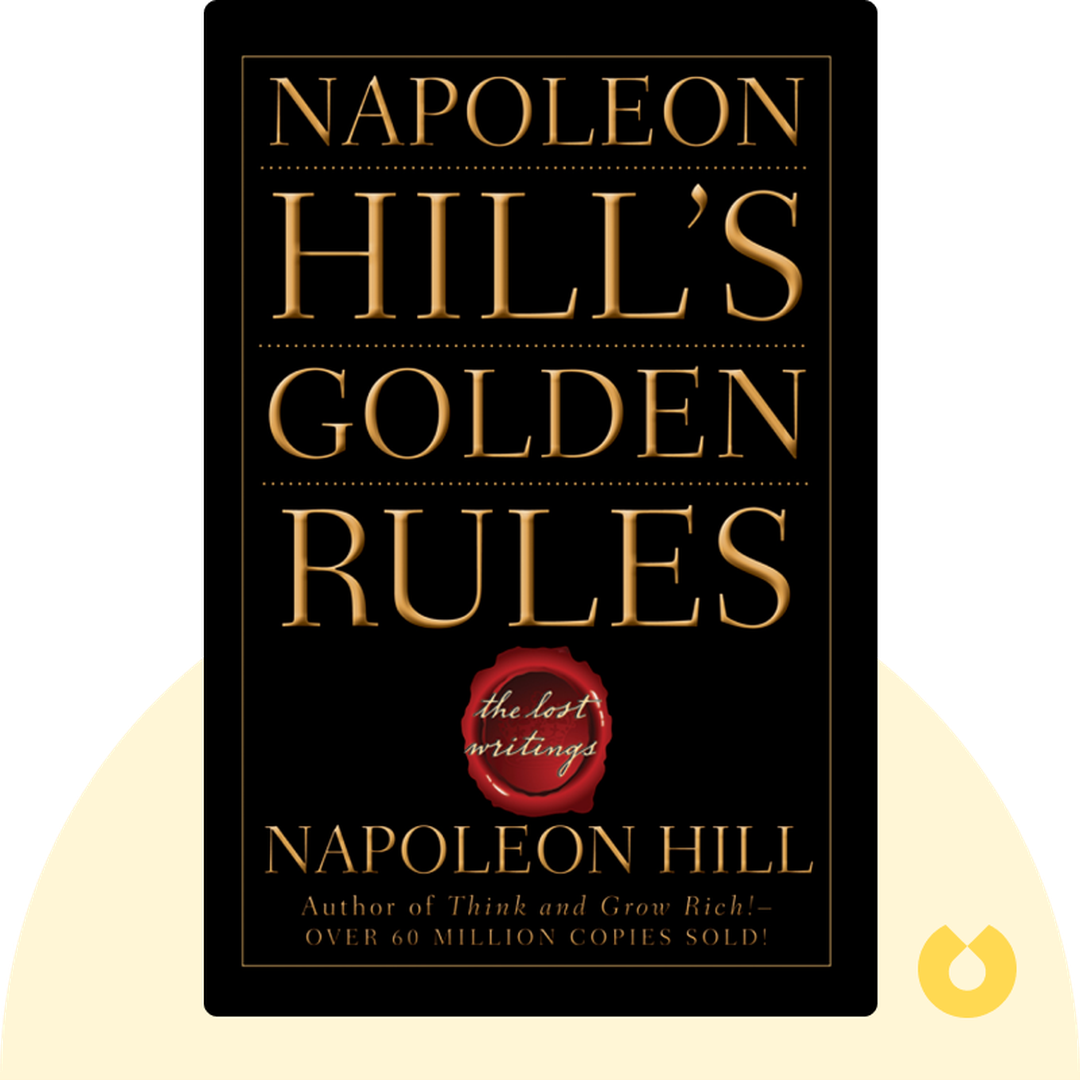
Napoleon Hill’s Golden Rules
Start ListeningDownload Try free on iPhoneScan to start in 5 seconds
Categories:
If You're Curious About These Questions...
You should listen to this audiobook
- What's the secret to turning your thoughts into tangible results?
- Are you curious about how to rewire your mind for success?
- What if you could tap into the power of positive thinking to overcome any obstacle?
Listen to Napoleon Hill’s Golden Rules — Free Audiobook
Loading player...
Key Takeaways from Napoleon Hill’s Golden Rules
- Discover how to achieve success without natural talent by replacing defeatist thoughts with determination and actionable habits.
- Learn how to use autosuggestion and imaginary conversations with historical figures to absorb their best traits and overcome personal fears.
- Master the art of persuasion using a strategy from Shakespeare by initially agreeing with opponents to gain their trust before introducing your own ideas.
- Understand why positive reinforcement and subtle suggestions are far more effective than criticism for boosting employee efficiency and closing sales.
- Find out how to harness the practical power of prayer to improve your business performance and achieve professional goals, regardless of your religious beliefs.
Learning Tools
Reinforce what you learned from Napoleon Hill’s Golden Rules
Mind Map
Napoleon Hill’s Golden Rules
Power of Thought+
Persuasion & Influence+
Positive Suggestion+
Law of Retaliation & Prayer+
Self-Confidence & Affirmations+
Habit Formation+
Power of Environment+
Memory & Observation+
Actionable Advice+
Quiz — Test Your Understanding
Question 1 of 9
How did Napoleon Hill use autosuggestion to develop desirable personal characteristics?
Question 2 of 9
According to the book, what is the most effective way to change someone's mind or convince a crowd, as demonstrated by Marc Antony in Julius Caesar?
Question 3 of 9
How did the manager in the book successfully handle an employee whose efficiency had recently dropped?
Question 4 of 9
What is the 'law of retaliation' in the context of business and personal interactions?
Question 5 of 9
According to Hill, what is the foundational step required to develop true self-confidence?
Question 6 of 9
Why does Hill recommend developing positive habits rather than relying solely on willpower?
Question 7 of 9
What does the book suggest is the primary reason the current prison system fails to reform inmates?
Question 8 of 9
Which of the following represents the three steps Hill recommends for strengthening your memory of people's names?
Question 9 of 9
What is the primary reason given in the actionable advice section for why you should 'dress for success'?
Napoleon Hill’s Golden Rules — Full Chapter Overview
- 1Recommendation
- 2We shape our lives through our thoughts, which can lead to transformative success.
- 3Shakespeare shows us how to win anyone’s confidence – another key to success.
- 4Positive suggestions can boost workplace performance and even improve health.
- 5Use the power of prayer and the law of retaliation to secure better business deals.
- 6Self-confidence is a vital part of success and can be strengthened through affirmation.
- 7Autosuggestion can also help develop useful habits.
- 8We should surround ourselves with positive influences and remove negative ones from our prisons.
- 9Tips for strengthening memory include a technique that also sharpens our powers of observation.
- 10Final summary
Napoleon Hill’s Golden Rules Summary & Overview
Napoleon Hill’s Golden Rules (2009) offers a wide array of tips and life hacks to improve your life and bring you closer to realizing your goals. Author Napoleon Hill developed his techniques – many of which stem from the power of positive thinking – nearly a century ago, but they’re still the cornerstone of many of today’s self-help and personal development theories.
Who Should Listen to Napoleon Hill’s Golden Rules?
- Entrepreneurs
- Students of business and marketing
- Readers who want to develop better habits
Books Similar to Napoleon Hill’s Golden Rules
Readers who enjoyed this also liked these titles.