If You're Curious About These Questions...
You should listen to this audiobook
- Have you ever wondered why some middle-income workers retire as millionaires while many high-earning professionals end up broke?
- What’s the secret to outperforming most financial advisors using a simple strategy that takes less than ninety minutes a year to manage?
- Did you know that following conventional investment advice might actually be the biggest obstacle standing between you and true financial freedom?
Listen to Millionaire Teacher — Cinematic Audio Edition
Loading player...
Key Takeaways from Millionaire Teacher
- Discover why true wealth depends more on frugal spending habits than a high-paying salary, and learn why the average millionaire drives a Toyota instead of a luxury car.
- Understand the wealth-building magic of compound interest and why investing your money as early as possible yields much greater rewards than simply leaving it in a savings account.
- Learn why you should avoid actively managed funds pushed by financial advisors, as 96 percent of them actually perform worse than the overall stock market after fees and taxes.
- Find out how investing in low-cost index funds offers a simpler, more profitable strategy by allowing your money to reliably grow with the entire stock market.
- Master the art of stabilizing your investment portfolio by treating it like a balanced diet and using bonds to offset the risks of the stock market.
Learning Tools
Reinforce what you learned from Millionaire Teacher
Mind Map
Millionaire Teacher
Frugality & Saving+
Compound Interest+
Index Funds Over Active Management+
Portfolio Stability with Bonds+
Avoid Market Timing+
Picking Individual Stocks+
Quiz — Test Your Understanding
Question 1 of 8
According to the book, what is the most critical factor in accumulating wealth?
Question 2 of 8
What does wealth researcher Thomas Stanley's data reveal about the lifestyle of the average American millionaire?
Question 3 of 8
Why does the author emphasize starting to invest as early as possible?
Question 4 of 8
Why does the author recommend index funds over actively managed funds?
Question 5 of 8
What primary role do bonds play in an investment portfolio?
Question 6 of 8
According to the book's rule of thumb, what percentage of your investment portfolio should be allocated to bonds if you are 45 years old?
Question 7 of 8
What is the author's stance on 'timing the market' (trying to predict when the stock market will rise or fall)?
Question 8 of 8
If an investor cannot resist the urge to buy specific individual stocks, what guidelines does the book suggest?
Millionaire Teacher — Full Chapter Overview
- 1Recommendation
- 2Reduce your spending if you want to build wealth.
- 3Start investing as early as possible to benefit from compound interest.
- 4Skip actively managed funds and choose index funds instead.
- 5Use bonds to make your portfolio more stable.
- 6Resist the urge to “time the market.”
- 7If you insist on buying individual stocks, choose them very carefully.
- 8Final summary
Millionaire Teacher Summary & Overview
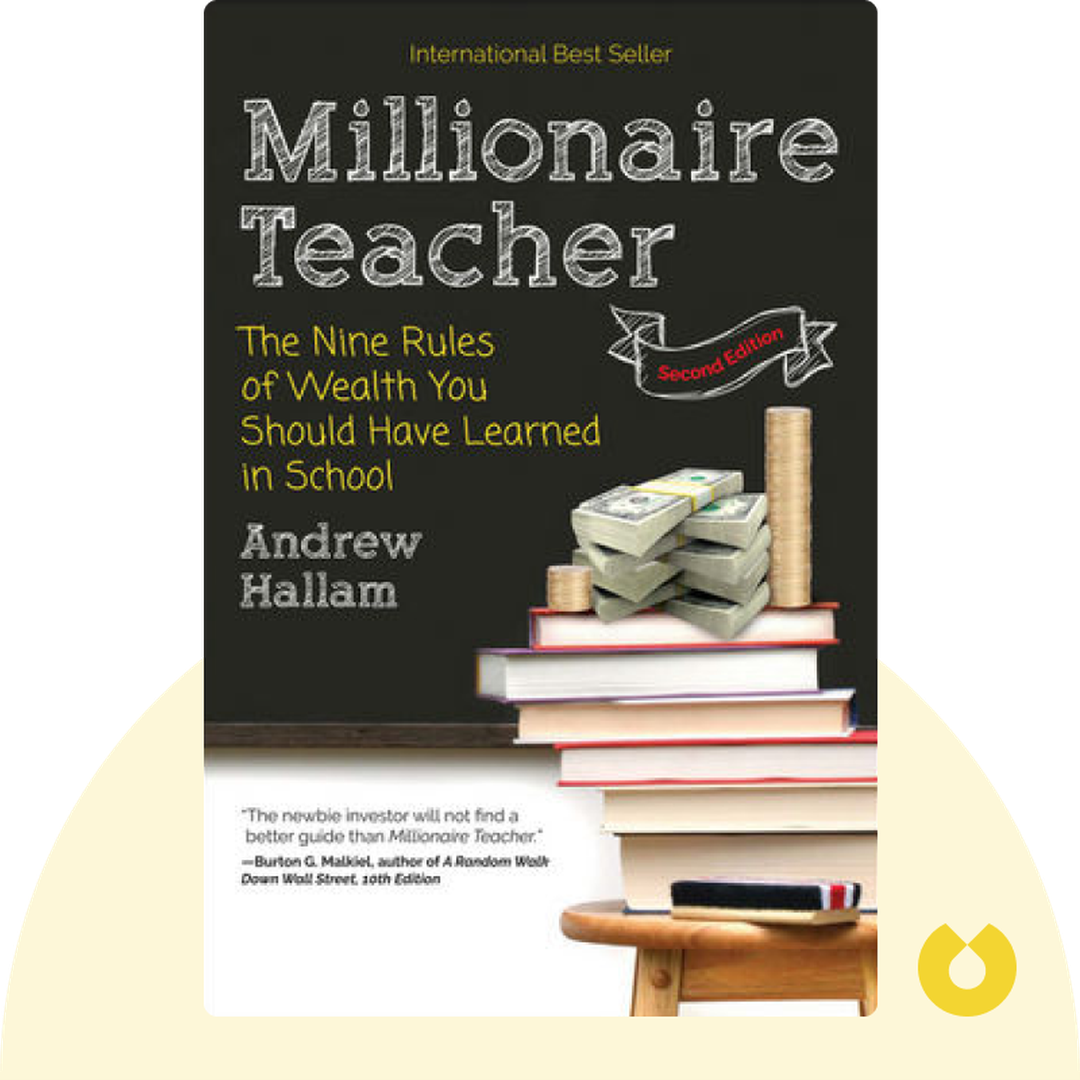
Millionaire Teacher (2011) explains how people with middling incomes can grow rich through clever money management. From the importance of frugality to the value of government bonds, this is a simple guide to growing wealthy on modest means.
Who Should Listen to Millionaire Teacher?
- Middle-income workers looking to grow wealthy
- Financial novices who want a simple guide to investing
- Anyone who needs to start saving for retirement
Books Similar to Millionaire Teacher
Readers who enjoyed this also liked these titles.