If You're Curious About These Questions...
You should listen to this audiobook
- Have you ever wondered how the deeply personal flaws of Abraham Lincoln and Jefferson Davis ultimately determined the fate of the entire American Union?
- Did you know that the outcome of the Civil War was shaped as much by the psychological battle between two rival leaders as it was by the soldiers on the front lines?
- Are you curious about the secret moral dilemmas and high-stakes decisions that defined the contrasting leadership styles of the two most powerful men in 19th-century America?
Listen to Lincoln vs. Davis — Free Audiobook
Loading player...
Key Takeaways from Lincoln vs. Davis
- Discover how the contrasting backgrounds of Jefferson Davis, a seasoned military man, and Abraham Lincoln, a self-taught politician, fundamentally shaped their respective strategies at the dawn of the Civil War.
- Learn how the Confederate capture of Fort Sumter acted as a double-edged sword, unifying a previously indifferent North while simultaneously pushing Virginia to join the Confederacy.
- Understand why Jefferson Davis’s desperate need for foreign alliances was severely hindered by Britain and France's reluctance to support a slaveholding nation.
- Find out how Lincoln's lack of military experience and demand for a direct march on Richmond led to a humiliating Union defeat against strategically reinforced Confederate troops at the First Battle of Bull Run.
- Explore how the early military maneuvers of Jefferson Davis and his Confederate generals inadvertently pushed a hesitant Lincoln to make his decisive, war-altering shift toward emancipation.
Learning Tools
Reinforce what you learned from Lincoln vs. Davis
Mind Map
Lincoln vs. Davis
Leadership Profiles+
Early Conflict+
The Military Struggle+
The Strategic Shift+
Emancipation Proclamation+
Final Legacies+
Quiz — Test Your Understanding
Question 1 of 7
How did Abraham Lincoln respond to the standoff at Fort Sumter against the advice of General Winfield Scott?
Question 2 of 7
Why did President Lincoln order Major General John Frémont to rescind his declaration freeing enslaved people in Missouri?
Question 3 of 7
What was a defining characteristic of Union General George McClellan's leadership during the early years of the war?
Question 4 of 7
Why was Jefferson Davis initially hesitant to launch a major offensive invasion into the North?
Question 5 of 7
What fateful decision by Jefferson Davis and Robert E. Lee ultimately gave Lincoln the political opportunity to issue the Emancipation Proclamation?
Question 6 of 7
How did the Emancipation Proclamation affect the Confederacy's international standing?
Question 7 of 7
According to the book's final summary, what ultimately shaped the Union's survival and the abolition of slavery?
Lincoln vs. Davis — Full Chapter Overview
- 1Recommendation
- 2The story of two presidents
- 3The first shots are fired
- 4The soldier and the politician
- 5What path forward?
- 6The Little Napoleon
- 7Caught on the peninsula
- 8The defenders turn aggressors
- 9Redefining the war and the nation
- 10Final summary
Lincoln vs. Davis Summary & Overview
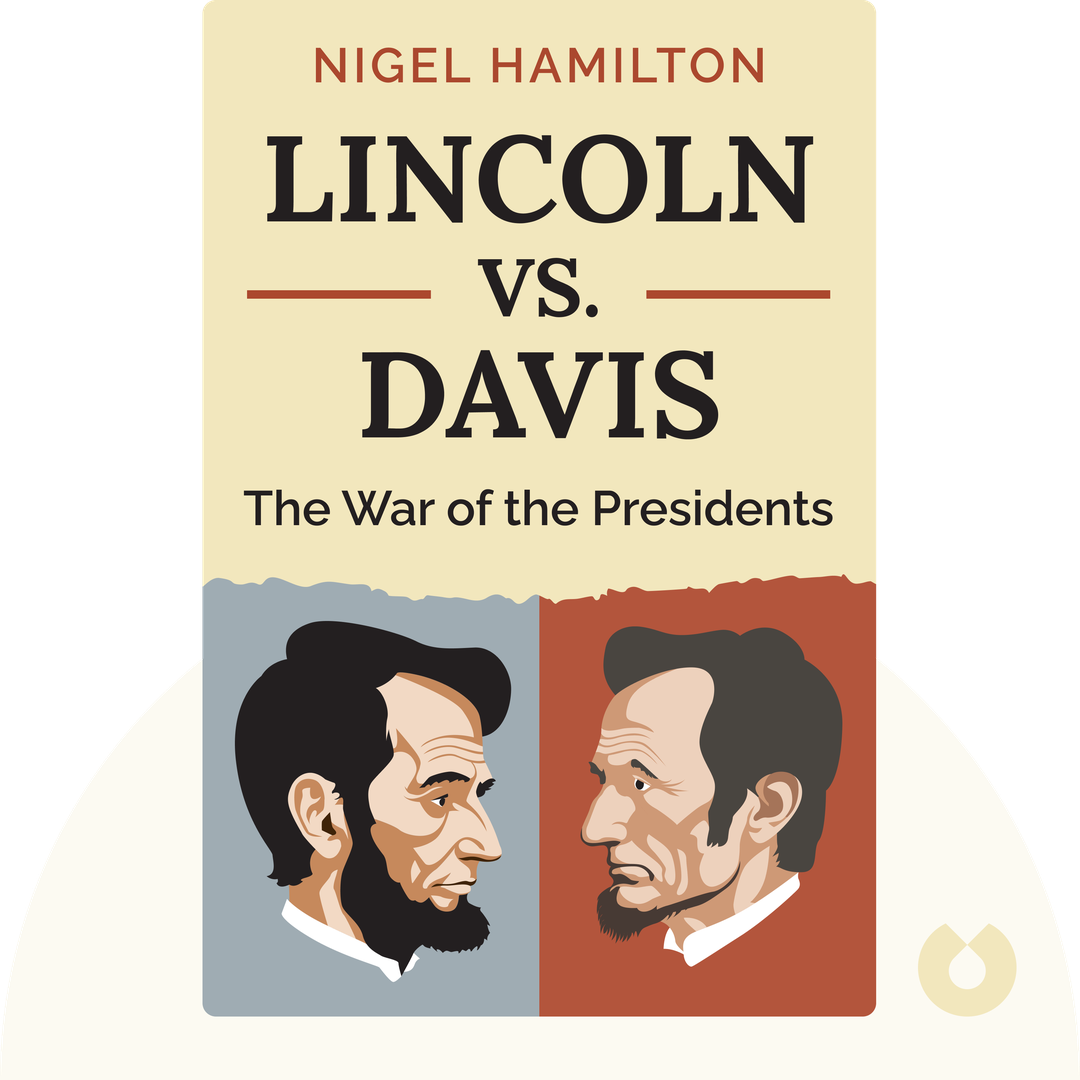
Lincoln vs. Davis (2024) offers a gripping, in-depth look at the personal and political struggles of Abraham Lincoln and Jefferson Davis during the American Civil War. Nigel Hamilton explores how these two men – one seeking to preserve the Union, the other fighting for Southern independence – shaped the fate of the nation through their contrasting leadership. With rich historical detail and fresh insights, this book reveals the high-stakes decisions, personal flaws, and moral dilemmas that defined America's most turbulent era.
Who Should Listen to Lincoln vs. Davis?
- History enthusiasts ready for their next chapter
- Civil War buffs looking for a fresh perspective on the war
- Biography fans
Books Similar to Lincoln vs. Davis
Readers who enjoyed this also liked these titles.