If You're Curious About These Questions...
You should listen to this audiobook
- Did you know that a single city battle in 1968 shattered the U.S. government's narrative that the Vietnam War was almost won?
- Have you ever wondered what it was like for soldiers to endure the most intense and brutal urban combat of the entire conflict?
- Are you curious about why the events in Hue became the definitive turning point that forever changed how the American public viewed the war?
Listen to Hue 1968 — Free Audiobook
Loading player...
Key Takeaways from Hue 1968
- Understand how the Battle of Hue became the definitive turning point that shifted American public opinion against the Vietnam War and derailed Lyndon B. Johnson’s political career.
- Discover why the Vietnam War was actually rooted in French colonial history, and how the US-backed cancellation of the 1956 democratic elections sparked the Viet Cong's armed resistance.
- Learn why America's massive WWII-style bombing campaigns were entirely ineffective against Vietnam's agricultural society and ultimately inspired more communist recruits.
- Recognize how both sides operated on fatal misconceptions in 1968, with the US trusting massively inflated casualty metrics and Hanoi falsely expecting a civilian uprising.
- Explore the strategic and historical significance of Hue, a culturally vital city whose unexpected infiltration during the Tet Offensive required meticulous, clandestine planning.
Learning Tools
Reinforce what you learned from Hue 1968
Mind Map
Hue 1968
Historical Context+
Pre-Battle Delusions+
The Attack on Hue+
The US Counterattack+
The Media's Role+
Aftermath & Legacy+
Quiz — Test Your Understanding
Question 1 of 10
Why did the US and South Vietnamese governments refuse to hold the 1956 reunification elections mandated by the Geneva agreements?
Question 2 of 10
According to the text, why was the extensive US bombing campaign largely ineffective against North Vietnam?
Question 3 of 10
Why was General William Westmoreland overly optimistic about a swift victory in late 1967?
Question 4 of 10
What was a major expectation the North Vietnamese had for the Tet Offensive in Hue that ultimately failed to materialize?
Question 5 of 10
How did the Communist forces treat the local population of Hue after taking control of the city?
Question 6 of 10
How did US military command initially react to the Communist capture of Hue?
Question 7 of 10
How did US Marines adapt their combat strategy to successfully retake southern Hue?
Question 8 of 10
What was the significance of journalist Gene Roberts's reporting from Hue?
Question 9 of 10
What was a direct political consequence in the United States following the Battle of Hue and the Tet Offensive?
Question 10 of 10
According to the text, what was an unintended regional consequence of the prolonged Vietnam War following the Battle of Hue?
Hue 1968 — Full Chapter Overview
- 1Recommendation
- 2The Vietnam War had its roots in the region’s colonial past.
- 3America’s role in Vietnam escalated into full-scale war, with little success.
- 4By January 1968, both sides mistakenly believed victory was near.
- 5The Tet Offensive against Hue was planned in secret and in careful detail.
- 6The Tet Offensive began on the night of January 30, 1968.
- 7After Hue was captured, the expected people’s uprising never happened.
- 8US military leaders seriously underestimated the strength of the Northern attack on Hue.
- 9Journalists such as Gene Roberts exposed the reality of what was happening in Hue.
- 10The American and South Vietnamese counterattack finally started gaining ground.
- 11The Battle of Hue became a turning point in American support for the Vietnam War.
- 12Hue’s ancient Citadel was finally recaptured on February 25, 1968.
- 13After the Battle of Hue, US withdrawal became only a matter of time.
- 14Final summary
Hue 1968 Summary & Overview
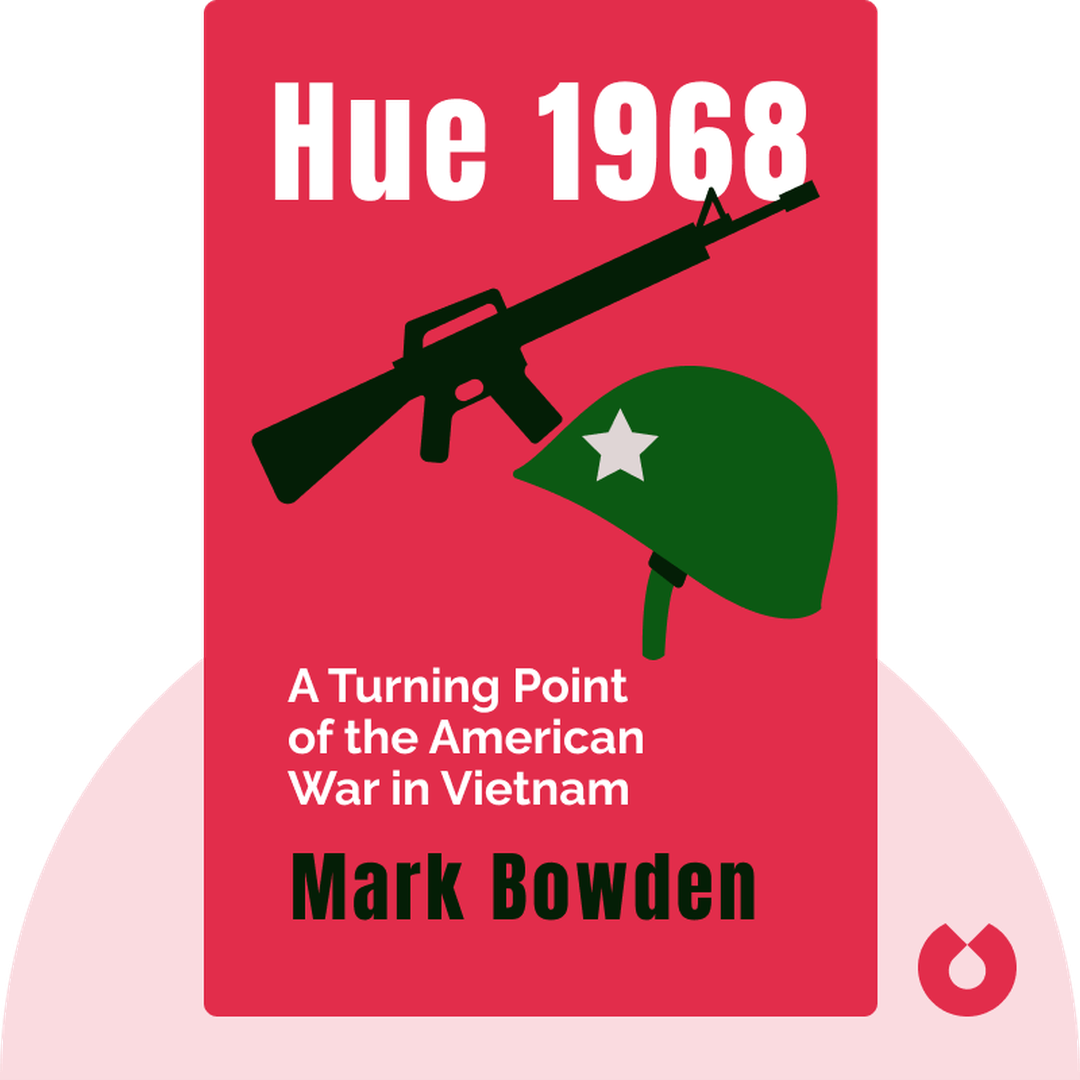
The Vietnam War is remembered as one of the longest and bloodiest conflicts of the twentieth century. At the end of 1967, the US government was assuring the public the war was almost won; by February 1968, that was no longer the case. In Hue 1968 (2017) Mark Bowden examines the battle in the city of Hue which changed the way the American public viewed the war.
Who Should Listen to Hue 1968?
- Anyone interested in modern American history
- Students of politics or international relations
- Soldiers and veterans
Books Similar to Hue 1968
Readers who enjoyed this also liked these titles.