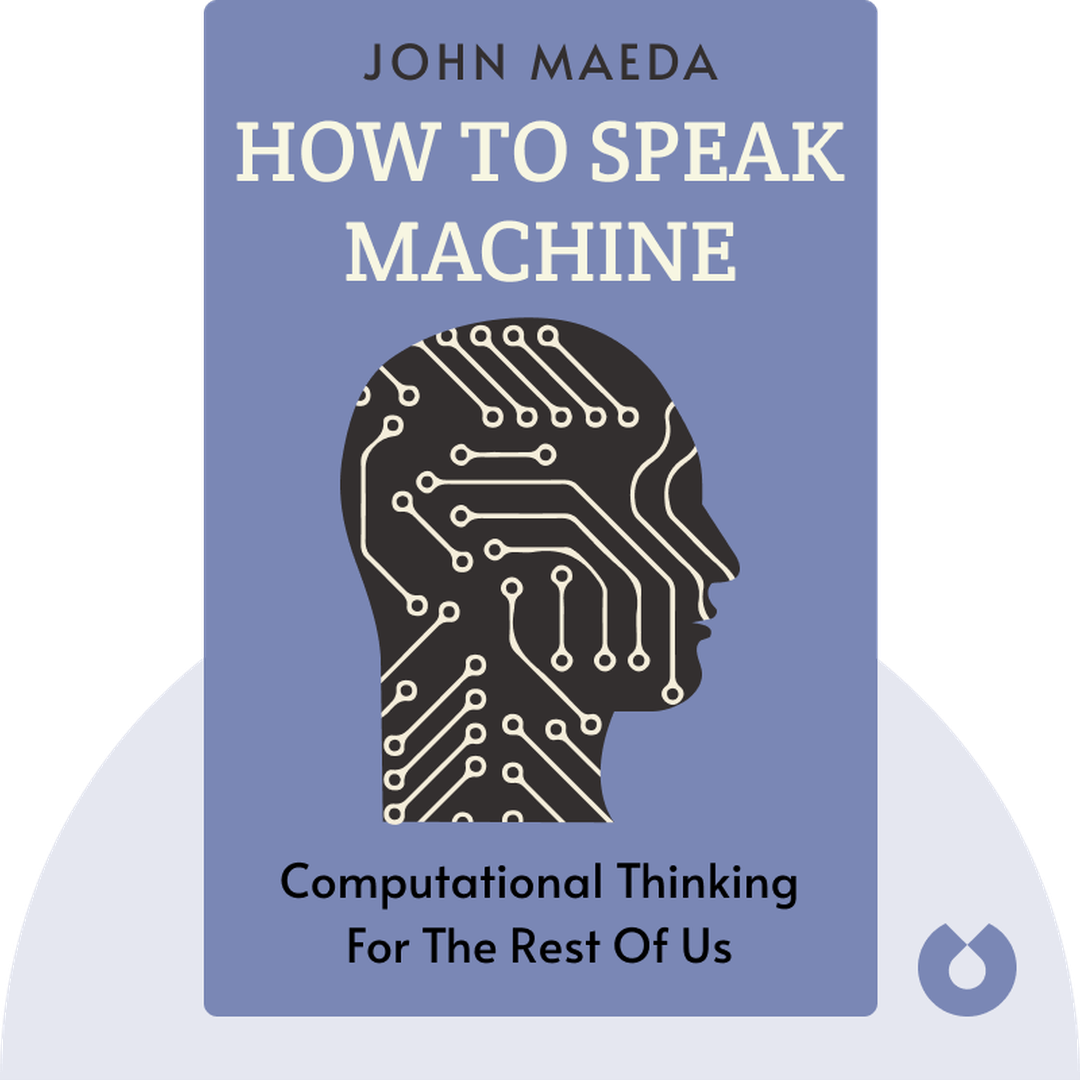
If You're Curious About These Questions...
You should listen to this audiobook
- Have you ever wondered how the invisible logic of computers is silently reshaping our business, politics, and personal lives?
- Did you know that the way a machine is programmed can unintentionally perpetuate social biases—and what does that mean for our future?
- What’s the secret to 'speaking machine' and using that knowledge to protect your data while building more inclusive technology?
Listen to How to Speak Machine — Free Audiobook
Loading player...
Key Takeaways from How to Speak Machine
- Discover why learning to 'speak machine' is essential for navigating the digital future and unlocking lucrative, low-cost entrepreneurial opportunities.
- Understand how computers operate tirelessly through loops and recursion, functioning like infinite assembly lines and Russian nesting dolls.
- Learn how machines process information exponentially using nested code and cloud networks to multiply their collective computing power.
- Recognize the psychological risks of working with infinite digital scales, which can cause tech professionals to lose touch with reality and develop a god complex.
- Find out how deep learning empowers artificial intelligence to learn by observation, rapidly pushing technology toward a future where computers may surpass human intelligence.
Learning Tools
Reinforce what you learned from How to Speak Machine
Mind Map
How to Speak Machine
Fundamentals of Computing+
Evolution of Artificial Intelligence+
Business & Product Development+
Ethics & Human Limitations+
Actionable Advice+
Quiz — Test Your Understanding
Question 1 of 8
According to the book, how does 'recursion' in computer programming differ from a simple loop?
Question 2 of 8
What psychological danger does the author warn about for people who work closely with exponential computer scales?
Question 3 of 8
How does 'deep learning' enable computers to execute tasks?
Question 4 of 8
In the context of digital product development, what characterizes the 'lean or agile' business model?
Question 5 of 8
According to the text, how might a company use a pop-up survey to collect data beyond just the answers you type?
Question 6 of 8
Why does hiring primarily for a 'culture fit' in the tech industry often lead to problematic outcomes?
Question 7 of 8
What key limitation of machines is illustrated by the story of the AI designed to make soup?
Question 8 of 8
What actionable advice does the author provide to help users take back control of their personal data?
How to Speak Machine — Full Chapter Overview
- 1Recommendation
- 2Machines excel at repeating tasks endlessly.
- 3Computers think in exponential ways.
- 4Machines are becoming more and more lifelike.
- 5Machines have transformed how businesses make and sell products.
- 6Digital consumption lets companies get personal with your data — for better or worse.
- 7The tech world has a diversity problem, and machines can reinforce it.
- 8Machines process data, but data alone doesn’t always tell the whole story.
- 9Final summary
How to Speak Machine Summary & Overview
How to Speak Machine (2019) prepares us for a future where computers will play an increasingly dominant role in business, politics, and our personal lives. It helps us understand the inner workings of the machines we use every day and how their programming can perpetuate social issues or be used to exploit our personal data. By learning how to speak machine, we can arm ourselves with the knowledge we need to ensure that the future is inclusive and safe for everyone.
Who Should Listen to How to Speak Machine?
- Entrepreneurs interested in forming a tech start-up
- Policymakers who need to keep regulations up to date with technological advancements
- Anyone who wants to understand the basics behind how computers “think”
Books Similar to How to Speak Machine
Readers who enjoyed this also liked these titles.