If You're Curious About These Questions...
You should listen to this audiobook
- What’s the secret to revolutionizing your team’s efficiency without spending a single penny on new technology or consultants?
- Have you ever wondered why the most powerful solutions to your business challenges are hidden right where the work happens, yet often go completely unnoticed?
- What if you could eliminate the hidden waste in your workflow by applying a simple Japanese philosophy that prioritizes common sense over capital?
Listen to Gemba Kaizen — Cinematic Audio Edition
Loading player...
Key Takeaways from Gemba Kaizen
- Understand how to achieve more with less by eliminating muda (wasteful elements) from your daily processes without relying on expensive external consultants.
- Learn why frontline employees, not managers, are the true experts of your business and how to empower them to implement continuous, day-to-day improvements.
- Find out how a post-WWII Japanese manufacturing strategy can be adapted to drastically improve efficiency in any field, from hospital administration to your personal life.
- Master the use of flexible workplace standards to eliminate errors, and see how turning a single employee's clever solution into a company-wide procedure drives massive success.
- Discover how to apply the 'Five Ss' of workplace organization to foster self-discipline, starting with a clever red tape technique that quickly strips away nonessential clutter.
Learning Tools
Reinforce what you learned from Gemba Kaizen
Mind Map
Gemba Kaizen
Core Philosophy+
Eliminating Waste (Muda)+
The Gemba (Workplace)+
The 5S Framework+
Standardization+
Visual Management+
Leadership Roles+
Practical Tools+
Quiz — Test Your Understanding
Question 1 of 9
How does the Gemba Kaizen strategy primarily suggest companies achieve greater productivity?
Question 2 of 9
According to the principles of Gemba Kaizen, who are considered the 'real experts' responsible for creating and implementing improvement strategies?
Question 3 of 9
Why was the Kaizen philosophy initially so critical to the success of Toyota post-World War II?
Question 4 of 9
What is the primary purpose of establishing standards in the workplace according to Gemba Kaizen?
Question 5 of 9
In the 5S framework of self-discipline, what does the first step, Seiri (Sort), typically involve?
Question 6 of 9
How can visual management tools, like a whiteboard tracking daily production, directly improve workflow efficiency?
Question 7 of 9
How should a CEO demonstrate their commitment to the Gemba Kaizen mindset?
Question 8 of 9
Why did Soichiro Honda, the founder of Honda, reportedly never have a real office?
Question 9 of 9
What is the purpose of the 'five-why' technique mentioned in the book's actionable advice?
Gemba Kaizen — Full Chapter Overview
- 1Recommendation
- 2Gemba Kaizen is a low-cost strategy that boosts productivity by involving employees in eliminating unnecessary steps.
- 3Gemba Kaizen can be used across many kinds of businesses.
- 4Flexible standards help companies succeed.
- 5Self-discipline helps workplaces build and maintain efficiency.
- 6Visualizing work processes enables faster troubleshooting and boosts employee motivation.
- 7A Kaizen approach requires a CEO who practices what he preaches.
- 8Good managers work right in the Gemba.
- 9Final summary
Gemba Kaizen Summary & Overview
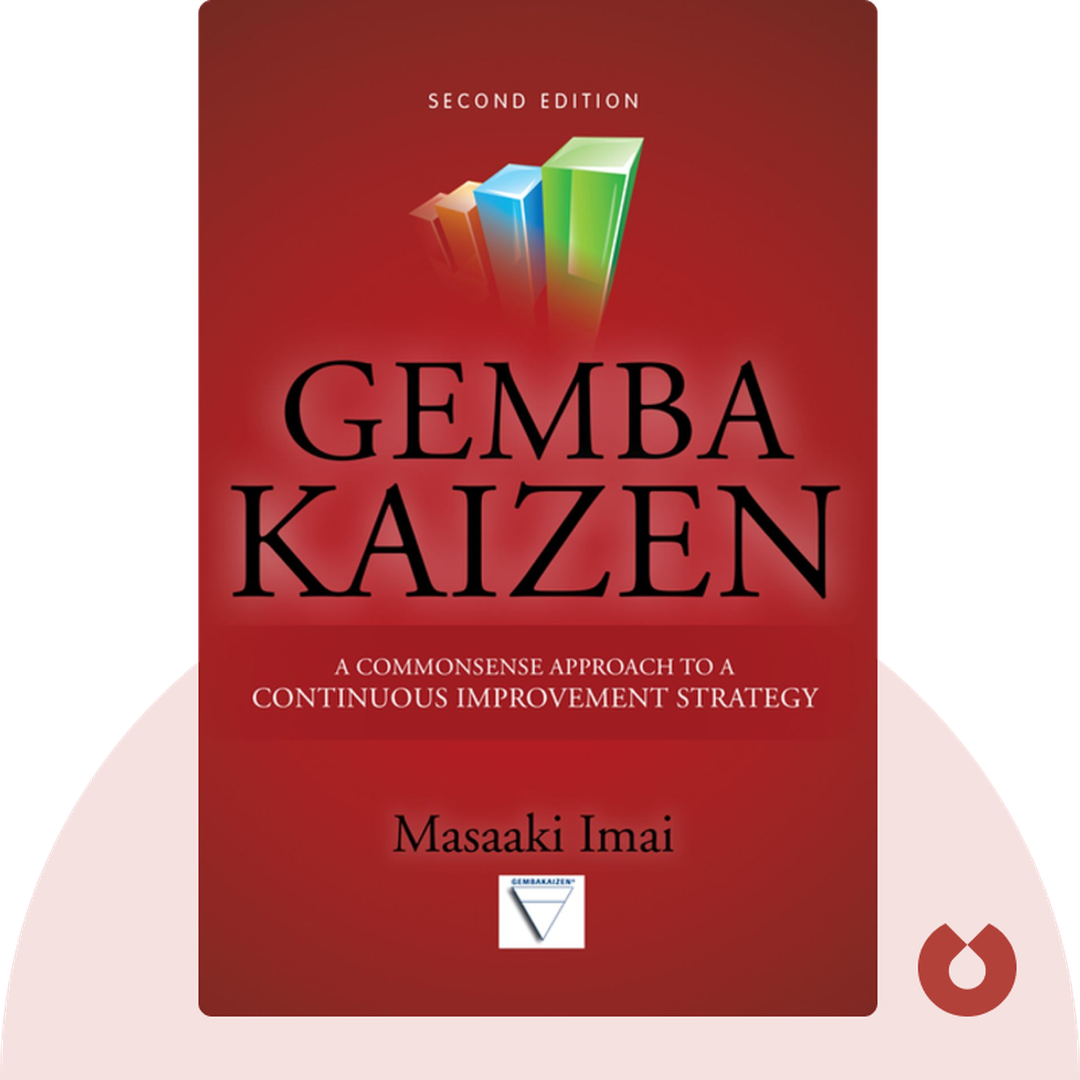
Gemba Kaizen (1997) is an introduction to the Japanese business philosophy of Kaizen, which revolutionizes working standards to reduce waste and increase efficiency at little cost. Author Masaaki Imai reveals the aspects of Kaizen that are crucial to building lean business strategies.
Who Should Listen to Gemba Kaizen?
- People working in production and managers who supervise standardized processes
- Anyone interested in Japanese management philosophies
- Anyone who wants to improve their overall workflow
Books Similar to Gemba Kaizen
Readers who enjoyed this also liked these titles.