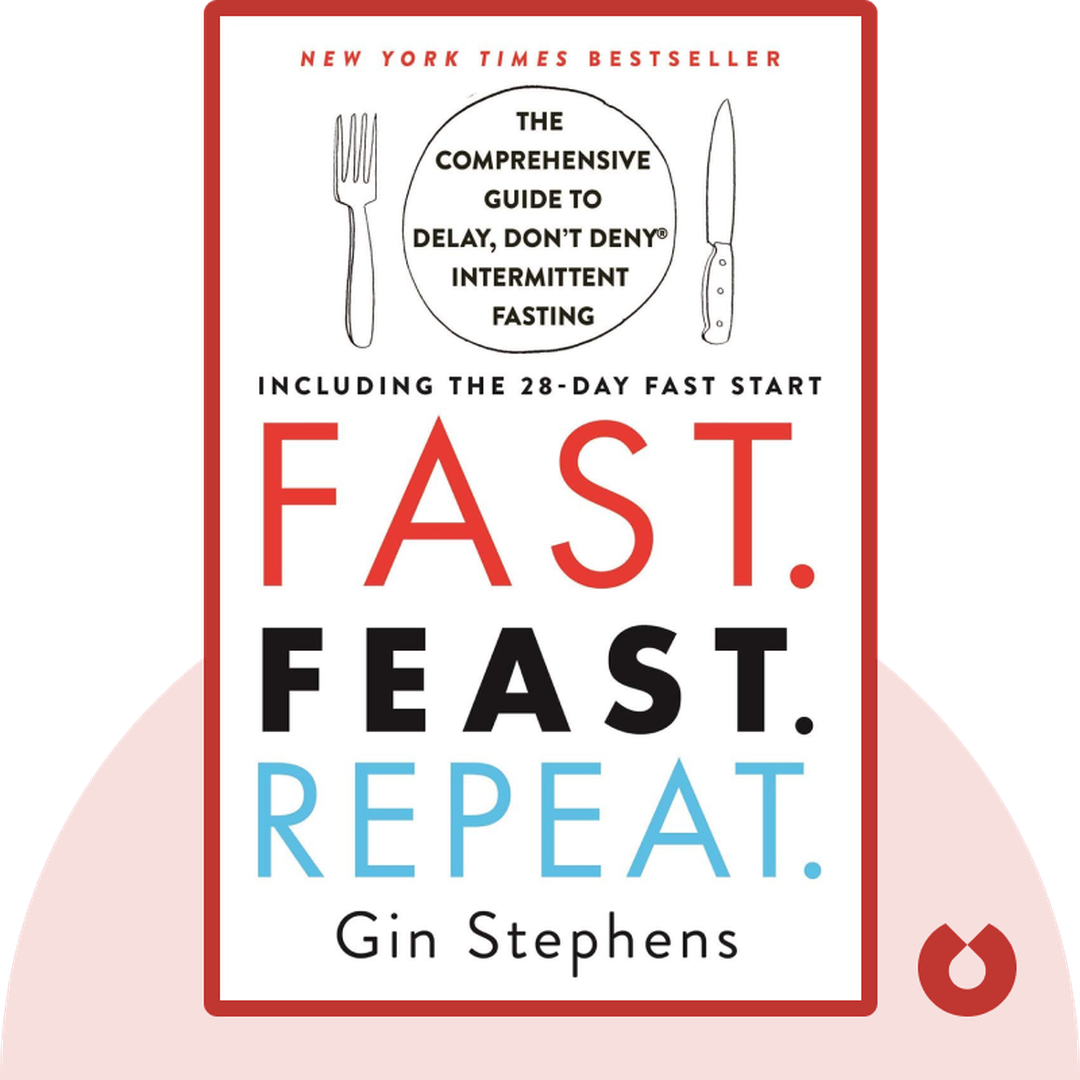
If You're Curious About These Questions...
You should listen to this audiobook
- Have you ever wondered why counting calories often fails, while simply shifting *when* you eat could be the secret to unlocking your body’s hidden fat-burning potential?
- Did you know that even a tiny, seemingly "innocent" addition to your morning routine could be sabotaging your body’s natural ability to repair itself and burn fat?
- What if you could trigger a powerful "cellular cleanup" that boosts your energy and slows down aging—all without ever having to give up your favorite foods?
Listen to Fast. Feast. Repeat. — Free Audiobook
Loading player...
Key Takeaways from Fast. Feast. Repeat.
- Understand why fasting beats traditional dieting by lowering insulin levels to switch your body into a natural fat-burning mode.
- Discover how fasting prevents the body's starvation response, keeping your metabolism steady and hunger hormones in check unlike traditional calorie restriction.
- Learn how intermittent fasting triggers autophagy, a cellular 'upcycling' process that combats aging, reduces chronic inflammation, and protects against disease.
- Explore daily fasting schedules like 16:8 or One Meal A Day (OMAD), and find out why fat-burning accelerates significantly after 18 to 24 hours of fasting.
- Master the 'up-and-down-day' approach to fasting, where eating unrestricted meals on certain days prevents your metabolism from adapting to calorie deficits.
Learning Tools
Reinforce what you learned from Fast. Feast. Repeat.
Mind Map
Fast. Feast. Repeat.
Fasting vs. Dieting+
Health Benefits+
Fasting Protocols+
The Clean Fast+
Importance of Variation+
Food and Appetite+
Quiz — Test Your Understanding
Question 1 of 7
According to the text, why does fasting prevent the metabolic slowdown typically associated with traditional dieting?
Question 2 of 7
What is 'autophagy' in the context of fasting?
Question 3 of 7
Why are zero-calorie diet sodas and fruit-flavored teas prohibited during a 'clean' fast?
Question 4 of 7
What does the author suggest doing to overcome weight loss plateaus and prevent homeostasis?
Question 5 of 7
How does intermittent fasting help retrain your appetite over time?
Question 6 of 7
What does the fasting ratio '19:5' indicate?
Question 7 of 7
What actionable advice does the text provide for dealing with intense hunger pangs during a fast?
Fast. Feast. Repeat. — Full Chapter Overview
- 1Recommendation
- 2For fat loss, fasting beats dieting hands down.
- 3Fasting’s benefits go well beyond weight loss.
- 4There are several ways to begin fasting.
- 5Avoid a few key things if you want to fast “clean.”
- 6For the best results, vary your fasting style from time to time.
- 7Fasting can help you start eating more healthily.
- 8Final summary
Fast. Feast. Repeat. Summary & Overview
Fast. Feast. Repeat. (2020) takes readers on a whistle-stop tour of the theory and practice of intermittent fasting. Drawing on cutting-edge research and immersion in the culture of the fasting community, Fast. Feast. Repeat. lays out the whys and hows of fasting in gripping detail.
Who Should Listen to Fast. Feast. Repeat.?
- Serial dieters trying to lose weight for good
- Amateur nutritionists interested in human health
- Skeptics who think fasting is just another fad
Books Similar to Fast. Feast. Repeat.
Readers who enjoyed this also liked these titles.