If You're Curious About These Questions...
You should listen to this audiobook
- Did you know that one man’s obsession led to the creation of a literal 'map' of every disease and injury known to humanity?
- Have you ever wondered why the world’s most powerful health organizations were looking at the wrong data for decades—and what it took to finally correct them?
- What if you could pinpoint exactly which diseases are stealing the most years of healthy life from people in any corner of the globe?
Listen to Epic Measures — Free Audiobook
Loading player...
Key Takeaways from Epic Measures
- Discover why slapdash global health data historically hindered the proper allocation of medical funding and how one man set out to fix it.
- Learn how a childhood medical sabbatical in Africa taught Christopher Murray that careful analysis and tenacious research are critical skills in treating disease.
- Understand why relying solely on life expectancy and infant mortality rates creates a misleading picture of global health that completely ignores a patient's actual quality of life.
- Find out how siloed health organizations manipulated statistics to secure funding, resulting in a disastrous '10/90-gap' where 90 percent of global health problems received only 10 percent of research funds.
- Explore how shifting statistical focus to neglected adult diseases, like tuberculosis, helped secure targeted funding that quickly saved millions of lives.
Learning Tools
Reinforce what you learned from Epic Measures
Mind Map
Epic Measures
Flawed Legacy Health Data (1980s)+
Christopher Murray's Foundation+
The DALY & Global Burden of Disease+
Institute for Health Metrics and Evaluation (IHME)+
Core Takeaways+
Quiz — Test Your Understanding
Question 1 of 8
What crucial lesson about disease analysis did Christopher Murray learn during his childhood sabbatical at a hospital in Niger?
Question 2 of 8
Why did Murray consider the infant-mortality rate and life expectancy to be misleading indicators of a country's overall health in the 1980s?
Question 3 of 8
In the 1980s, how did the organizational structure of the World Health Organization (WHO) negatively impact global health data?
Question 4 of 8
What did Christopher Murray mean by the '10/90-gap' in his early published research?
Question 5 of 8
What two factors are combined to calculate a 'disability-adjusted life year' (DALY) in Murray’s health measurement system?
Question 6 of 8
Why did the initial results of the Global Burden of Disease study generate backlash from the World Health Organization (WHO)?
Question 7 of 8
What led Christopher Murray to leave the World Health Organization and eventually found the Institute for Health Metrics and Evaluation (IHME)?
Question 8 of 8
How did Murray's research evolve in 2012 to further improve global health interventions?
Epic Measures — Full Chapter Overview
- 1Recommendation
- 2Christopher Murray’s unusual childhood taught him key lessons about analyzing and treating disease.
- 3In the 1980s, health organizations relied on poor and unreliable ways to measure global health.
- 4Health data was also distorted to defend ineffective work and funding.
- 5Murray created a better way to measure global health by focusing on quality of life and years lost.
- 6Murray’s study results revealed neglected issues and brought him criticism and scorn.
- 7After being pushed out of the World Health Organization, Murray founded a new institute to improve global health.
- 8Murray’s organization now publishes updated, easy-to-access versions of the Global Burden Study.
- 9Final summary
Epic Measures Summary & Overview
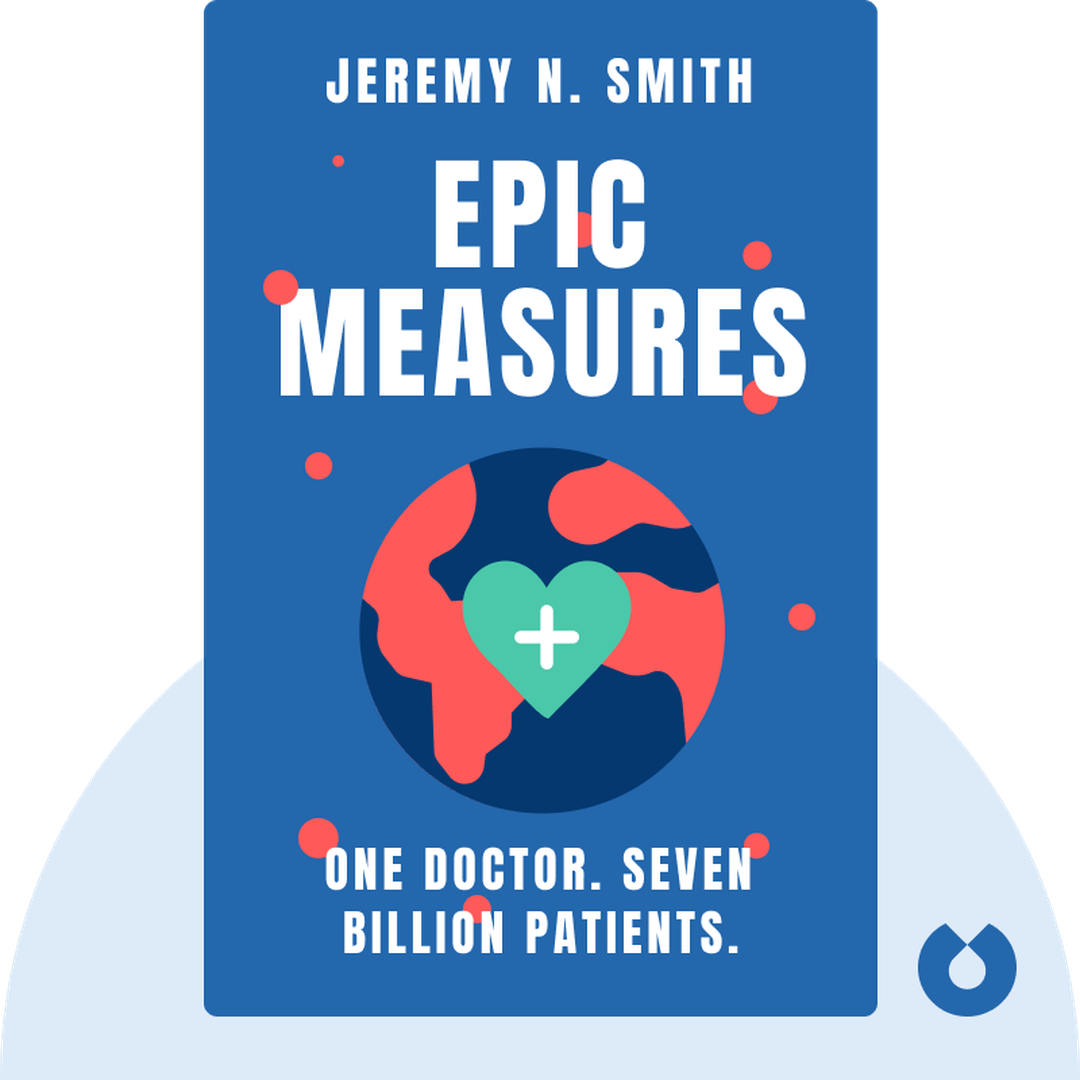
Epic Measures (2015) tells the incredible story of how one man, Christopher Murray, came to build the most comprehensive medical study ever assembled. Find out what motivated Murray and his dedicated team of collaborators to build a worldwide map of every disease and illness known to man – and discover how his remarkable work has revolutionized the face of world health.
Who Should Listen to Epic Measures?
- Medical students
- Readers working in the health sector
- Humanitarians
Books Similar to Epic Measures
Readers who enjoyed this also liked these titles.