If You're Curious About These Questions...
You should listen to this audiobook
- Did you know that your most painful physical struggles and periods of isolation could actually be the hidden catalysts for your greatest intellectual breakthroughs?
- Have you ever wondered why conventional ideas of morality might be the very things preventing you from achieving your true potential?
- What if the secret to becoming your most authentic self lies in a radical new way of looking at your own life story—one that turns every hardship into a source of power?
Listen to Ecce Homo — Free Audiobook
Loading player...
Key Takeaways from Ecce Homo
- Discover how questioning society's sacred moral constraints isn't destructive, but an essential step toward discovering your authentic self and achieving genuine greatness.
- Understand why illness and physical suffering can serve as powerful catalysts for profound intellectual breakthroughs, stripping away superficial concerns to reveal true self-knowledge.
- Learn how environmental factors like climate and atmospheric humidity fundamentally dictate your cognitive capacity, proving that where you live directly shapes your potential for genius.
- Discover the crucial connection between digestion and mental performance, and why optimizing your nutrition is just as important as intellectual training for unlocking your creative resources.
- Master the ability to view life through the dual lenses of both strength and weakness to gain extraordinary psychological insights unavailable to those who only experience a single perspective.
Learning Tools
Reinforce what you learned from Ecce Homo
Mind Map
Ecce Homo
Transforming Illness into Strength+
Physical Foundations of Genius+
The Dual Perspective of Existence+
Decadence of Conventional Morality+
Intellectual Independence+
Solitude and Self-Discipline+
Quiz — Test Your Understanding
Question 1 of 7
How does Nietzsche view the experience of severe physical illness?
Question 2 of 7
According to the text, how does a fundamentally healthy nature respond to illness compared to a 'decadent' nature?
Question 3 of 7
According to Nietzsche, what is a primary cause of German intellectual mediocrity?
Question 4 of 7
Why does Nietzsche argue that experiencing life from positions of both strength and weakness is essential for true wisdom?
Question 5 of 7
How does Nietzsche characterize traditional Christian morality?
Question 6 of 7
What habit does Nietzsche describe as 'positively vicious' for original thinkers?
Question 7 of 7
What is the primary purpose of the rigorous self-discipline and temporary solitude that Nietzsche advocates?
Ecce Homo — Full Chapter Overview
- 1Recommendation
- 2Illness can become a powerful path to strength and self-knowledge when understood correctly
- 3Physical factors like climate and nutrition fundamentally shape intellectual and creative capacity
- 4True wisdom requires experiencing life from positions of both strength and weakness
- 5Conventional morality often reflects the values of declining life rather than ascending life
- 6Intellectual independence requires the courage to think beyond popular agreement
- 7Solitude and self-discipline are essential for discovering an authentic identity
- 8Final summary
Ecce Homo Summary & Overview
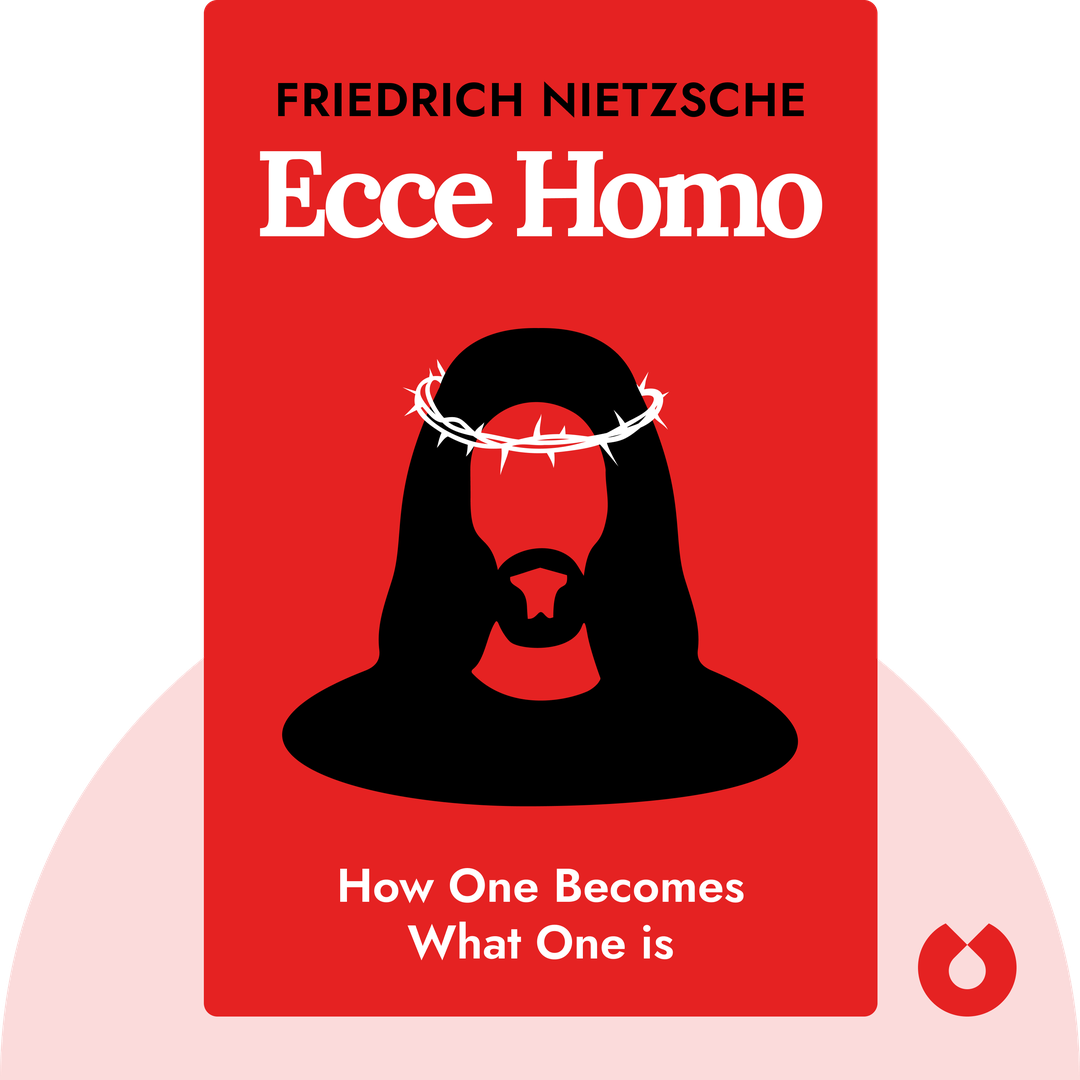
Ecce Homo (1908) presents a radical autobiography examining the development of philosophical genius through self-analysis. It explores how physical conditions, illness, and solitude shape intellectual capacity while challenging conventional morality as a system that weakens rather than strengthens human potential.
Who Should Listen to Ecce Homo?
- Independent thinkers questioning conventional wisdom
- Anyone transforming personal struggles positively
- People seeking authentic self-development
Books Similar to Ecce Homo
Readers who enjoyed this also liked these titles.