If You're Curious About These Questions...
You should listen to this audiobook
- What if you could achieve peak physical fitness and a sculpted body by exercising for only twelve minutes just once a week?
- Have you ever wondered why spending hours at the gym might actually be hindering your progress instead of helping it?
- What’s the secret biological trigger that tells your body to build muscle, and how can you activate it without traditional, grueling workouts?
Listen to Body by Science — Free Audiobook
Loading player...
Key Takeaways from Body by Science
- Understand why physical fitness and overall health are not the same thing, and how prolonged activities like long-distance running can actually cause long-term bodily damage.
- Discover how true health is achieved by balancing your body's catabolic and anabolic processes to safely break down and build up internal resources.
- Learn why short, high-intensity workouts can dramatically increase your endurance, proving far more effective than traditional, low-intensity aerobic exercises.
- Master the concept of treating exercise like medicine, where applying the precise 'dosage' of effort and frequency is essential for optimal results and injury prevention.
- Find out how heavy weight training forces your body to utilize powerful, high-energy fast-twitch muscle fibers, rapidly kickstarting your metabolism in just a few minutes.
Learning Tools
Reinforce what you learned from Body by Science
Mind Map
Body by Science
Redefining Health & Fitness+
High-Intensity Training (HIT)+
The Big Five Routine+
Progression & Advanced Tactics+
Genetics & Expectations+
Weight Loss & Recovery+
Quiz — Test Your Understanding
Question 1 of 8
What does the story of the ancient Greek courier Pheidippides illustrate about physical activity?
Question 2 of 8
According to the text, a truly healthy body naturally balances which two internal chemical processes?
Question 3 of 8
What did the 2005 McMaster University study reveal about short, high-intensity workouts compared to regular aerobic exercise?
Question 4 of 8
Why do low-intensity exercises like jogging fail to yield dramatic metabolic results?
Question 5 of 8
What is the primary goal when performing the 'Big Five' workout routine?
Question 6 of 8
What does the book recommend you do when your fitness gains plateau while doing the Big Five routine?
Question 7 of 8
Why is it unrealistic for most people to achieve the muscular physique of a Hollywood bodybuilder?
Question 8 of 8
According to the text, why is building muscle the most efficient way to lose weight?
Body by Science — Full Chapter Overview
- 1Recommendation
- 2Not every physical activity leads to a healthier body.
- 3A brief, high-intensity workout can be as effective as a long, steady one.
- 4To build muscle, train harder but less frequently.
- 5Simplify your workout with the Big Five routine.
- 6A good exercise routine never really ends.
- 7Exercise to reach your own personal best, not a media ideal.
- 8The most effective way to lose weight is to build more muscle.
- 9Final summary
Body by Science Summary & Overview
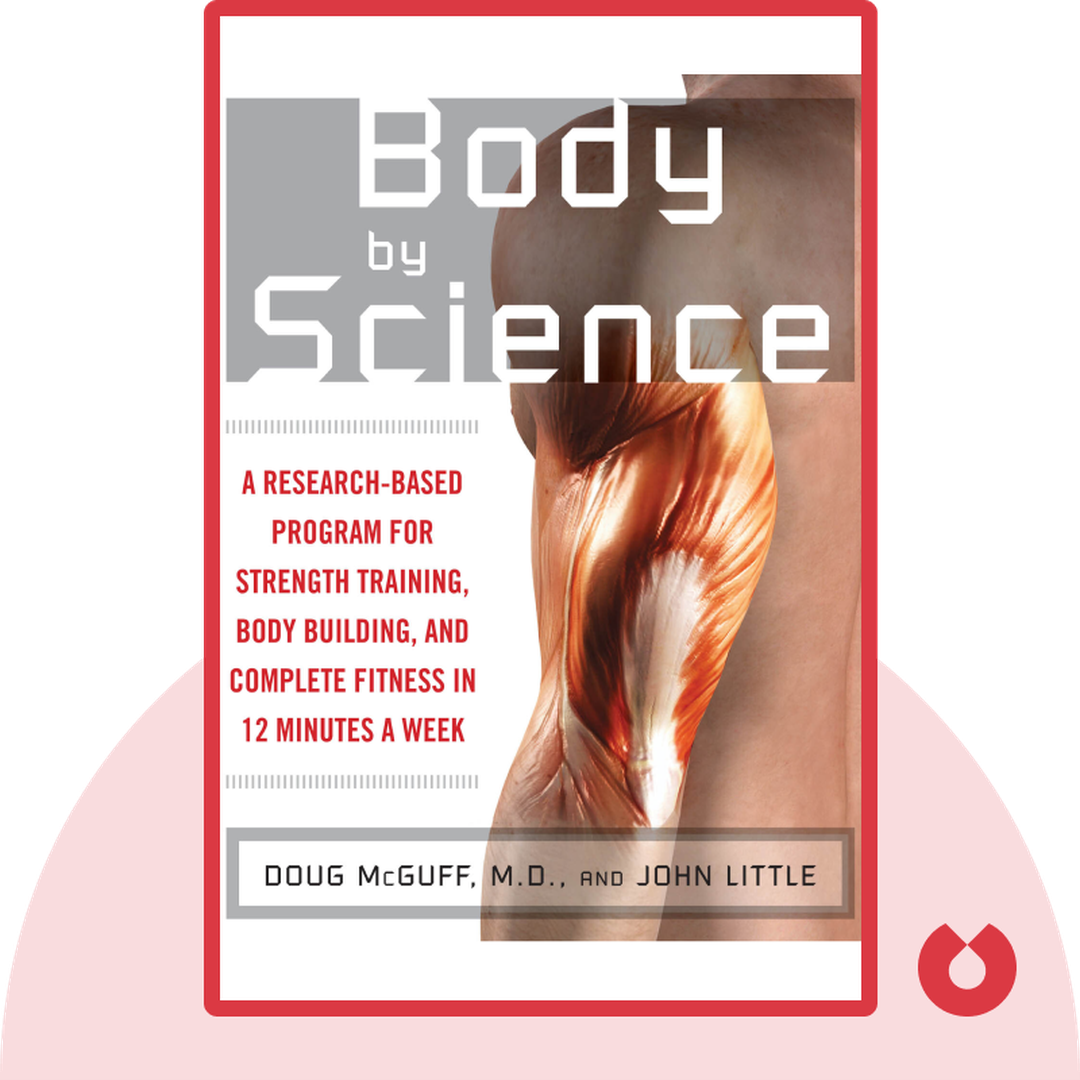
Body by Science (2009) is a comprehensive guide to building muscle. This handbook is driven by data, and it offers a scientifically proven approach to sculpting a fitter, firmer body. All you’ll need is a few minutes a week.
Who Should Listen to Body by Science?
- Fitness buffs looking to optimize their routine
- Couch potatoes eager to amp up their physical activity
- Anyone curious about the science of building up muscle
Books Similar to Body by Science
Readers who enjoyed this also liked these titles.