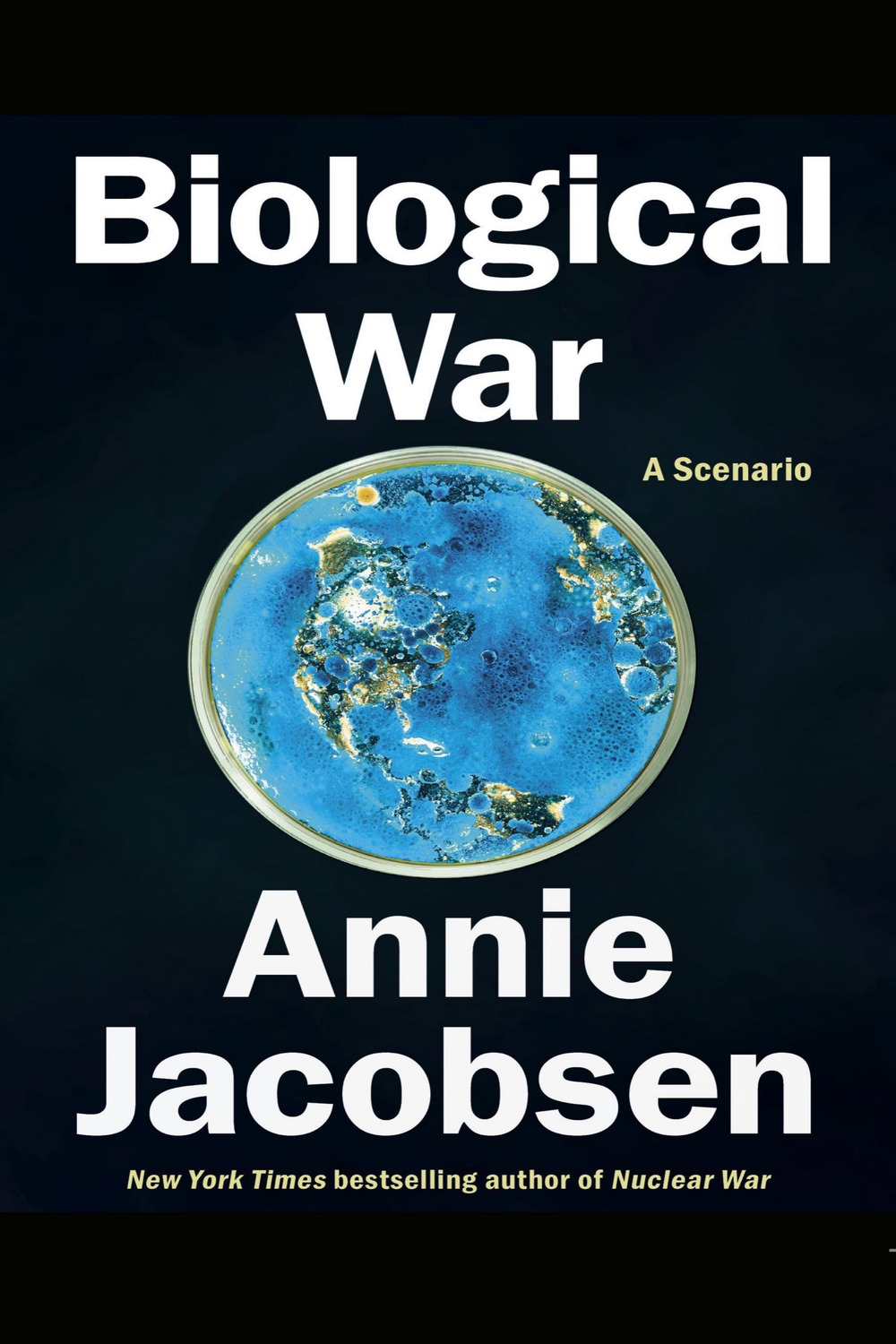
Biological War: A Scenario audiobook cover - A laboratory accident releases an engineered plague that outruns medicine, diplomacy, and government, turning a meticulously researched biological-war scenario into a disturbing examination of whether modern civilization could survive the technologies it has created.
Theme Song

Biological War: A Scenario

A laboratory accident releases an engineered plague that outruns medicine, diplomacy, and government, turning a meticulously researched biological-war scenario into a disturbing examination of whether modern civilization could survive the technologies it has created.

Annie Jacobsen

4.5 / 5(408 ratings)
Start ListeningDownloadQR code that opens AudiobookHub on the App StoreTry free on iPhoneScan to start in 5 seconds

If You're Curious About These Questions...

You should listen to this audiobook

Listen to Biological War: A Scenario — Cinematic Audio Edition

Loading player...

Key Takeaways from Biological War: A Scenario

Learning Tools

Reinforce what you learned from Biological War: A Scenario

Mind Map

Biological War
Introduction & Threat Overview+
Scientific Origins & History+
The Outbreak & Global Spread+
Systemic Failures & Scarcity+
The Weapon's True Nature+
Governmental Collapse & Aftermath+

Quiz — Test Your Understanding

Question 1 of 10
What is the unique, engineered characteristic of the Yersinia pestis pathogen during its initial contagious stage in the scenario?
  • A. It induces a state of euphoria that encourages social interaction.
  • B. It mimics the symptoms of a common cold to avoid detection.
  • C. It remains completely dormant for two weeks before spreading.
  • D. It causes immediate respiratory collapse within minutes of exposure.
Question 2 of 10
Why did the 1972 Biological Weapons Convention fail to prevent the Soviet Union from developing biological weapons?
  • A. The Soviet Union refused to sign the treaty, making it entirely legally exempt.
  • B. The treaty allowed for defensive research, creating a loophole for offensive programs under the guise of vaccine preparation.
  • C. The treaty only regulated viral pathogens, leaving bacterial agents completely unrestricted.
  • D. The United Nations lacked the financial resources to organize the mandated international inspections.
Question 3 of 10
What central asymmetry of biological defense is highlighted by the government's response to the Vector Institute explosion?
  • A. The military has superior weapons, but civilian agencies have better intelligence.
  • B. Artificial intelligence models can predict outbreaks, but they cannot manufacture vaccines fast enough.
  • C. Authorities possess advanced satellites and weapons, yet an infected traveler can move faster than all of them.
  • D. Developing a new pathogen takes years, while developing a cure takes only days.
Question 4 of 10
Why do traditional international public-health procedures inadvertently assist the spread of the engineered pathogen?
  • A. They prioritize localized quarantines over international travel bans.
  • B. They require formal laboratory confirmation before declaring a highest-level emergency, causing crucial delays.
  • C. They mandate the immediate distribution of broad-spectrum antibiotics, which accelerates mutation.
  • D. They rely entirely on self-reporting by infected nations, which are usually truthful but slow.
Question 5 of 10
Why does the engineered plague initially evade detection by the CDC's national syndromic-surveillance platform in Los Angeles?
  • A. The surveillance system relies on data from private hospitals, which refuse to share patient records.
  • B. The initial victims are from a vulnerable, unhoused population, creating a blind spot in the data.
  • C. The early symptoms perfectly mimic a rare strain of influenza that the system is programmed to ignore.
  • D. Cyberattacks originating from Russia temporarily blind the American medical surveillance networks.
Question 6 of 10
How does the scarcity of resources alter societal behavior during the outbreak?
  • A. It fosters unprecedented cooperation as communities share limited medical supplies equally.
  • B. It drives citizens to abandon cities peacefully and establish isolated agrarian communes.
  • C. It causes the government's overlapping emergency plans to function flawlessly by prioritizing first responders.
  • D. It leads to violence and institutional collapse, as survival seems to depend on securing medicine before others.
Question 7 of 10
What is the devastating 'second mechanism' concealed within the engineered plague?
  • A. It mutates into a waterborne pathogen once exposed to the open air.
  • B. It renders the infected permanently infertile, destroying future population growth.
  • C. Antibiotic treatment activates a secondary neurological agent, attacking both the body and medical trust.
  • D. It causes the immune system to attack the heart, resulting in sudden cardiac arrest.
Question 8 of 10
What is the primary focus of the U.S. military once the Continuity of Government plans are fully activated?
  • A. Distributing experimental vaccines to the highest-density civilian populations.
  • B. Securing critical national infrastructure, such as nuclear plants and water systems, rather than saving every community.
  • C. Launching retaliatory nuclear strikes against the foreign laboratories responsible for the outbreak.
  • D. Enforcing strict stay-at-home orders by arresting unhoused individuals across major cities.
Question 9 of 10
In the 'biological twilight' that follows the disaster, what demographic reality shapes the surviving American population?
  • A. Survivors are predominantly scientists and doctors who had early access to cures.
  • B. The population is remarkably young, as the pathogen exclusively targeted the elderly.
  • C. Society is almost entirely rural, as all major cities were permanently destroyed by military firebombing.
  • D. Soldiers constitute a disproportionate share of survivors, leaving a heavily militarized and demographically distorted society.
Question 10 of 10
What hypothetical future danger does the author raise regarding synthetic biology beyond engineered plague?
  • A. The creation of 'mirror life' with reversed molecular structures potentially invisible to natural immunity.
  • B. Pathogens that can travel through digital networks to infect laboratory hardware directly.
  • C. Biological agents that rewrite the DNA of crops to cause global famine within a single season.
  • D. Nanobots that entirely replace natural blood cells with programmable metallic fluids.

Biological War: A Scenario — Full Chapter Overview

Biological War: A Scenario Summary & Overview

Biological War: A Scenario combines investigative history, expert interviews, public-health science, and a speculative near-future catastrophe. Annie Jacobsen traces modern biological risk from the invention of recombinant DNA and the Soviet Union’s clandestine weapons program to gain-of-function research, expanding high-containment laboratories, and the weak enforcement provisions of international arms-control treaties.

The book’s central scenario begins when an explosion at Russia’s Vector Institute releases a genetically engineered strain of pneumonic plague. International travel spreads it before officials understand what has happened. Hospitals misdiagnose victims, surveillance systems overlook vulnerable communities, and fear overwhelms emergency institutions. The crisis escalates through quarantine, military deployment, continuity-of-government measures, and martial law. A final revelation—that antibiotics activate a concealed neurological component—destroys public trust along with the population. Jacobsen presents this outcome not as a prediction, but as a warning about dual-use biotechnology, secrecy, inadequate oversight, and scientific capabilities advancing faster than the systems meant to govern them.

Who Should Listen to Biological War: A Scenario?

  • Readers interested in biological warfare, pandemic preparedness, and national security
  • Listeners who enjoy deeply researched disaster scenarios grounded in expert interviews
  • Policymakers, scientists, and citizens concerned about dual-use biotechnology and laboratory oversight

About the Author: Annie Jacobsen

Annie Jacobsen is an investigative journalist and the author of bestsellers including Nuclear War, Area 51, and Operation Paperclip. Her history of DARPA, The Pentagon’s Brain, was a Pulitzer Prize finalist. A Princeton University graduate and former contributing editor at the Los Angeles Times Magazine, she specializes in secret military programs, intelligence, emerging technology, and catastrophic national-security risks.

🎧
Listen in the AppOffline playback & background play
Get App
Biological War: A ScenarioTheme Song
NOW PLAYING
Biological War: A Scenario

Biological War: A Scenario

Theme Song
0:000:00