If You're Curious About These Questions...
You should listen to this audiobook
- Have you ever wondered if there’s a hidden mathematical strategy that determines exactly where a soccer star aims during a high-stakes penalty shootout?
- Did you know that a referee’s 'biased' decision might actually be a predictable psychological response to the environment around them?
- Are you curious about how the world’s most popular sport can reveal the secret logic behind the complex economic choices we make every day?
Listen to Beautiful Game Theory — Free Audiobook
Loading player...
Key Takeaways from Beautiful Game Theory
- Understand how John Neumann's minimax theorem applies to zero-sum games, revealing why using mixed, randomized strategies is essential to prevent opponents from predicting and exploiting your next move.
- Discover how soccer penalty kicks provide the ultimate real-world proof of game theory, as the lightning-fast speed of the ball forces players to independently lock in their decisions beforehand.
- Learn why professional soccer players naturally randomize their shot locations to remain completely unpredictable, proving that avoiding patterned behavior maximizes your likelihood of success.
- Explore how the simple, isolated variables of a penalty shoot-out offer economists a perfect tournament model to analyze competitive human psychology far more reliably than complex scenarios like job promotions.
- Find out why you should always choose to strike first in a competitive sequence, as historical soccer data shows the team kicking first in a shoot-out wins over 60 percent of the time due to psychological pressure.
Learning Tools
Reinforce what you learned from Beautiful Game Theory
Mind Map
Beautiful Game Theory
Minimax Theorem+
Psychology in Tournaments+
Social Pressure & Bias+
Economics of Fear & Risk+
Quiz — Test Your Understanding
Question 1 of 8
What does John von Neumann’s minimax theorem assume players attempt to do in a zero-sum game?
Question 2 of 8
Why do penalty kicks serve as an ideal real-world verification of the minimax theorem?
Question 3 of 8
What does data reveal about the sequence of shot locations chosen by penalty kickers over time?
Question 4 of 8
Why are penalty shoot-outs considered superior to real-life scenarios (like job promotions) for studying competitive 'tournament settings'?
Question 5 of 8
How does the standard alternating kicking order (ABABABABAB) affect the outcome of a penalty shoot-out?
Question 6 of 8
How does social pressure from the home crowd manifest in a referee's decision-making during close games?
Question 7 of 8
According to the Becker-Rubinstein model, how do individuals manage their fear of regular, risky situations?
Question 8 of 8
Based on Spanish League data, why did married people show a much stronger drop in ticket renewals after violent seasons compared to single season-ticket holders?
Beautiful Game Theory — Full Chapter Overview
- 1Recommendation
- 2The minimax theorem explains and predicts player behavior and strategy choices.
- 3Penalty kicks confirm Neumann’s minimax theorem.
- 4A penalty shoot-out brings economics and psychology into a real-world setting.
- 5Psychological pressure gives the first-kicking team an advantage in penalty shoot-outs.
- 6Social pressure on the referee influences how much injury time is added at the end of the game.
- 7People predictably manage their fear of familiar situations based on costs and benefits.
- 8Hooliganism affects fans in different ways, making it harder to explain statistically.
- 9Final summary
Beautiful Game Theory Summary & Overview
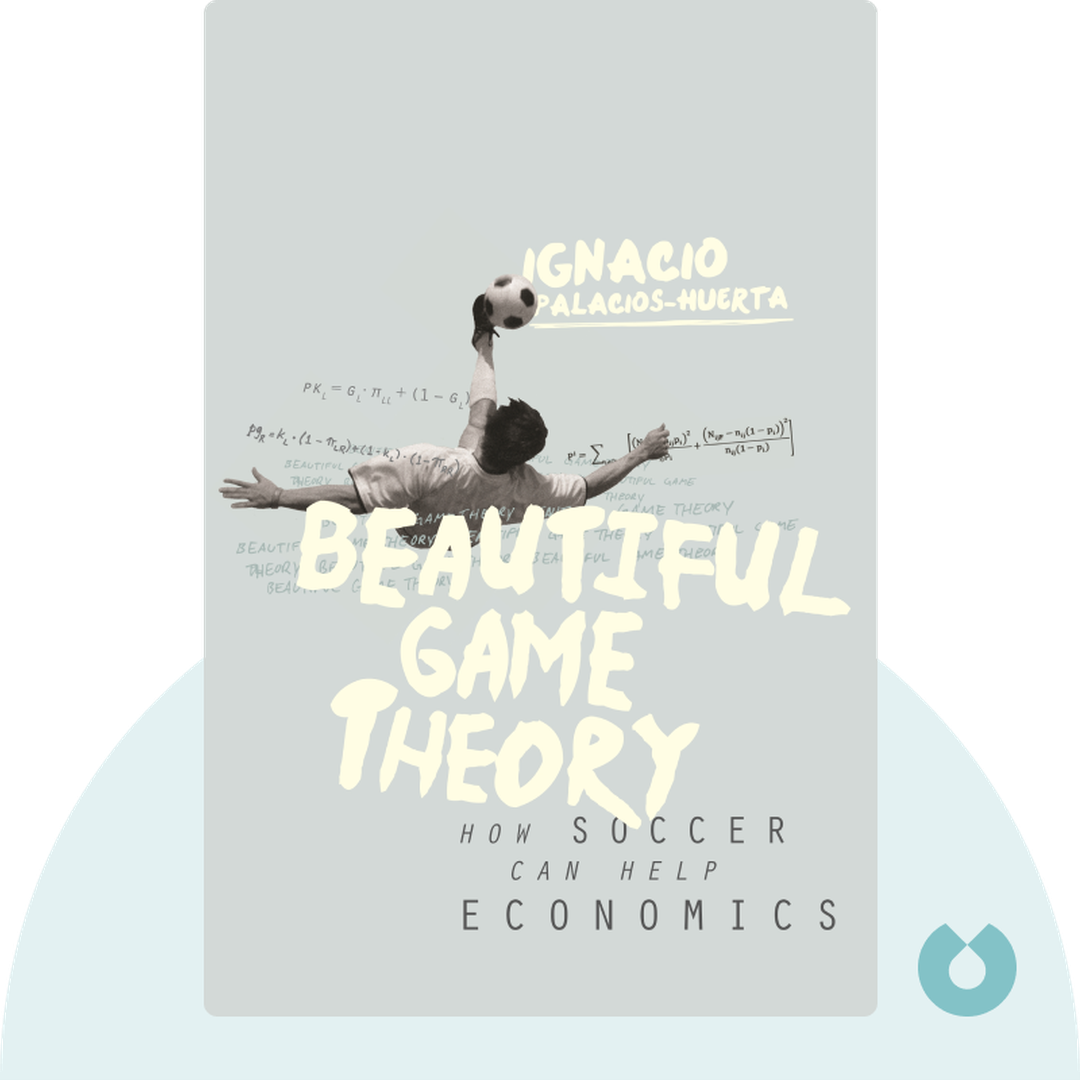
Beautiful Game Theory (2014) shows us how applicable economics is to our daily lives by looking at the fascinating world of professional soccer. By examining compelling statistics and studies on shoot-outs, referee calls, and ticket sales, Beautiful Game Theory offers some interesting insights into the psychology of behavioral economics.
Who Should Listen to Beautiful Game Theory?
- Soccer fans all over the world
- Anyone who is interested in economics
- Anyone who has ever felt like the referee was biased against his or her team
Books Similar to Beautiful Game Theory
Readers who enjoyed this also liked these titles.