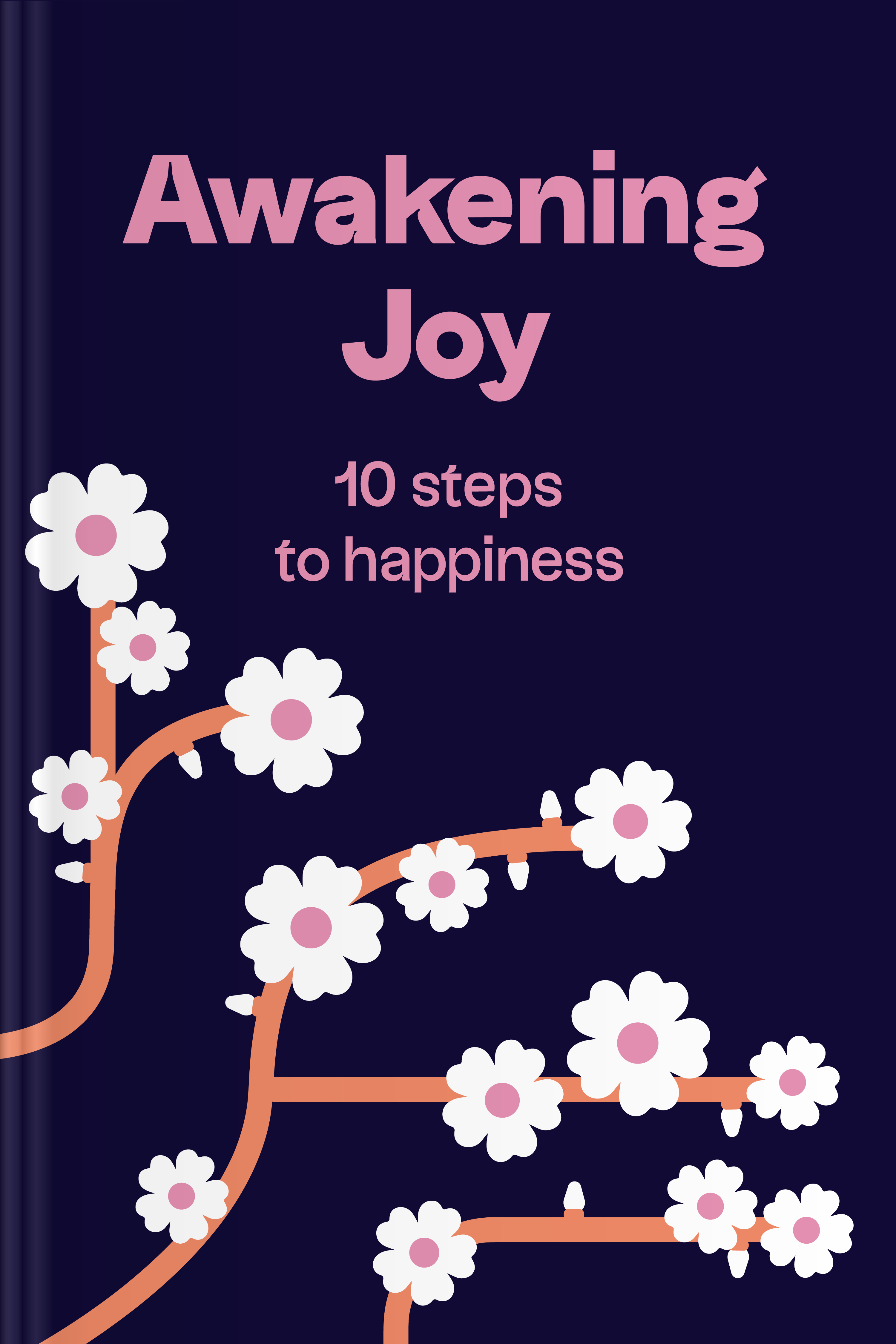
Awakening Joy audiobook cover - Many adults assume joy is something they lost for good, but this gentle guide reframes happiness as an inner capacity that can be rediscovered—through clear intention, simple mindfulness, steady gratitude, and a willingness to let joy and pain coexist without losing heart.

Awakening Joy

Many adults assume joy is something they lost for good, but this gentle guide reframes happiness as an inner capacity that can be rediscovered—through clear intention, simple mindfulness, steady gratitude, and a willingness to let joy and pain coexist without losing heart.

James Baraz

4.2 / 5(5 ratings)

If You're Curious About These Questions...

You should listen to this audiobook

Listen to Awakening Joy — Free Audiobook

Loading player...

Key Takeaways from Awakening Joy

Learning Tools

Reinforce what you learned from Awakening Joy

Mind Map

Awakening Joy
The Nature of Joy+
The Power of Intention+
Mindfulness & The Present Moment+
Meeting Pain with Awareness+
Joy Through Connection & Kindness+
The Role of Gratitude+
Synthesizing the Practice+

Quiz — Test Your Understanding

Question 1 of 10
According to the book, what is the core misunderstanding about the origin of joy that leads many people to be unhappy?
  • A. They believe joy comes from external conditions like the right job or partner, which provides only temporary pleasure.
  • B. They assume joy is a rare gift reserved for a fortunate few, rather than an inherent capacity everyone possesses.
  • C. They think that feeling negative emotions like sadness or anger means they are incapable of being joyful.
  • D. They believe joy was only possible in childhood and is impossible to feel again in adulthood.
Question 2 of 10
What is the key distinction the book makes between 'wanting happiness' and 'setting an intention for it'?
  • A. Wanting happiness is emotional, while setting an intention is a purely logical decision.
  • B. Wanting happiness is a passive desire, whereas setting an intention is an active commitment that shapes choices and attention.
  • C. Wanting happiness applies to small daily pleasures, while intention is for major life achievements.
  • D. Wanting happiness is a private feeling, while an intention must be publicly declared to be effective.
Question 3 of 10
What is the crucial element in the book's definition of mindfulness that might feel surprising to many people?
  • A. Acknowledging reality only after you have analyzed it.
  • B. Acknowledging reality and immediately feeling grateful for it.
  • C. Acknowledging reality without trying to fix it.
  • D. Acknowledging reality while simultaneously ignoring your thoughts about it.
Question 4 of 10
How does mindfulness help a person navigate difficult or painful moments in life?
  • A. It helps a person analyze the pain until a logical solution is found.
  • B. It erases the pain by focusing exclusively on positive memories.
  • C. It encourages the denial of pain to maintain a constant state of joy.
  • D. It keeps pain from consuming one's entire life by making room for other present experiences.
Question 5 of 10
According to Chapter 5, what happens when a person chooses to express virtues like kindness and love towards others?
  • A. The person's own supply of those virtues decreases and needs to be replenished.
  • B. The person's own joy and the virtue itself expand and mature through the act of sharing.
  • C. The person risks becoming emotionally drained if the kindness is not reciprocated.
  • D. The person primarily benefits the receiver, with little to no effect on their own happiness.
Question 6 of 10
What does the book identify as the 'secret' or foundational path to practicing gratitude, especially in a world of comparison and negativity?
  • A. Superior achievement, which gives you more things to be grateful for.
  • B. Complete withdrawal from social media and news.
  • C. Contentment, or the practice of being at peace with where one is right now.
  • D. Intense focus on the suffering of others to put your own life in perspective.
Question 7 of 10
When setting an intention for joy, the mind may push back with doubtful thoughts. What is the book's recommended response?
  • A. Forcefully deny the thoughts and replace them with positive affirmations.
  • B. Stop the practice, as the objections prove that you don't truly deserve to be happy.
  • C. Acknowledge the thoughts without aggression or denial, and steadily return to the intention.
  • D. Analyze the source of each negative thought before continuing.
Question 8 of 10
In the final chapter, which two practices are highlighted as being 'especially vital' because they support all the other principles for awakening joy?
  • A. Connection and Kindness
  • B. Intention and Action
  • C. Mindfulness and Gratitude
  • D. Stillness and Silence
Question 9 of 10
What is the key difference presented between joyful people and others regarding negative emotions?
  • A. Joyful people have perfected their lives so they no longer face situations that cause negative emotions.
  • B. Joyful people never feel anger, sadness, or fear.
  • C. Joyful people feel negative emotions, but they have practiced strategies for finding their way back to a state of well-being.
  • D. Joyful people are born with a higher tolerance for emotional pain.
Question 10 of 10
What is a simple, practical, and consistent method suggested for making gratitude a daily habit?
  • A. Writing a lengthy essay on gratitude once a month.
  • B. Only thinking grateful thoughts when something exceptionally good happens.
  • C. Listing three to five things you are grateful for each day, and possibly sharing this list with a partner.
  • D. Quietly feeling grateful but never speaking about it to others.

Awakening Joy — Full Chapter Overview

Awakening Joy Summary & Overview

This warm narration explores why so many people grow up feeling disconnected from joy, even when life looks “fine” on the outside. Drawing from James Baraz’s teachings, it describes joy as an innate human quality—often buried under stress, worry, comparison, and the ordinary weight of adulthood.

Across seven chapters, the script offers practical, compassionate steps: setting an honest intention to be happier, practicing mindfulness to return to the present, meeting pain with steadier awareness, nurturing joy through connection with others, and strengthening gratitude as a daily habit. The aim is not constant positivity, but a reliable pathway back to aliveness.

Who Should Listen to Awakening Joy?

  • People who feel busy, responsible, and worn down—and want to reconnect with joy in a realistic, sustainable way.
  • Listeners who are curious about mindfulness and gratitude, and prefer gentle, practical practices over intense self-criticism.
  • Anyone moving through stress, grief, or change who wants support in holding both pain and possibility at the same time.

About the Author: James Baraz

James Baraz is a longtime teacher of mindfulness and meditation who has spent decades studying and sharing practical ways to cultivate happiness, resilience, and inner freedom. His work emphasizes awakening joy through intention, present-moment awareness, gratitude, and compassionate connection.

🎧
Listen in the AppOffline playback & background play
Get App