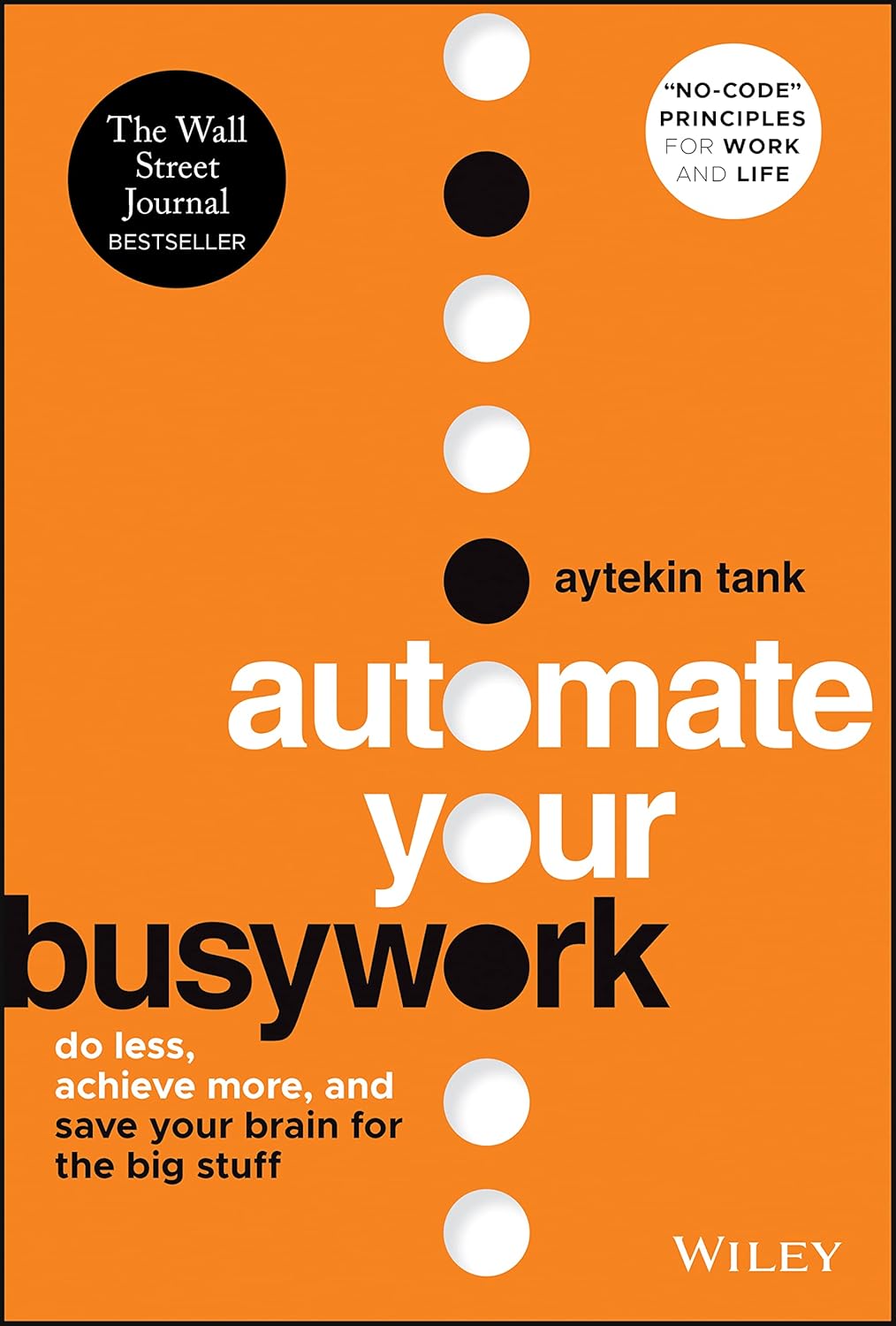
Automate Your Busywork audiobook cover - If your days disappear into emails, meetings, and mindless admin, this book offers a practical system—the “automation flywheel”—to spot repeatable workflows, map them clearly, automate them with accessible tools, and keep improving until busywork stops running your life.

Automate Your Busywork

If your days disappear into emails, meetings, and mindless admin, this book offers a practical system—the “automation flywheel”—to spot repeatable workflows, map them clearly, automate them with accessible tools, and keep improving until busywork stops running your life.

Aytekin Tank

4.0 / 5(3 ratings)
Start ListeningDownloadQR code that opens AudiobookHub on the App StoreTry free on iPhoneScan to start in 5 seconds

If You're Curious About These Questions...

You should listen to this audiobook

Listen to Automate Your Busywork — Free Audiobook

Loading player...

Key Takeaways from Automate Your Busywork

Learning Tools

Reinforce what you learned from Automate Your Busywork

Mind Map

Automate Your Busywork
Core Premise: The Problem of Busywork+
The Automation Flywheel (Core Framework)+
Phase 1: Divide & Conquer (Identify & Prioritize)+
Phase 2: Design & Implement (Map & Build)+
Phase 3: Refine & Iterate (Measure & Improve)+
A Life Without Busywork (Applications)+

Quiz — Test Your Understanding

Question 1 of 9
According to the book, what is the fundamental problem with modern work that leads to so much busywork?
  • A. A lack of personal discipline and willpower among employees.
  • B. The assumption that a human should personally handle every repetitive task.
  • C. The failure of technology to create tools that can reduce tasks.
  • D. Poor time management techniques like the Pomodoro method.
Question 2 of 9
The book's core framework is the 'automation flywheel.' What are its three repeating phases?
  • A. Spot, Map, and Deploy
  • B. Audit, Prioritize, and Measure
  • C. Divide & Conquer, Design & Implement, and Refine & Iterate
  • D. Plan, Do, Study, and Act
Question 3 of 9
What is the book's key insight about tasks like 'replying to an email about an unpaid invoice'?
  • A. They are not single tasks but multi-step workflows with hidden dependencies.
  • B. They are low-priority and should be delegated to an assistant immediately.
  • C. They are urgent but not important and can often be ignored.
  • D. They are prime examples of work that cannot be automated.
Question 4 of 9
When prioritizing which workflows to automate, what does the 'impact/effort matrix' suggest as the best starting point?
  • A. High-impact, high-effort projects to prove the value of automation.
  • B. Low-impact, low-effort tasks to practice your skills.
  • C. High-impact, low-effort wins to build momentum.
  • D. All urgent tasks, regardless of their impact or effort.
Question 5 of 9
The book uses the London Underground map as a metaphor for workflow mapping. What is the main principle of this metaphor?
  • A. The map should be geographically accurate to be useful.
  • B. The map should show what's essential for the system (connections) rather than precise, real-world details.
  • C. The map must include every single detail, no matter how small, to be complete.
  • D. The map is only useful for mapping physical, not digital, processes.
Question 6 of 9
When you're ready to deploy an automation, where does the author suggest you first look for tools?
  • A. In the hidden automation features of apps you already use.
  • B. On a list of the most popular and powerful enterprise software.
  • C. By immediately signing up for a third-party integrator like Zapier or Make.
  • D. By hiring a programmer to build a custom solution from scratch.
Question 7 of 9
When measuring the success of an automation, what important distinction does the author emphasize?
  • A. The only metric that truly matters is the total amount of time saved.
  • B. Quantitative data from dashboards is always more valuable than qualitative feedback.
  • C. The goal is to improve outcomes (value), not just outputs (volume or speed).
  • D. Metrics should focus on company-wide business goals, not individual workflows.
Question 8 of 9
The book applies principles from Lean manufacturing to workflows. In this context, how is the 'waste of waiting' defined?
  • A. The time spent building the initial automation.
  • B. Delays caused by waiting for approvals, information, or handoffs from other people.
  • C. The idle time before a scheduled task is programmed to begin.
  • D. The time an employee spends in an unnecessary meeting.
Question 9 of 9
What is the ultimate, philosophical goal of automation as presented in the book's conclusion?
  • A. To achieve a four-hour workweek and work from the beach.
  • B. To eliminate work by replacing all humans with machines.
  • C. To remove mindless repetition so humans can focus on meaningful work.
  • D. To create a life with no need for meetings or email.

Automate Your Busywork — Full Chapter Overview

Automate Your Busywork Summary & Overview

Automate Your Busywork argues that modern work isn’t broken because people lack discipline—it’s broken because too many repetitive, low-value tasks still depend on human attention. Aytekin Tank, founder of Jotform, shows how to reclaim time and focus by turning recurring tasks into automated workflows using affordable, no-code tools.

The core framework is the automation flywheel: Divide & Conquer (identify busywork and detect workflows), Design & Implement (map processes visually and deploy tools), and Refine & Iterate (measure results, gather feedback, and continuously improve). The book closes with a wide set of real-world automation examples—email, meetings, HR, finance, customer support, content, and more—helping readers redesign workdays around meaningful output instead of endless maintenance.

Who Should Listen to Automate Your Busywork?

  • Professionals overwhelmed by email, meetings, scheduling, and recurring admin who want a repeatable system to remove busywork.
  • Founders, managers, and team leads who need scalable workflows for HR, support, sales, and operations without hiring a large team.
  • Non-technical creators and operators curious about no-code automation (Zapier/Make/forms/AI transcription) who want practical use cases and a step-by-step method.

About the Author: Aytekin Tank

Aytekin Tank is the founder and CEO of Jotform, a bootstrapped global SaaS company that helps millions of users automate work through online forms. He writes about productivity, leadership, and workflow automation, and advocates for no-code tools as a way to democratize innovation.

🎧
Listen in the AppOffline playback & background play
Get App