If You're Curious About These Questions...
You should listen to this audiobook
- Have you ever wondered how we can thrive in an economy where human labor is no longer the most valuable resource?
- What if the end of traditional work wasn't a crisis to be feared, but an opportunity to redefine the very meaning of a successful life?
- Are you curious about how a world with fewer jobs could actually lead to more prosperity and equality than the one we live in today?
Listen to A World Without Work — Free Audiobook
Loading player...
Key Takeaways from A World Without Work
- Discover how society can embrace rapid automation to build a future where traditional work is no longer a requirement for a happy and fulfilling life.
- Understand why machines won't simply steal all human jobs, but will instead complement labor by taking over routine duties and freeing up humans for creative, problem-solving roles.
- Learn how technological innovations actually expand the overall economic pie, leading to increased overall demand and new opportunities rather than just widespread unemployment.
- Find out why middle-class roles are currently at the highest risk of automation, as algorithms easily master routine tasks while initially leaving complex, interpersonal jobs to humans.
- Explore the history of artificial intelligence and see how the ultimate breakthrough occurred only when scientists stopped trying to make computers mimic human thought processes.
Learning Tools
Reinforce what you learned from A World Without Work
Mind Map
A World Without Work
Impact on Employment+
The Evolution of AI+
Economic Consequences+
The 'Big State' Solution+
Actionable Advice+
Quiz — Test Your Understanding
Question 1 of 7
How did the introduction of ATMs affect the banking industry according to the text?
Question 2 of 7
According to economists mentioned in the text, which group of workers is currently suffering the most from technological automation?
Question 3 of 7
What was the key shift in AI research that led to major breakthroughs in the late 1980s and beyond?
Question 4 of 7
Why might a country with a young population and abundant low-wage workers automate its healthcare industry slower than a country like Japan?
Question 5 of 7
What does the text identify as a major reason displaced workers might not simply fill the new jobs created by automation?
Question 6 of 7
How does automation primarily drive economic inequality according to the book?
Question 7 of 7
Why does the author prefer a Conditional Basic Income (CBI) over a Universal Basic Income (UBI)?
A World Without Work — Full Chapter Overview
- 1Recommendation
- 2Machines will replace some jobs – but they’ll also support others.
- 3Every job is vulnerable to technological change.
- 4AI research advanced when computers stopped trying to think like people.
- 5Machines are improving at many kinds of work, but progress will vary everywhere.
- 6More capable machines will cause major job losses.
- 7Automation has increased inequality by widening income gaps between jobs.
- 8If automation breaks the labor market, the “Big State” must distribute wealth.
- 9Final summary
A World Without Work Summary & Overview
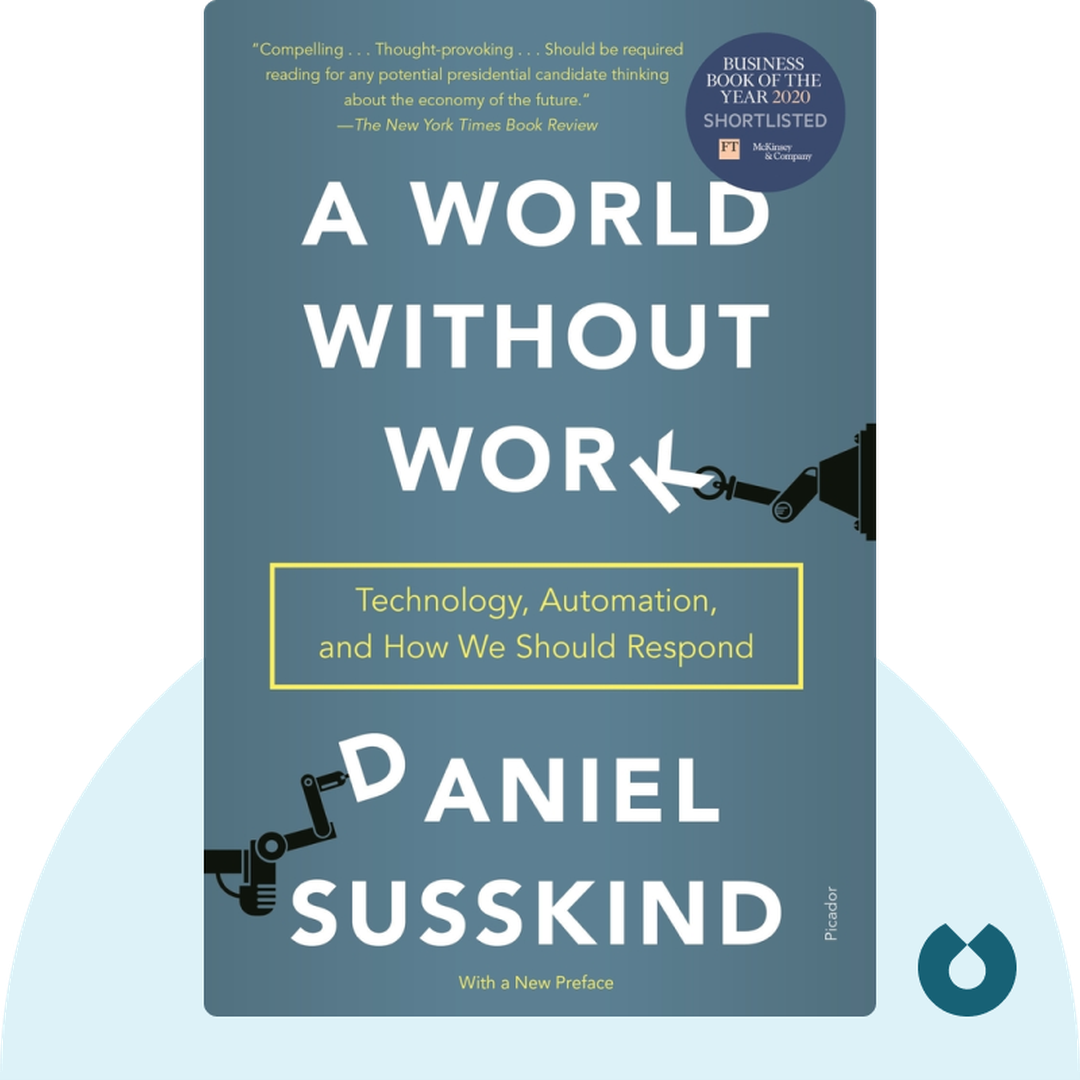
A World Without Work (2020) is an exploration into how artificial intelligence will bring unemployment to so many industries – and why that doesn’t have to be a bad thing. The author outlines the history of technological progress and explains how new capabilities will allow for unprecedented productivity. Yes, many jobs will become irrelevant, but, as a society, we can ensure that everybody will be better off in this new world.
Who Should Listen to A World Without Work?
- Forecasters
- Technophiles and luddites alike
- Anyone curious about the future of work
Books Similar to A World Without Work
Readers who enjoyed this also liked these titles.