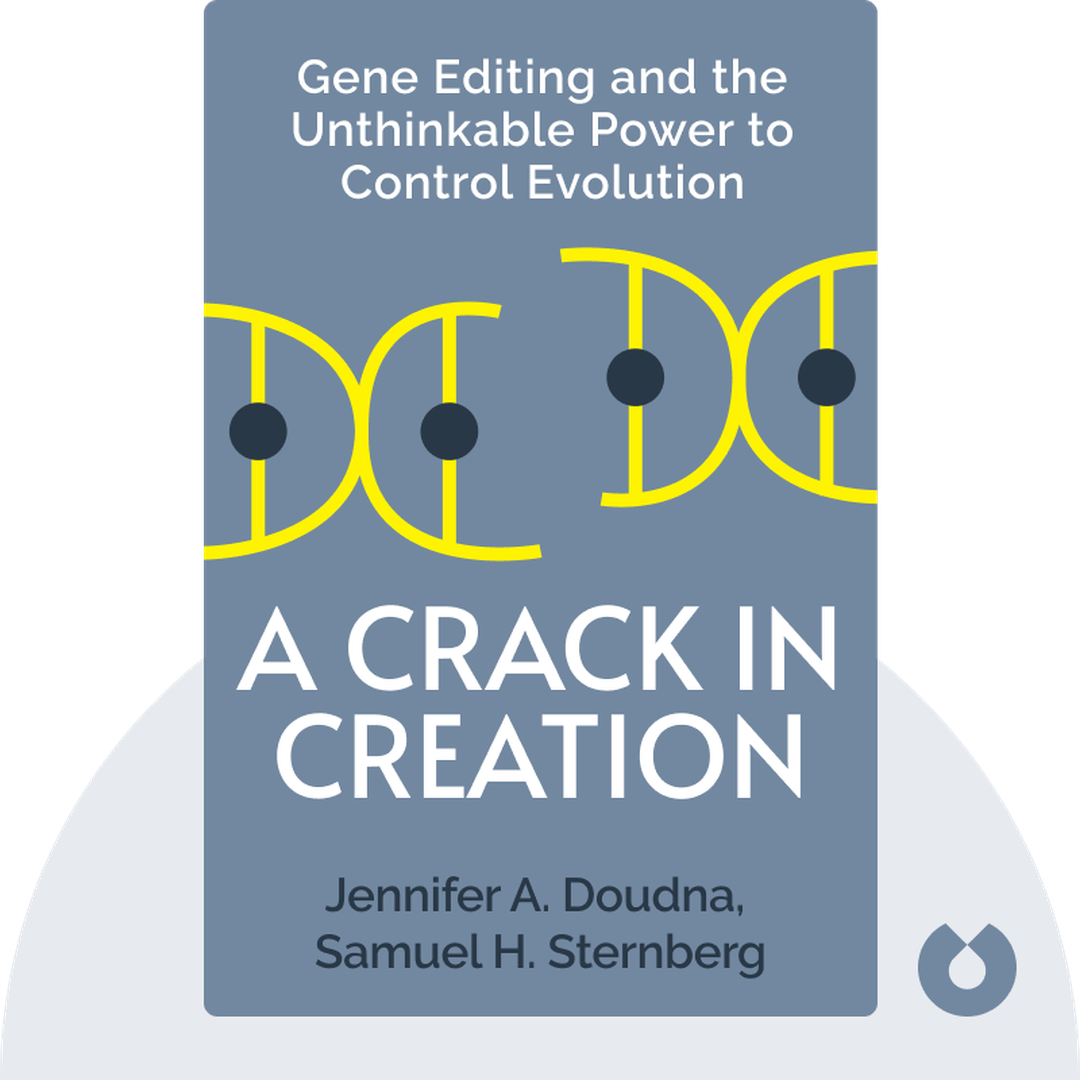
Theme Song
If You're Curious About These Questions...
You should listen to this audiobook
- What if you could rewrite the code of life to cure genetic diseases?
- Are you curious about the secret to editing genes with unprecedented precision and efficiency?
- Have you ever wondered what the consequences would be if scientists could alter the human gene pool?
Listen to A Crack in Creation — Free Audiobook
Loading player...
Key Takeaways from A Crack in Creation
- Understand how the revolutionary technology of gene editing holds the power to cure devastating diseases, while also presenting profound ethical dilemmas like the creation of 'designer babies.'
- Discover why genetic modification is not entirely unnatural by exploring real-life medical miracles where nature spontaneously 'edited' a patient's DNA to cure a lethal disorder.
- Learn how early attempts at deliberate DNA modification were highly impractical until researchers uncovered a repeating bacterial DNA region known as CRISPR.
- Find out how bacteria use CRISPR as a natural immune system, storing viral DNA as molecular 'vaccination cards' to recognize and destroy future infections.
- Grasp the biological mechanics of the CRISPR-Cas9 DNA cutting machine, and see how scientists utilize specific proteins and RNA to easily and cheaply splice targeted DNA.
Learning Tools
Reinforce what you learned from A Crack in Creation
Mind Map
A Crack in Creation
Foundations of Gene Editing+
The CRISPR-Cas9 Mechanism+
Agricultural Impact+
Medical Possibilities+
Ethical Dilemmas+
Future Governance+
Quiz — Test Your Understanding
Question 1 of 8
What natural phenomenon spontaneously cured a patient's WHIM syndrome by rearranging her chromosomes?
Question 2 of 8
Why were early gene editing techniques, such as homologous recombination developed in the 1980s, not clinically viable?
Question 3 of 8
In nature, what is the primary biological function of CRISPR in bacteria?
Question 4 of 8
Which component of the CRISPR system acts as the 'cutting machine' that physically slices through invading DNA?
Question 5 of 8
How could CRISPR potentially be used to prevent HIV infections according to current research?
Question 6 of 8
What is one practical agricultural application of gene editing mentioned in the text?
Question 7 of 8
What specific area of gene editing did the authors' 2015 white paper urge the scientific community to hold back on until thorough societal discussions could occur?
Question 8 of 8
According to the author, what is a major ethical concern regarding the use of CRISPR for genetic enhancements like intelligence or athleticism?
A Crack in Creation — Full Chapter Overview
- 1Recommendation
- 2Genetic modification can happen naturally.
- 3Deliberate DNA modification was impractical until a new genetic discovery emerged.
- 4CRISPR research led to the discovery of a DNA-cutting machine.
- 5With CRISPR, the author found a cheap, easy gene-editing method that sparked further research.
- 6Gene editing has many practical uses in agriculture alone.
- 7CRISPR gene editing could open up new medical possibilities.
- 8Gene editing raises ethical questions and calls for careful discussion.
- 9The future of gene editing depends on several key considerations.
- 10Final summary
A Crack in Creation Summary & Overview
A Crack in Creation (2017) describes everything you need to know about CRISPR, a new technique to alter the genes of living organisms. These blinks explain the scientific details of gene editing, while also discussing its medical and ethical implications.
Who Should Listen to A Crack in Creation?
- Biologists, chemists and natural scientists
- Philosophers and ethicists who wonder about the implications of gene editing
- Anyone interested in the future of medical science
Books Similar to A Crack in Creation
Readers who enjoyed this also liked these titles.